Question About Thin INFI:

Joined
Sep 17, 2009
Messages
2,692
So, I recently bought a Tigerhide Culti for a user and I have some questions about INFI this thin. From what I've read, INFI stands up well when it has quite a lot of metal behind it. Thick blades with obtuse grinds make great choppers and the INFI tends roll or dent rather than chip out or fracture when it has enough steel behind it. On the other hand, I've read that thin INFI is "softer" than other steels when it's thin. Obviously I won't be chopping with a Culti, but what should I expect that is different from other steels with one this thin?

By the way, it is a great little knife! I wasn't expecting a convex grind but that's what I got. Are they standard on Culti's? For a knife this size, it really does the trick for me.
 
Use a knife the size of a Culti for jobs suited for a knife that size. Don't try to breach any locked doors just cut things and you are fine. Break it and Jerry will get you another one.
 
You can expect it to cut thru a steak like it's butter! It'll perform well for any task appropriate for it's size.

I believe it is convex with a micro bevel. I tend to trust the edge Busse chooses for a particular blade and try to leave it as it is. Using it as a pocket knife, you can expect the edge to not need much more than a stropping now and then.
 
Thanks for the weigh in's thus far. Thanks for the info. I'm more just curious about the properties of INFI on thin blades. I know this little Culti will do EVERYTHING I ask it AND more. However, I am interested in how INFI plays out in thinner blades. I'm looking more for the metalurgical response than reassurance here. I do appreciate the resassurance equally though. All you hogs are great guys and gals.
 
Its called thinfi, and its good, I mean look at BWM.
 
Hi Iboschi,

Firstly, I'm not a metallurgist. I'm a mechanical engineer, and sometimes because mech. eng.'s have to know a bit about a lot of things they can fall into the trap of thinking they know everything about everything. Well, I don't. But I will have a shot at telling you what I do know where it relates to your question.

Jerry has clearly done an outstanding job of formulating a recipe and working out a treatment program for INFI that produces a steel of excellent properties in an unusually wide range of areas and then further producing grinds that play to those strengths exceptionally well. Typically, given his target market that has been with robust edges which are well supported by the material behind.

Pretty much all steels have the same Young's modulus, to within a few percent. This is a measure of how far they stretch or squash under a given load while you are in the elastic range. So in this elastic range they behave very much alike. Once you go past the elastic range into the plastic range the steel is said to have yielded. Before yield, steel behaves like very stiff rubber, you remove the load and it returns back to how it was before, for example stop bending a blade and it returns to true. After the yield point has been reached by some of the metal, it starts to flow like stiff putty and takes a permanent set. So you want the highest possible yield point so your edge doesn't roll or flatten out in use.

Pretty much all of the common methods of measuring hardness are a simplified way of measuring the yield point. With variations, they involve pressing some sort of indenter into the metal under a known load, like pressing on a tyre with your thumb to check the inflation, which will first off go in elastically to a depth until the material reaches yield at which point there is a bunch of temporary, elastic deformation and a bit of permanent, plastic deformation. When the load is removed, all the elastic deformation comes back so the indenter is pushed back nearly all the way and the plastic deformation remains as a dent of some size in the metal. The size of this remaining dent is related to tables that say for instance Rc of 60. You can see how this is affected by the yield strength, the higher the yield point the smaller the remaining dent.

The actual measurement of the exact yield point is done by stretching specifically shaped bars and recording the point at which they remain 0.2% longer after the test than they were before. So, as you can see the two properties are closely related but not exactly the same. There are tables that convert hardness values into yield but due to the influence of carbide fraction, distribution, size and other issues they are a bit woolly. Honestly, in practice hardness is more often used to tell you about the history of the steel. For example, across a weld a hardness traverse will tell you that it wasn't properly stress relieved and hence has high locked in stresses and is brittle to boot or that it was over tempered and will yield at a lower point than you want. Both of these are best determined by a metallurgical examination but a hardness test is much easier to do. Still, the relationship of hardness to yield is pretty good.

Once you have reached the yield point, then the next critical question is how far will it stretch before if fractures completely. This seems to be where INFI ( and to some extent I have to say, H1 ) seem a bit exceptional. Around Rc 60, most materials will stretch only a further few % past yield before they crack through and fail utterly. This is called the Ultimate Tensile Strength. INFI appears to have a lot of capacity to deform past its yield point. Hence it tends to bend under high load across the edge, or dent on a direct edge on load, where other steels of this hardness would have reached their UTS and broken out or chipped. And hence the ability to re-straighten bent INFI edges which just amazes me.

This last property relates to what is generally meant by toughness. Again, they are related properties measured in different ways. UTS/yield/% deformation are measured by the bar stretching machine and tell you a lot about what you want to know. Toughness is normally measured by taking a specially shaped pin and breaking it in two with a hammer machine. The amount of energy absorbed from the hammer in breaking the sample is quoted as the toughness. The higher the value, the tougher. So a glass rod can be hard and have a high yield but because it won't deform at its yield point, it breaks and absorbs no energy so it is not tough. A low to mid-carbon steel can be made pretty hard, but not very hard, so it will have a moderate yield, but will deform a long way at that stress and so absorb a pretty high amount of energy and be declared fairly tough. Something like INFI that has a very high yield and still deforms a lot without fracture will be very tough.

I guess a way to think about this is like a heavy weight on the garage floor, I don't know, say an anvil. If you try to shove it across the floor, you put a lot of sideways load on it. If it doesn't move, then no energy is absorbed. It may feel like it, but you could put a hydraulic jack against the side of it and load it up and as long as it doesn't move you could leave it a month or a year and it would just sit there still loaded and nothing changes. No energy is being lost no matter how high the force is. If it does start to slide though, you have to keep pumping the jack to keep the load up. Energy is now being lost in friction across the floor and you need to keep putting it in. In a brittle material, like most high hardness steels, it is as if the anvil just tipped over and the load disappeared. In a soft low hardness material, it is a light anvil or a greased floor, not much resistance even though it is moving. In INFI it is like pushing that weight all the way and working hard at it, a lot of energy is being absorbed. In most high hardness steels in a high impact little energy is lost in deforming and so most remains to go into creating a cleavage plane which makes a crack and the thing breaks. In INFI a great deal of energy is lost in deforming the metal and rarely does enough of it remain to make a crack.

I don't know of anyone who has tested the yield/UTS/% deformation of INFI and so hardness is all we have to go on. But nothing in its composition leads me to think that it would have an anomalously high Rc for its yield.

Sorry for the long and tedious background, but now ( finally ) I will get on relating it to your specific question. The thinner the edge, without doubt the easier the cutting. We should have all seen cheap kitchen knives or fishing knives that present no danger to your fingers still being used to chop vegetables or whatever because they are made of thin stock. Thicker stock simply has to wedge its way into the material more and the material pushes back, so higher load. If your edge is thin and acute then not much of it will be in contact with the material being cut, so the point pressures will be high and the wear resistance will become very important in retaining a really fine edge. So for very fine, very thin edges the optimum is probably one of the ultra-hard and or ultra-high wear resistance steels and accept that side loadings and unexpected impacts will lead to chipping. I tend to sharpen some of these at a more obtuse micro-bevel for this reason. INFI which has pretty good, but not exceptional, wear resistance will probably not hold a super fine edge as long as some of the above but should be pretty easy to restore as it will tend to fold or roll more than chip. I would expect it to hold a reasonable, working edge for a long time though and be easy to live with. If you go thin enough though the laws of physics say that you will end up with a bent edge or a chipped edge and INFI will bend a little easier than some others but won't chip as easily as pretty much anything else of comparable hardness.

I don't know if that helps at all, but I guess the short answer is my take is INFI is fine in this application. Not where it shines the brightest, but it isn't a total misapplication either like some things you see being sold.
 
sandgrouper,
Great post. I like your metallurgy 101 and analogies! :thumbup: :)
 
Sandgrouper,

I can't thank you enough. That is as fine answer as I could ever hope to get (and more); I am honored that you took the time, not only to formulate the answer, but to write it down. You're a gentleman and a scholar. I am grateful.

I don't know of anyone who has tested the yield/UTS/% deformation of INFI and so hardness is all we have to go on

The question of INFI's unusual qualities have been answered by the collective experience of many people. However, I would be excited to see a bit of independent testing done, with tangible data points. It correlates to knowing your child is smart, but when he/she receives a full ride to a competitive and prestigious University, the knowledge is that much sweeter to the palate.
 
Howdy Sandgrouper... Great post.

And, I must say, welcome to bladeforums.

Interesting as "yield" isn't generally a well known term in the knife business (at least to me). But it makes complete sense. All steel is basically a compromise.

With regard to the OP, I'd say that you have no fear using a .125 cultie on just about anything. Frankly, you have nothing to lose... Busse has the best guarantee in the business.
 
Hey, Iboschi,

No worries. I am off work today while a crew of renderer's are working on the house I am building out the back here, so I can't go anywhere and they only need me now and again so I had some time to put a blurb together. I am afraid that I write slow, so I don't get around to posting much, but glad to help out if I can.

I agree that my own experiences, as well as those of all the group here, demonstrate that INFI is pretty special stuff and over time a picture emerges of what those basic properties would look like if you could get to them. Even when someone has one of those rare sad experiences when questions are raised about the heat treat, I usually look at it and think; Nope, pretty much what you would expect given the geometry and the likely loading. Its great stuff, not magic stuff.

Engineers always want numbers to plug into equations, though. It's what we do. But, I don't want to know enough to cut one of my Mistress up into test pieces! So I will continue to rely on the field experiences of mine and those generous souls who take the time to post theirs.
 
Hi Iboschi,

Firstly, I'm not a metallurgist. I'm a mechanical engineer, and sometimes because mech. eng.'s have to know a bit about a lot of things they can fall into the trap of thinking they know everything about everything. Well, I don't. But I will have a shot at telling you what I do know where it relates to your question.

Jerry has clearly done an outstanding job of formulating a recipe and working out a treatment program for INFI that produces a steel of excellent properties in an unusually wide range of areas and then further producing grinds that play to those strengths exceptionally well. Typically, given his target market that has been with robust edges which are well supported by the material behind.

Pretty much all steels have the same Young's modulus, to within a few percent. This is a measure of how far they stretch or squash under a given load while you are in the elastic range. So in this elastic range they behave very much alike. Once you go past the elastic range into the plastic range the steel is said to have yielded. Before yield, steel behaves like very stiff rubber, you remove the load and it returns back to how it was before, for example stop bending a blade and it returns to true. After the yield point has been reached by some of the metal, it starts to flow like stiff putty and takes a permanent set. So you want the highest possible yield point so your edge doesn't roll or flatten out in use.

Pretty much all of the common methods of measuring hardness are a simplified way of measuring the yield point. With variations, they involve pressing some sort of indenter into the metal under a known load, like pressing on a tyre with your thumb to check the inflation, which will first off go in elastically to a depth until the material reaches yield at which point there is a bunch of temporary, elastic deformation and a bit of permanent, plastic deformation. When the load is removed, all the elastic deformation comes back so the indenter is pushed back nearly all the way and the plastic deformation remains as a dent of some size in the metal. The size of this remaining dent is related to tables that say for instance Rc of 60. You can see how this is affected by the yield strength, the higher the yield point the smaller the remaining dent.

The actual measurement of the exact yield point is done by stretching specifically shaped bars and recording the point at which they remain 0.2% longer after the test than they were before. So, as you can see the two properties are closely related but not exactly the same. There are tables that convert hardness values into yield but due to the influence of carbide fraction, distribution, size and other issues they are a bit woolly. Honestly, in practice hardness is more often used to tell you about the history of the steel. For example, across a weld a hardness traverse will tell you that it wasn't properly stress relieved and hence has high locked in stresses and is brittle to boot or that it was over tempered and will yield at a lower point than you want. Both of these are best determined by a metallurgical examination but a hardness test is much easier to do. Still, the relationship of hardness to yield is pretty good.

Once you have reached the yield point, then the next critical question is how far will it stretch before if fractures completely. This seems to be where INFI ( and to some extent I have to say, H1 ) seem a bit exceptional. Around Rc 60, most materials will stretch only a further few % past yield before they crack through and fail utterly. This is called the Ultimate Tensile Strength. INFI appears to have a lot of capacity to deform past its yield point. Hence it tends to bend under high load across the edge, or dent on a direct edge on load, where other steels of this hardness would have reached their UTS and broken out or chipped. And hence the ability to re-straighten bent INFI edges which just amazes me.

This last property relates to what is generally meant by toughness. Again, they are related properties measured in different ways. UTS/yield/% deformation are measured by the bar stretching machine and tell you a lot about what you want to know. Toughness is normally measured by taking a specially shaped pin and breaking it in two with a hammer machine. The amount of energy absorbed from the hammer in breaking the sample is quoted as the toughness. The higher the value, the tougher. So a glass rod can be hard and have a high yield but because it won't deform at its yield point, it breaks and absorbs no energy so it is not tough. A low to mid-carbon steel can be made pretty hard, but not very hard, so it will have a moderate yield, but will deform a long way at that stress and so absorb a pretty high amount of energy and be declared fairly tough. Something like INFI that has a very high yield and still deforms a lot without fracture will be very tough.

I guess a way to think about this is like a heavy weight on the garage floor, I don't know, say an anvil. If you try to shove it across the floor, you put a lot of sideways load on it. If it doesn't move, then no energy is absorbed. It may feel like it, but you could put a hydraulic jack against the side of it and load it up and as long as it doesn't move you could leave it a month or a year and it would just sit there still loaded and nothing changes. No energy is being lost no matter how high the force is. If it does start to slide though, you have to keep pumping the jack to keep the load up. Energy is now being lost in friction across the floor and you need to keep putting it in. In a brittle material, like most high hardness steels, it is as if the anvil just tipped over and the load disappeared. In a soft low hardness material, it is a light anvil or a greased floor, not much resistance even though it is moving. In INFI it is like pushing that weight all the way and working hard at it, a lot of energy is being absorbed. In most high hardness steels in a high impact little energy is lost in deforming and so most remains to go into creating a cleavage plane which makes a crack and the thing breaks. In INFI a great deal of energy is lost in deforming the metal and rarely does enough of it remain to make a crack.

I don't know of anyone who has tested the yield/UTS/% deformation of INFI and so hardness is all we have to go on. But nothing in its composition leads me to think that it would have an anomalously high Rc for its yield.

Sorry for the long and tedious background, but now ( finally ) I will get on relating it to your specific question. The thinner the edge, without doubt the easier the cutting. We should have all seen cheap kitchen knives or fishing knives that present no danger to your fingers still being used to chop vegetables or whatever because they are made of thin stock. Thicker stock simply has to wedge its way into the material more and the material pushes back, so higher load. If your edge is thin and acute then not much of it will be in contact with the material being cut, so the point pressures will be high and the wear resistance will become very important in retaining a really fine edge. So for very fine, very thin edges the optimum is probably one of the ultra-hard and or ultra-high wear resistance steels and accept that side loadings and unexpected impacts will lead to chipping. I tend to sharpen some of these at a more obtuse micro-bevel for this reason. INFI which has pretty good, but not exceptional, wear resistance will probably not hold a super fine edge as long as some of the above but should be pretty easy to restore as it will tend to fold or roll more than chip. I would expect it to hold a reasonable, working edge for a long time though and be easy to live with. If you go thin enough though the laws of physics say that you will end up with a bent edge or a chipped edge and INFI will bend a little easier than some others but won't chip as easily as pretty much anything else of comparable hardness.

I don't know if that helps at all, but I guess the short answer is my take is INFI is fine in this application. Not where it shines the brightest, but it isn't a total misapplication either like some things you see being sold.

you enlighten me .
man, good shoots.
dingy
 
On the other hand, I've read that thin INFI is "softer" than other steels when it's thin.

Speaking of high performance cutters, I have a few customs that will easily outsice my Battle Mistress as they have far more acute profiles. But of course the amount of strain that will break them would not even cause the Battle Mistress to know it was being used.

It would be interesting to see some thin blades ground out of INFI. Awhile ago I was simulating high stress impacts (for light use blades) by slicing through staples in 1/8 ridged cardboard. I was doing violent rakes though rows of five staples which were being ripped out of the cardboard during the cuts.

I was using a variety of blade steels with similar profiles (very acute edges about 15 degrees or so). All the blades chipped during this except the Battle Mistress. It was getting slightly blunted but nothing else. I steeled it and gave it a few strokes on a ceramic hone when I was finished and it was 100% again.

-Cliff

from:
http://www.bladeforums.com/forums/showpost.php?p=1072728&postcount=6

I've only ever brought an edge down to 15 degree's per side (30 total included), so I don't have direct experience with really thin edges (I beleive cliff meant 15 degree's included, so 7.5 per side). but, from what little experience I could gather from that is similar to what cliff says above. while it does appear to roll and mash easily, the things that mash and roll the edge would chip an equivalent edge in many of the other high hardness steels like s30v.

that said:

Jerry is a big fan of D-2 blades when everything is done right on the knife. We have taken his advice on design, heat-treat, edge geometry, etc… and, in concert, with our superior Resiprene C handles will bring the finest, highest performance D-2 Tool Steel blades to the market. I asked Jerry to answer some questions about D-2 and here are his responses.

Why not stick with SR-101? And how does D-2 compare to SR-101?


Jerry:

“In the performance arena, it is nearly impossible to match what Swamp Rat is getting out of SR-101 in certain areas. The combination of incredible edge holding and toughness are unparalleled in the industry (except for INFI . . Sorry, I had to throw that in ;) ) . D-2 has a much better resistance to the elements in an uncoated or satin finished format than does SR-101. D-2 rivals ATS-34 for stain resistance and in fact proves to be nearly identical in this area in our accelerated salt spray corrosion tests. Surprisingly, or maybe not so surprisingly, the heat treatment and finish of D-2 can have a major impact on its corrosion resistance. When done properly, a D-2 blade requires minimal maintenance. Cleaning and oiling are a good idea but simply wiping the blade off and keeping it fairly dry will usually be all that is required for proper care.

In edge holding D-2 is an excellent steel and easily surpasses SR-101 when cutting harder materials such as steel banding, bone, etc. . . In soft to medium materials they are very similar in edge holding. In chopping and high impact applications, SR-101 easily surpasses D-2. Because of this, I do not recommend that any D-2 blades be longer than 5”.

In extremely thin edges, such as are planned for the Hunter/Utility line, D-2 will prove to be a superior choice. The same qualities that make SR-101 a great steel for abuse, play against the house when it comes to extremely thin cross sections. Under contact (cutting not chopping) with harder materials such as metal banding, bone, rock, etc. . . SR-101 will roll whereas D-2 will prove to be the clear winner in these applications. However, if you do any heavy lateral stressing on a thin cross sectioned D-2 blade, you may be glad that your Swamp Rat D-2 blade is backed by the best no BS warranty in the industry! ;)

D-2 also has a much greater resistance to high heat applications. What does that mean to you? Well, for us, as manufacturers that means that very fine edges can be satin finished with little worry of affecting the temper along the edge. This is not the case with SR-101, or any other simple “high carbon” steels, where extremely thin sections along the edge can be greatly affected by the heat generated from polishing.

So, in summary, for an uncoated blade with extremely thin cross sections, where cutting is the only intended application and hard materials such as bone, metal banding, etc…will be in contact with the edge, D-2 will prove to be a superior steel in edge holding and resistance to the elements.

In more abusive applications where cutting is to be coupled with prying, lateral stressing, high impact, and overall toughness, SR-101 will prove to be far superior to D-2.” --- Jerry Busse


So, when looking at the properties of these 2 steels you can see why we chose D-2 for our thin edged, bare metal, slicers.

Swamp Rat D-2 Tool Steel blades will prove to some of your favorite Rats. They will also stand as the only D-2 blades on the market that are covered against any and all major damage. . . :cool:

Thanks! :D

Jennifer

from
http://www.bladeforums.com/forums/showpost.php?p=2152304&postcount=1

If the heat treat is done well, a thin edge on d2 will take more force before chipping than sr101 will take before rolling (sr101 = 52100 with more chromium, and is close to infi in use). But, d2 will chip if stressed enough where sr101 (and infi) is more likely to tear away before it's complete failure.
 
I'm not going to bust out scientific facts, as to be honest, i'm not a metallurgist but I do have some experience with THIN infi.

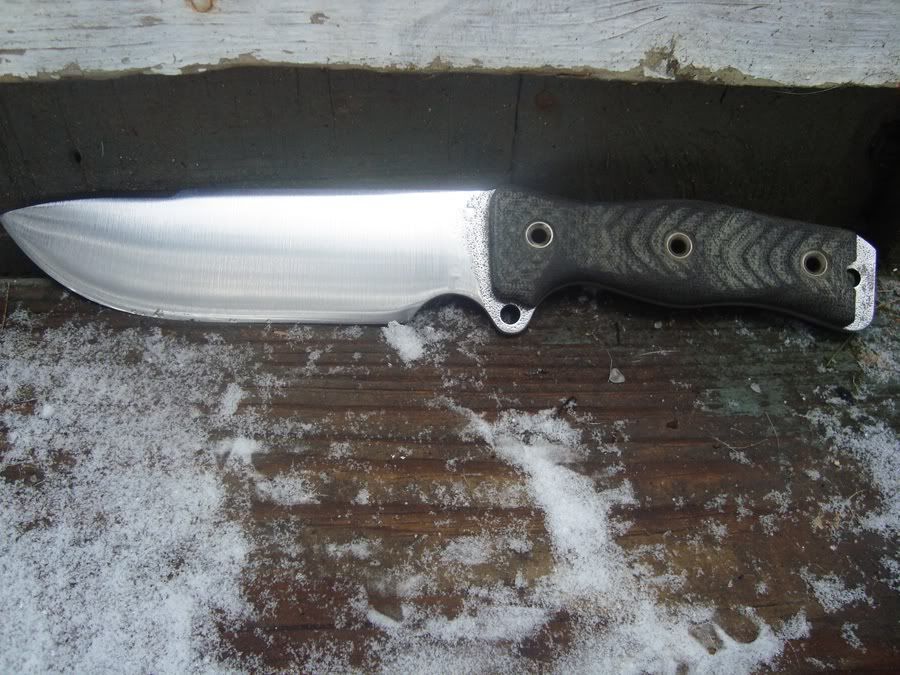
I took a comp grade sarsquatch, and figured... hey this decarb sucks, so I ground it off. While I was there, I figured why not grind out the infi dimples

sarqfinished.jpg


Now that the primary grind was sufficiently thinned, I figured.. hey this comp grade edge is RAZOR sharp, but why not make it sharper, why not make it a scalpel. I took the edge down to about 10 degrees per side, convexed. It was the sharpest knife I have ever touched, simply making contact with the edge would make you bleed.

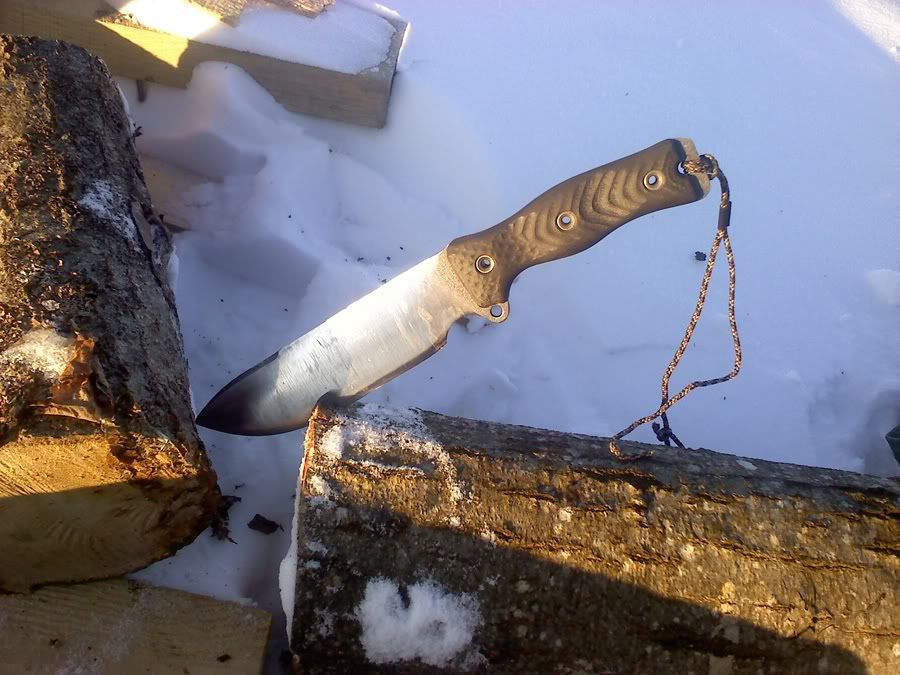
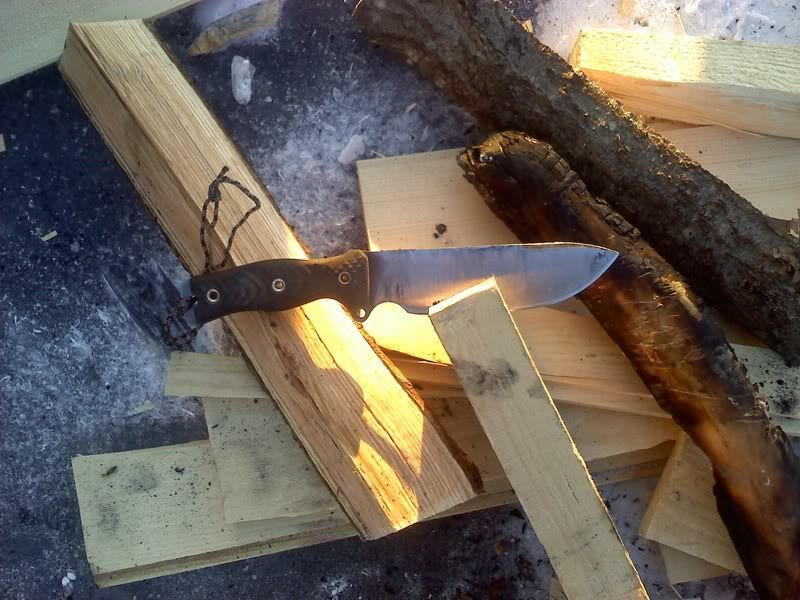
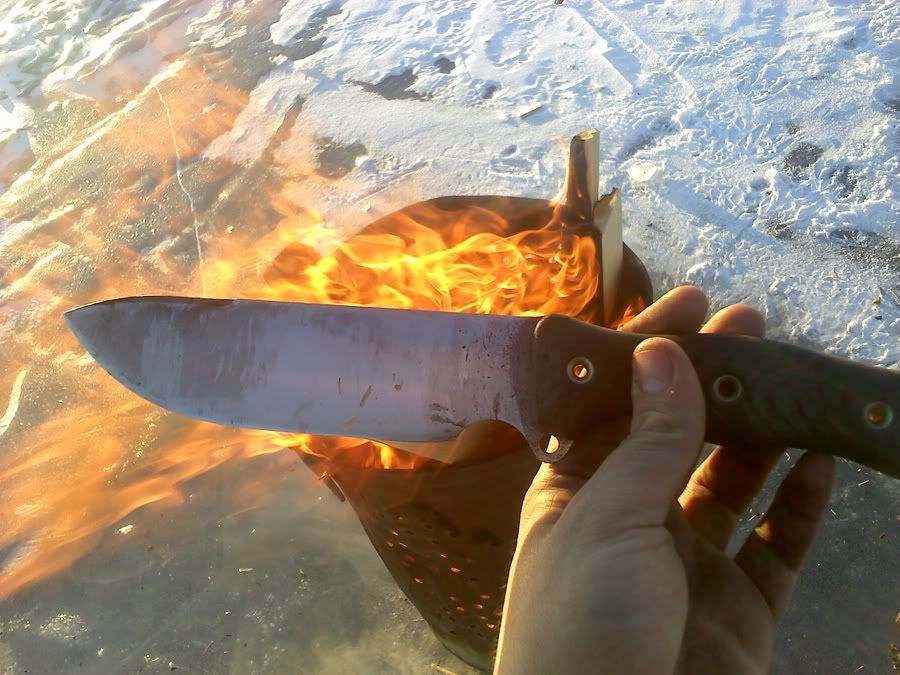
In use the knife worked AMAZING, it cut through everything I needed to, but I never really put it to the test I put my Busses through. I took it out Ice Fishing and was using it to split kindling for our fire barrel. It was going through wood scraps no problem, I even chopped some up with it.

s3.jpg


s.jpg


s2.jpg


I didn't run into any real problems with the edge until I decided to test it out on some frozen wood my buddy had brought. Making angled chops I quickly went after the wood and I was pleased with its performance.. until i went to resheath it and it wouldn't fit in the sheath. The edge was very very dented, certainly not the fault of INFI or Busse though. The combination of me thinning the edge to a scary degree and the lateral stress against the actual cutting edge while chopping/removing the blade at an angle were just too much.

s4.jpg


sarchip.jpg


I ended up grinding out the damage and thickening it up some and it worked fine after.

I will say, the knife held up tremendously well using it to split wood, chop up softer stuff, kitchen use and general knife tasks even with the very thin primary grind and edge. Your culti will hold up FINE to any normal use. My sarsquatch didn't even chip after all that, just dent and rip a little.
 
wow killer post guys, I have a Busse Jackhammer, & have used it much like 230grains.
I did not chop frozen wood with it, but everything I did was sharpened up quick
with just a strop & buffing compound.
 
sandgrouper,
Great post. I like your metallurgy 101 and analogies! :thumbup: :)

Hell--That was BY FAR the best explination most of US here are going to get and be able to understand..

BRAVO!!!!

Sincerely

Dr.Bill
 
Back
Top