Question For Makers Who Forge...

Joined
Jun 5, 2002
Messages
2,761
Very simple question: What is more time consuming to make. a forged, complex patterned damascus blade, or a forged single steel blade with a complicated hamon? My guess is damascus, but I'm not sure.

 
For damascus first you have to forge the layers. Then you forge the shape just as you do for the single steel blade . The hamon is produced in the heat treating process not during forging.
 
Ari,

A complex damascus patern is more time consuming to make. The level of polish desired for the hamon is a big factor on time, but it is still faster than an intricate damascus.

I am headed to the shop now to do both, a bilet of explosion pattern and heat treat a big bowie with hamon....
 
Mr.Ari Sir :)

It takes me longer to make a complex damascus blade than it dose to make a forged blade with hamon but not by much. I spend much more time heat treating and finishing a carbon steel blade with hamon than I do a damascus blade. But hey, forging damascus is more fun than hand polishing a blade, although I feel a killer hamon is worth the extra work and I do like them.
You will see more hamons from my shop :D

Don Hanson lll sunfishforge.com
 
sunfishman said:
Mr.Ari Sir :)


You will see more hamons from my shop :D

Don Hanson lll sunfishforge.com

Yes, and some (more) of them will make their way down to Florida no doubt. :)

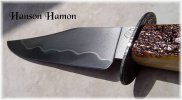
Let me be the first to publicly coin the phrase: "My Handsome, Hanson Hamon collection..."

I realized that creating the layers in the damascus was extra work, but I knew that the special diff heat treating and the clay quenching techniques, as well as the etching and or polishing of a hamon blade is also something extra, hey, it's all good. :)

Somebody should tell Yoshindo that diff heat treating and hamons are easy... :)

Thanks to all, BTW, Bailey, did you get my email?

And, speaking of Hanson Hamons... :)
 

Attachments

  • hansonhamon800.jpg
    hansonhamon800.jpg
    47.4 KB · Views: 53
Ari-

While I've made a few buckets full of mosaic damascus it's still only a drop in the ocean compared to what Don has done. But I've still got enough under my belt to have an answer :)

I would have much rather made that camp knife of Danbo's in damascus. It took me several days to polish it out (part of that being the abrasion resistance of W2).

But it's a trade-off either way (IMHO). Sometimes the damascus is the bigger job, sometimes getting a pristine straight steel blade is tougher to do.


The trick here is that you did say complex pattern. I once sold a simple, random pattern, san-mai damascus bowie for quite a bit less than a similar sized blade with crazy hamon. To most show-goers, they simply did not understand this, as many of them saw a hamon as a simple characteristic (almost an after-thought) to the knife...when it is actually the heart-and-soul of the knife. There was about 2 days more work into that straight steel blade than the random damascus one.

I'm sure Don could tell us stories about weeks spent on one billet though, so I'll shut-up now ;)

Nick

ps- It would be interesting to get a proffessional sword polisher's, like Konno's, opinion on this :D
 
NickWheeler said:
Ari-

While I've made a few buckets full of mosaic damascus it's still only a drop in the ocean compared to what Don has done. But I've still got enough under my belt to have an answer :)

I would have much rather made that camp knife of Danbo's in damascus. It took me several days to polish it out (part of that being the abrasion resistance of W2).

But it's a trade-off either way (IMHO). Sometimes the damascus is the bigger job, sometimes getting a pristine straight steel blade is tougher to do.


The trick here is that you did say complex pattern. I once sold a simple, random pattern, san-mai damascus bowie for quite a bit less than a similar sized blade with crazy hamon. To most show-goers, they simply did not understand this, as many of them saw a hamon as a simple characteristic (almost an after-thought) to the knife...when it is actually the heart-and-soul of the knife. There was about 2 days more work into that straight steel blade than the random damascus one.

I'm sure Don could tell us stories about weeks spent on one billet though, so I'll shut-up now ;)

Nick

ps- It would be interesting to get a proffessional sword polisher's, like Konno's, opinion on this :D

Ok, Nick. I'll pay you a little more to handrubb the other camp knife blade to a higher polish. :)
 
That's an interesting thread.

I do think that the range of work that can go into a damascus is wider than that for a hamon. For a hamon, I think you could go from a quick etch (0 days) to a full polish (2 - 3 days max maybe?). For damascus, it goes from a random 350 layers (1/2 day more maybe?) to the full enchilada with bells and whistles (interesting image there...): complex mosaic + san-mai,... I think that a complex mosaic can easily go into several day of work before you start forging the blade.

Note that for true Japanese swords, you have both problems, since the blade is made of "damascus". It's a simple layer pattern, without filing or fancy work (except for the Gassan school), but it starts with such a difficult material that it is a pretty difficult damascus to make.
 
i thank that the Damascus takes longer. But some like the Looks of Damascus. i Can forg out a 51/60 blade faster. R Polk
 
Hey Ari!
For me personally the time involved is almost the same for an intricate pattern welded vs. a intricate hamon in carbon steel.
One of these days I will learn to make a knife in a way that I don't spend hours agonizing over the finish.
A very good question. More makers should clock in and out on each type and see where they are. Clay hates me.
mike
 
A great deal dependes upon what the etch reveals and how to get there. Take a large bar, 5", work it down coupled with numerous planned thermal cycles and low temp forging, then to a blade and more thermal cycles to develop a complex grain structure, the maker can investe an astronomical amount of time. The time and energy results in a vision that not many can understand, but for those who do the result us worth the investment.
 
Back
Top