- Joined
- Mar 14, 2013
- Messages
- 216
I'm not too savvy on the particulars on traditional knives, so forgive my ignorance. I have owned a few Case knives (still do), and they have all been purchased by me from Case distributors, with the exception of one.
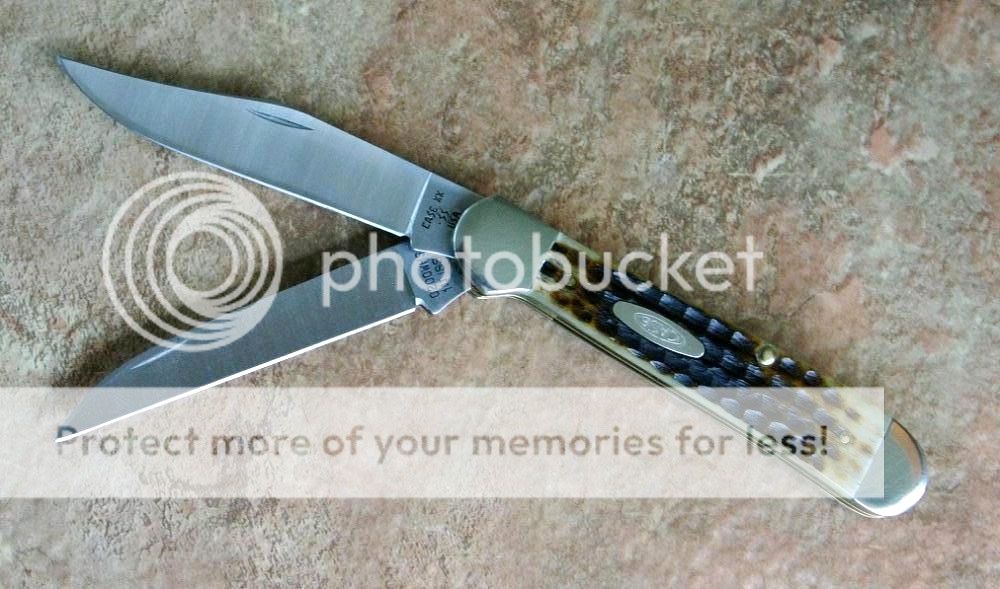
Now, I never thought much about it, but earlier today I was tinkering around with all my other Case knives and I noticed they all had something in common: a highly polished blade. I remembered a Mini-Copperlock that I have stashed in my vehicle's ashtray, and how the blade looked noticeably different than the others. So, I retrieved it from my vehicle and took some photographs of the mini-copperlock next to a different mini-copperlock.
As you will notice, the yellow handled knife has the CV blade steel; however, this doesn't change the fact that it, like all the others, is highly polished. The blade on the blue handled knife is a quite obvious satin finish, and the swedge on the top of the blade is noticeably smoother on the yellow knife, whereas it is pretty sharp on the blue knife.
Also a matter of note is the "Case" stamping on the inlaid handle shield looks different on both knives.
The blue handled knife was purchased on that famous auction site a few years ago, and I don't remember who sold it or what I paid for it. The stamp on the tang is "61749LSS" and a quick Google search shows the handle color to be quite different.
So, what do I have? A fake? I don't really care, so give me your best ideas. The knife is pretty well made, and other than the cosmetic differences I never would have given it a second thought.
Thanks,
Lee
Pictures:


Now, I never thought much about it, but earlier today I was tinkering around with all my other Case knives and I noticed they all had something in common: a highly polished blade. I remembered a Mini-Copperlock that I have stashed in my vehicle's ashtray, and how the blade looked noticeably different than the others. So, I retrieved it from my vehicle and took some photographs of the mini-copperlock next to a different mini-copperlock.
As you will notice, the yellow handled knife has the CV blade steel; however, this doesn't change the fact that it, like all the others, is highly polished. The blade on the blue handled knife is a quite obvious satin finish, and the swedge on the top of the blade is noticeably smoother on the yellow knife, whereas it is pretty sharp on the blue knife.
Also a matter of note is the "Case" stamping on the inlaid handle shield looks different on both knives.
The blue handled knife was purchased on that famous auction site a few years ago, and I don't remember who sold it or what I paid for it. The stamp on the tang is "61749LSS" and a quick Google search shows the handle color to be quite different.
So, what do I have? A fake? I don't really care, so give me your best ideas. The knife is pretty well made, and other than the cosmetic differences I never would have given it a second thought.
Thanks,
Lee
Pictures: