Question on knife patterns

Joined
Jan 6, 2008
Messages
710
Could someone tell me what a sleeve board whittler is. What does the term for a knife sleeve board mean. Also what is an equal end whittler? I've not run into these two patterns before.

 
Could someone tell me what a sleeve board whittler is. What does the term for a knife sleeve board mean. Also what is an equal end whittler? I've not run into these two patterns before.
Whittler refers to the blade types, normally three different blades for three different types of cuts. A coping blade is standard on whittler knives, for example.

Sleeveboard and Equal End refer to the overall shape of the knife body. A sleeveboard is wider on one end than the other, like an ironing board or an old steam press for shirt sleeves.
An equal end is symmetrical, both ends being the same.

Hope this helps.
 
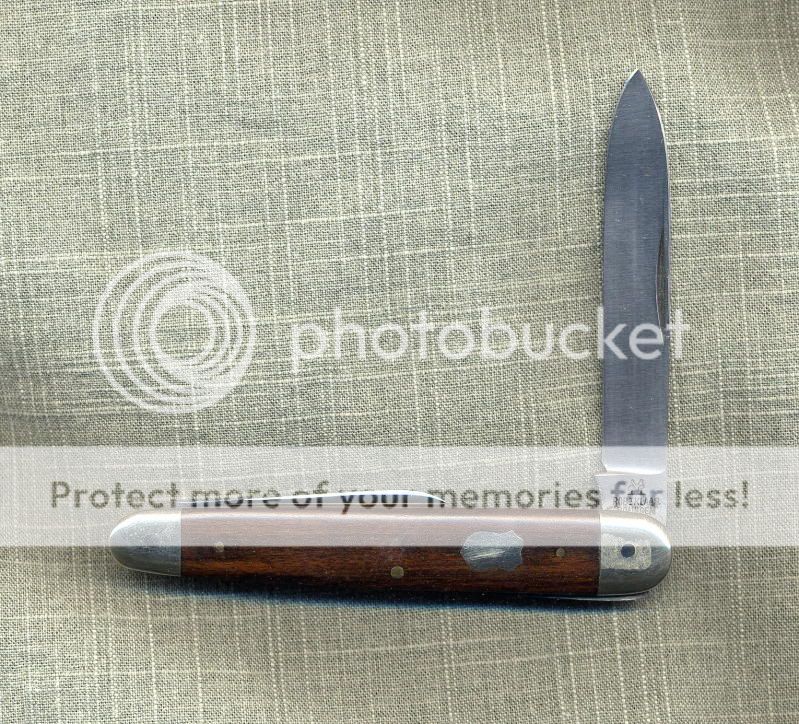
Sleeve board:
Klaas.jpg

They aren't always long and slender like this, but you can see that one end is wider than the other.

Equal end:
PALCutlery.jpg

This equal end knife would also be called a Jack Knife because both blades open from the same end. So I would call it an "equal end Jack knife."
 
Here's a good example of a Whittler knife. Notice the woodworking-specific coping blade.
However it is neither an equal end nor a sleeveboard because it has a serpentine frame shape like a stockman.

Boker_Whittler_280_WBB_1_.JPG

(random online photo)

Confused yet?

I am though, by Robin's post. I don't understand why the top knife would be called a whittler. With a spear point, pen blade, and nail tool combined with a sleeveboard frame, I'd just call it a three-blade sleeveboard. :confused:
I'm easily confused though. ;)
 
Confused yet?

I am though, by Robin's post. I don't understand why the top knife would be called a whittler. With a spear point, pen blade, and nail tool combined with a sleeveboard frame, I'd just call it a three-blade sleeveboard. :confused:
I'm easily confused though. ;)

Oh, oh, I think I know this one! A "whittler" pattern refers to the way the main blade is centered on two springs, and the secondary blades on the other end each use one spring. I've heard that the old style "split spring whittler" had one wide spring actually split down the middle to achieve this configuration. So it isn't necessarily blades used for whittling.

Who's confused, now? :D
 
Wow! That's a good looking Whittler you have there Bob W.

For the record, that Boker'ss not mine nor is the picture. Just a random picture I found online.

I do have a Boker with that bone though, and it is stunning. And I've bought that Boker pattern with a different handle for a niece that wanted a whittling knife. The quality is excellent!

The first two pictures I posted are more in line with my photographic skills (flatbed scanner).
 
Oh, oh, I think I know this one! A "whittler" pattern refers to the way the main blade is centered on two springs, and the secondary blades on the other end each use one spring. I've heard that the old style "split spring whittler" had one wide spring actually split down the middle to achieve this configuration. So it isn't necessarily blades used for whittling.

Who's confused, now? :D

I'll buy that. :thumbup:
 
Oh, oh, I think I know this one! A "whittler" pattern refers to the way the main blade is centered on two springs, and the secondary blades on the other end each use one spring. I've heard that the old style "split spring whittler" had one wide spring actually split down the middle to achieve this configuration. So it isn't necessarily blades used for whittling.

Who's confused, now? :D

I know I'm confused:)

I have noticed the Whittler looks very similar to the other 3 blade knives made:confused:
 
My understanding of the whittler pattern is that for it to be a 3-blade whittler, the primary blade has to be at one end and the smaller blades have to be at the other. If you were to compare this to the stockman pattern, you would find the main blade and a smaller blade at one end, with only a single small blade at the other end.

It is my further understanding that a knife can be a whittler without being a split spring whittler. The split spring design allows for a one spring for each of the smaller blades, while the main blade sits on both. This is an elegant solution for a method of springing such a design, but not the only solution.
 
Funny thing, I just checked the collection and it turns out I do have that exact same Boker Whittler. But it's still not my photo. ;)

For the record, the Boker uses two small springs. The main blade doubles up on both of them.
 
My understanding of the whittler pattern is that for it to be a 3-blade whittler, the primary blade has to be at one end and the smaller blades have to be at the other. If you were to compare this to the stockman pattern, you would find the main blade and a smaller blade at one end, with only a single small blade at the other end.

It is my further understanding that a knife can be a whittler without being a split spring whittler. The split spring design allows for a one spring for each of the smaller blades, while the main blade sits on both. This is an elegant solution for a method of springing such a design, but not the only solution.

Thank you for the explanation, this makes more sense to me know.
 
Sleeve board:
Klaas.jpg

They aren't always long and slender like this, but you can see that one end is wider than the other.

Equal end:
PALCutlery.jpg

This equal end knife would also be called a Jack Knife because both blades open from the same end. So I would call it an "equal end Jack knife."

Wow!! I'd call both of them magnificent! Those are a couple of very good-looking knives, Bob :thumbup::thumb up: The equal end jack especially floats my boat!

- GT
 
The equal end jack especially floats my boat!

- GT

It was my grandfather's pocketknife. Pal Cutlery. The blades are worn and the handles are loose, but it's a cornerstone of the entire collection. :thumbup:
 
Very cool, Bob. When a knife has priceless sentimental value AND it's drop-dead gorgeous, life is good!! :)

- GT
 
I've always considered a Whittler to be a knife with 3 blades, with the large blade on 1 end, and the 2 smaller blades on the opposite end, and when all blades are closed the large blade sits down between the 2 smaller blades. Usually this style would also be a split-spring whittler, unless the knife has 3 backsprings.
 
Back
Top