Question on large propane tanks

Joined
Dec 4, 2001
Messages
3,824
I've been thinking of adding a 150-200 gallon tank. It'd be a lot cheaper, aprox. 2$ a gallon cheaper, to fill it than to fill my 25 gallon tank. The question is, do I route a line to the shop, or get a liquid line? I really like the idea of a liquid line so as to keep the main tank as far away from the shop as possible, and to fill my 25 gallon tank which I use with oxygen for a torch instead of acetylene. Of course using a liquid line means extra expense of having the line, and wasting some of the vapors while only partially filling a tank.

What's your set up, recomendations, ext.

Thanks
 
You might be better off looking at just a new supplier instead of the added complexity of the tank. Most likely you can get that size from the local propane companies as a delivery item and they may be able to fill it on site rather than do swaps. That's something you'd have to check with them. My company will do pickup/delivery swaps on 100lb tanks some won't. There are also certain code requirements for a bigger tank and liquid line that make it far more complicaed than many folks think. You do NOT want to be messing with the install afterward, leave it to the techs. If you want vapor at a particular spot then just have them set it up to give you vapor there and a quick disconnect. If there's a $2 price difference then you're either getting screwed now or someone's BSing you about the possible price cut.

As for waste, I wouldn't sweat it. The total vapor involved at the top of a tank amounts to a an ounce or two of propane in liquid form and once you've filled a tank that's always there unless you empty it completely and vent it. This is true whether discussing 30k bulk storage tanks or 20lb grill tanks, the differences is you can sort of use that last bit of vapor in a vapor system but you without pressure you won't get anything done with it anyway.

Personally, I'd shop around, if the pricing really does come back as that much better then talk to them about placement and the lines. Just explain what you use it for, show them the layout of the location and let THEM suggest where to put it and how to run lines. There are obvious ways, easy ways, cheap ways, and then the right ways, and it's pretty rare that all four ways are the same.

ETA: If he has a normal 25 gallon/100lb tank he can do a ROUGH test by opening the bleeder valve when he gets close. When it starts spitting liquid you stop. Unfortunately from the point of view of getting your money's worth and not overfilling, those things are rarely that accurate. My company fills them on scales so we know exactly how much propane was put in by weigh.
 
$2 per gallon cheaper? You can swap 20 lbs. tanks for around $18 at Wal-Mart. Yes, I priced refilling them once and it was around $40. Not sure why, but it's much cheaper to swap. Farm Depot on Blunt Dr carries Blue Rhino, which is usually under $20 per swap.
 
Not my experience. I have a little grill tank, which I assume is a 15-20 pounder, and there are several gas stations in the area that will refill it for 2.75 per gallon. They usually take about 5 gallons to fill, therefore making the cost under 15 dollars each.
 
Not my experience. I have a little grill tank, which I assume is a 15-20 pounder, and there are several gas stations in the area that will refill it for 2.75 per gallon. They usually take about 5 gallons to fill, therefore making the cost under 15 dollars each.

Same here, and that's about the price. I prefer 40 pounders so they don't need filling so often.
 
Just about any place down here charges around 4.50$ a gallon to fill small tanks, but the suppliers will deliver for a larger tank for around 2.50$ a gallon. Part of the issue is that the local suppliers don't fill small tanks, and the places that fill small tanks are independents that already bought it from the supplier so it's got a middle man involved. It's a bit cheaper during summer, which also brings up buying a larger tank full in summer and being able to use it all winter and refilling during the cheapest summer months. As for adding a line to my shop, I'll have to do that, they don't install lines. They could recommend someone to do it, but he'll charge an arm and a leg. If I do it don't worry, it'll be to standard or better. But living out in the country there is no code to follow. Same with my house, no building permits, no inspections, even though I wired it and framed it better than what's standard.

There's also the fact that sometimes I'm in the middle of forging and run out, and it always seems to happen on a Saturday night and I can't get it filled until Monday.
 
when you swap you get less propane than if you have a completely empty tank filled. If you shop around you should be able to get a fill for less than a swap, thus if you drain the tank each time it's better to fill until your tank is almost out of date then do a swap.
We are usually $15 for a fill (regardless of how full or empty your tank is, so best to bring it in almost empty) on 20lb grill tanks. Promos and such might drop that price further.
I asked today and we're at around $90+tax on a 100lb tank, delivered. Given the legal issues of transporting a cylinder that size in a personal vehicle (illegal), that's not bad. It's around $67 for the tank/fuel then the delivery charge. Whenever you get a price on this kind of stuff, make absolutely sure they give you a final price not just the base price. The price per gallon for a big tank might be $2 cheaper than for a small cylinder, but by the time you pay the various fees you might see much less of a price difference. Also, propane is generally cheaper if you use more, so if you're taking a few months to go through 25 gallons then you might find that the quoted price was lower than what you'll actually get charged per gallon when they find out your not going to be a high volume customer.

For the record, I don't think any region of the US allows transportation of a full 100lb cylinder in a non commercial/hazmat vehicle. That makes it tough to avoid the delivery fee without paying what is probably a similar sized fee for having a driver come out and fill it. With a larger tank you can reduce the number of fills and thus the number of times you are charged that fee but you pay a higher fee for the tank rental. If you buy the tank you're now out of pocket for a rather hefty sum AND responsible for anything that goes wrong. If you want to buy a tank, make SURE you get an ASME tank and the best quality regulator the company offers. You don't want the cheapo crimped edge junk, they go bad within a year or so and you're stuck buying a new one anyway.

ETA: As for the plumbing, just make sure to at least get it checked. You do NOT want to run liquid, not unless you switch to a burner designed for it. Propane devices are meant for one or the other, it's not something you can play with. I can't see any reason you'd run liquid for a forge, it's generally only used in things like motors or REALLY high btu torches. If you had one of those torches you'd be draining a 100lb tank in about an hour. That and burning up your steel in a few seconds. We have one at work that we use to burn down large tanks and the bulk trucks.

You're on the right track when it comes to buying in the summer/spring and making sure you have enough for all winter. Winter months are tight on propane supplies, it's not just the local guy trying to make a bit extra. The fuel coming in is very tightly allocated and the price is significantly higher than for the rest of the year. A good ASME 120gallon or even like a 250 might be your best bet. Fill it when the price is really low and even with the yearly lease and occasional delivery fee you'll still be paying a lot less. Best bet is to go in and talk to them about your options and make sure you get final prices and all fees. They won't be able to tell you the exact cents per gallon since that changes, but they can at least tell you any and all other fees involved and give you the price as it stands today. They should be able to estimate what it will be during the summer. Just make sure to ask around, we routinely hear of our competitors charging twice what we charge. Other places charging 20% less. We wonder why folks stay with the first and how the second stays in business. The cheap folks usually fold quickly or are actually charging a lot more in fees so their price per gallon is deceptive.
 
Last edited:
Just about any place down here charges around 4.50$ a gallon to fill small tanks, but the suppliers will deliver for a larger tank for around 2.50$ a gallon. Part of the issue is that the local suppliers don't fill small tanks, and the places that fill small tanks are independents that already bought it from the supplier so it's got a middle man involved. It's a bit cheaper during summer, which also brings up buying a larger tank full in summer and being able to use it all winter and refilling during the cheapest summer months. As for adding a line to my shop, I'll have to do that, they don't install lines. They could recommend someone to do it, but he'll charge an arm and a leg. If I do it don't worry, it'll be to standard or better. But living out in the country there is no code to follow. Same with my house, no building permits, no inspections, even though I wired it and framed it better than what's standard.

There's also the fact that sometimes I'm in the middle of forging and run out, and it always seems to happen on a Saturday night and I can't get it filled until Monday.
 
I've been thinking of adding a 150-200 gallon tank. It'd be a lot cheaper, aprox. 2$ a gallon cheaper, to fill it than to fill my 25 gallon tank. The question is, do I route a line to the shop, or get a liquid line? I really like the idea of a liquid line so as to keep the main tank as far away from the shop as possible, and to fill my 25 gallon tank which I use with oxygen for a torch instead of acetylene. Of course using a liquid line means extra expense of having the line, and wasting some of the vapors while only partially filling a tank.

What's your set up, recomendations, ext.

Thanks

I don't have a clue about knife-making, but I do know a little something about propane (I hauled it up and down the east coast for years - delivering it to the suppliers who deliver it to consumers).

Propane weighs (roughly) 4.2 lbs per gallon.

Containers that are considered to be movable are regulated by the DOT and are sized in pounds. Containers that are considered to be stationary are sized by Water capacity (in gallons). Right now I cannot recall the government agency that regulates the stationary tanks.

Transportable containers are called cylinders. Stationary containers are called tanks. Both must have release valves in case the pressure rises above a safe point. Neither should ever be filled above 80% of capacity. Both also have valves that are opened when filling - when the valve starts to emit propane, the cylinder/tank is full (80%).

The refill stations sell propane by weight. (as do most refineries).

Most of the home/business deliveries are sold by gallon - meaning the delivery vehicle has a pump that meters the propane when dispensing it.

Weight is the more accurate method of measuring the amount of propane, but even that weight is slightly different from one refinery to another.

You don't necessarily have to use a pump to refill your own containers (from your larger tank) but it would certainly make it easier. The pressure of the larger tank will push the propane out (into the smaller cylinder) until the pressure is equalized. This will work fairly well as long as the larger tank is relatively full. It will work better in colder temps than it will in warmer temps. I would not reccomend doing it (the above) for safety concerns.

I would urge you to talk to your local propane suppliers - they will know the state laws that will apply and they will have the ability to safely install a system (if it is legal in your state) that allows you to refill cylinders. I would guess that you'd have to have a license (even on your own property) in order to fill your own cylinders.

You might want to talk to the supplier about setting a larger cylinder (say a 420#) outside the shop and running the line into your shop, where the line connects to the regulator prior to going to the line to your torch. Again, I don't know if your state allows for such a hookup, but that (IMO) is probably a safer alternative to refilling your own cylinders.

Another option is to have the propane company deliver a few 100# cylinders at a time (picking up the empty cylinders). Such exchanges are very common services in most states. (This is likely to be the best option available). You are currently using a 100# cylinder (they're commonly called 25 gallon tanks, even though they do not actually hold 25 gallons of propane).

Whatever option you choose, I urge you to choose safety over conveinance.

 
Last edited:
Will, just get a small tank outside.
Then you don't have to worry about it.
These are from my old shop in Illinois, but the system is the same.
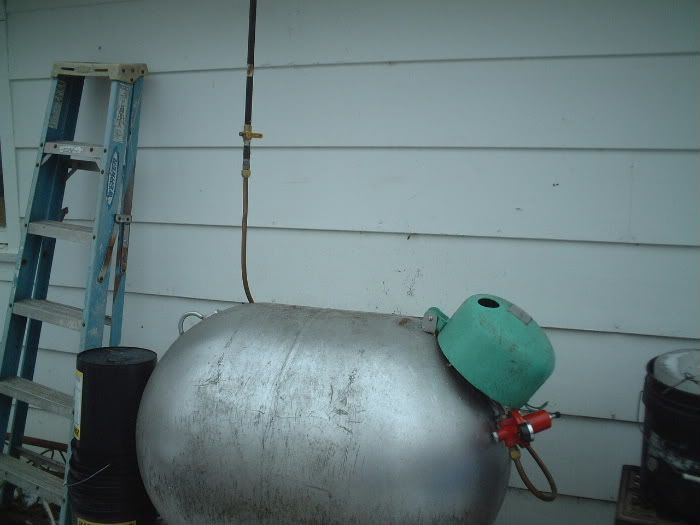
100 gallon or more tank outside.
Regulate line pressure at the tank to suit your needs inside.
I have a regulator outside that puts 7 pounds in the hard line.
Shut off on the tank.
Shut off on the line.
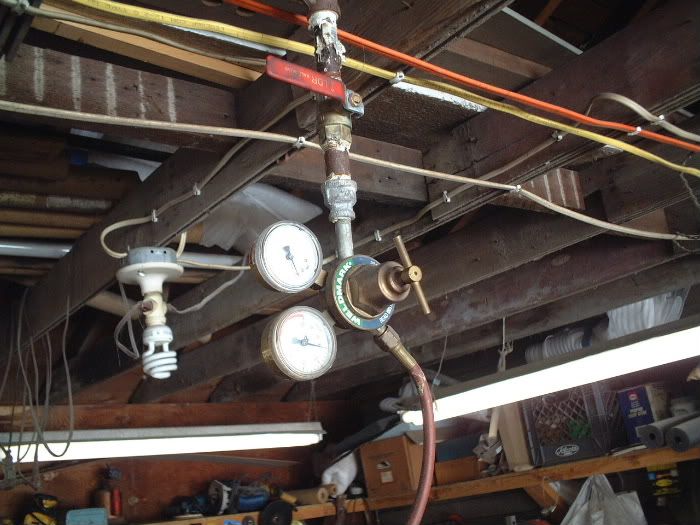
Run over to your forging area and put in another regulator to drop the line pressure to your needed amount at the burner.
With a shut off on the regulator.
Put another shut off on the burner.

I had insurance at this location and I have full replacement and liability at my new location. Fully inspected by the ins. company.

See the regulator on the tank and the shut off in the hard line.

gf2.jpg


Come in through the wall. I even had an in-line 100#-er for back up!
gf1.jpg


gf.jpg


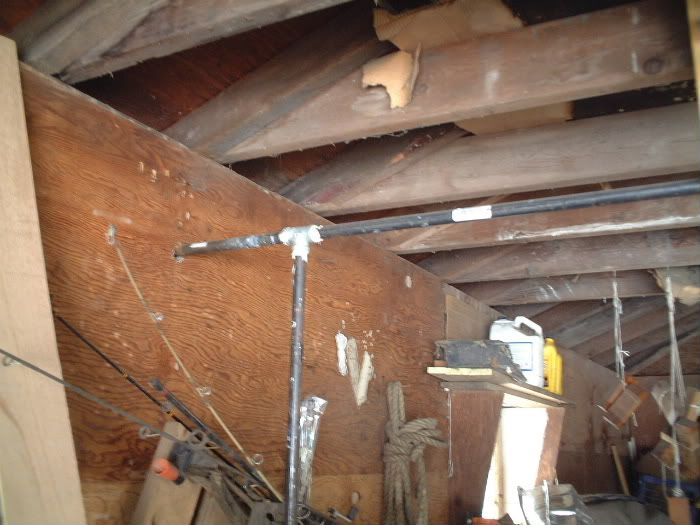
Take it overhead to your forging location:

gf3.jpg


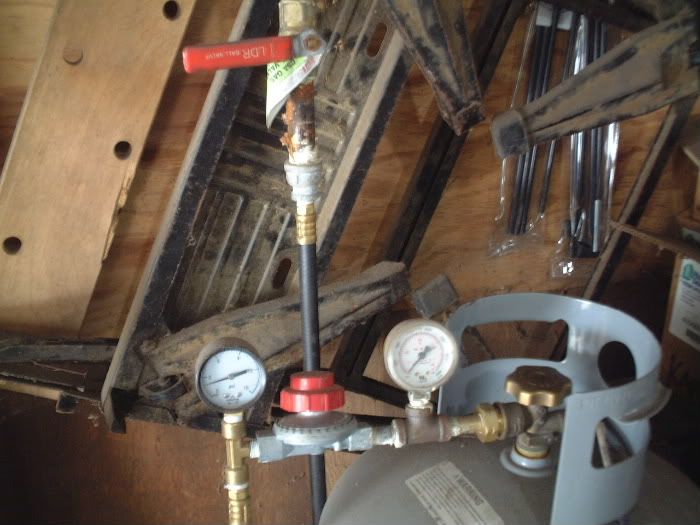
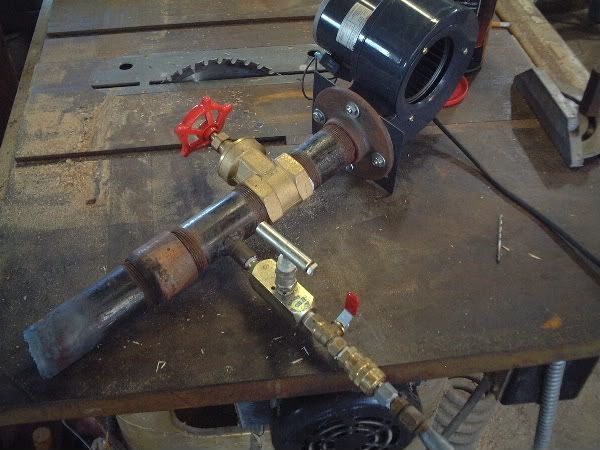
I use quick disconnects at the burner as I have three forges and burners.
With a shut off on the burner as well.
DSCF0005-1.jpg


Somebody said something about hauling 100#-ers being illegal?
Seriously? :rolleyes:
Whatever.

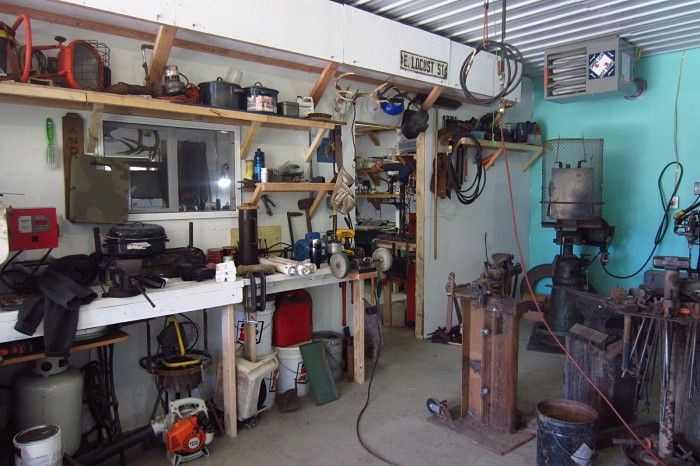
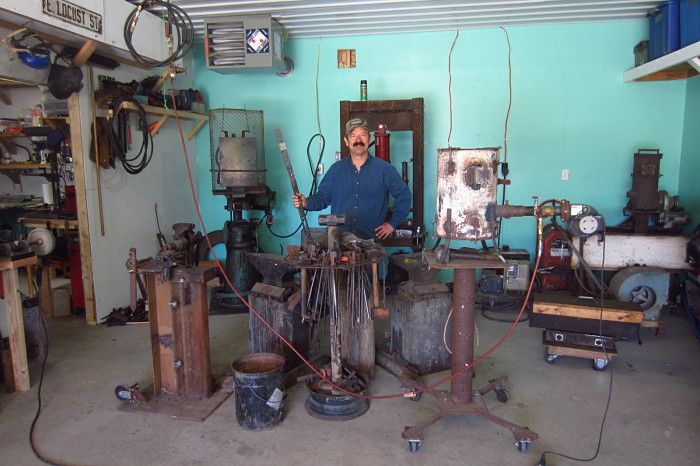
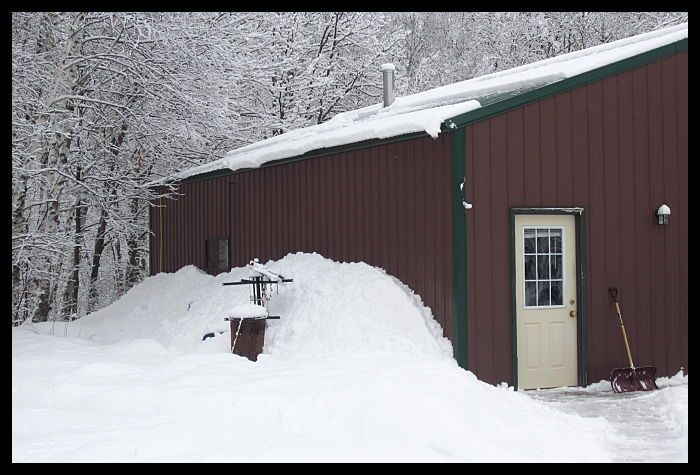
This is the new shop. See the same line dropped from the ceiling:

IS2_zps6d487f94.jpg


IS1_zpsea3746cb.jpg
 
That's real similar to what I'm thinking Karl. As for filling tanks, no regulation down here that I know of for farm or home use, there's still quite a few propane tractors running, though they are disappearing. With a propane tractor you have to have a liquid line, and like you said, your just equalizing pressure. I'll probably route a line to the shop, it's a lot of trouble with a liquid line just to keep a cylinder half way full.
 
Karl, I did some digging and I guess I'm just unlucky. As far as I can tell the weight limit for private transport is much more isolated a rule than I thought, I just happen to have almost always lived in places that had them. There are limits via federal requirements, but to hit them you'd need a bunch of cylinders or a tank rather than a cylinder, and once you start moving a tank with any propane in it the whole set of rules shifts since it's officially a hazmat item and must be placarded and driven by a hazmat driver... Good to know, I'm going to have to do some more digging and find out just who set that rule for my area and what rules apply to the rest of the state and surrounding states. I know the Mass Turnpike has some pretty strict rules that preclude even a grill tank from most of the bridges and tunnels. I imagine that particular regulation is ignored a few hundred times a day at the least.

Nice setup for the shop, and a great example of how it should be done, particularly if not being done by a tech (with the specialized gear to use some of the newer piping methods). Properly done good quality black iron is still a standby in the industry for good reason. A good example of a quality regulator too, Fisher makes good stuff that lasts. The nice red paint isn't bad either. The blah grey and green ones are boring. lol

If you do this kind of pipe work, keep some of the appropriate leak detecting fluid on hand, or mix up some soapy water and a spray bottle. The real stuff's not cheap but does work a bit better. Sometimes the home brew makes it tough to find the tiny leaks you can smell but not really localize.
 
Karl, I did some digging and I guess I'm just unlucky. As far as I can tell the weight limit for private transport is much more isolated a rule than I thought, I just happen to have almost always lived in places that had them. There are limits via federal requirements, but to hit them you'd need a bunch of cylinders or a tank rather than a cylinder, and once you start moving a tank with any propane in it the whole set of rules shifts since it's officially a hazmat item and must be placarded and driven by a hazmat driver... Good to know, I'm going to have to do some more digging and find out just who set that rule for my area and what rules apply to the rest of the state and surrounding states. I know the Mass Turnpike has some pretty strict rules that preclude even a grill tank from most of the bridges and tunnels. I imagine that particular regulation is ignored a few hundred times a day at the least.

Nice setup for the shop, and a great example of how it should be done, particularly if not being done by a tech (with the specialized gear to use some of the newer piping methods). Properly done good quality black iron is still a standby in the industry for good reason. A good example of a quality regulator too, Fisher makes good stuff that lasts. The nice red paint isn't bad either. The blah grey and green ones are boring. lol

If you do this kind of pipe work, keep some of the appropriate leak detecting fluid on hand, or mix up some soapy water and a spray bottle. The real stuff's not cheap but does work a bit better. Sometimes the home brew makes it tough to find the tiny leaks you can smell but not really localize.

Outside of federal laws which mostly apply to the transportation industry, almost all propane laws are set by the individual states. There could be additional laws set by municipalities, but I am unaware of any examples.

Since 911 no propane transport vehicle (placarded) may travel through a tunnel. In the case of tanker trucks, this includes the times the tank is supposedly empty. Specific bridges are also off-limits.

On a side note: one of the more amusing things about states and their propane laws (to me, anyway) is the fact that many states suspend specific laws when demand is really high. This is usually temperature related - but hours of service and weight limits are suspended or (depending on the state) eased back. I always thought it amusing that I could go out (legally) at 80,000 one day, and the next day (if it was cold enough and the state had declared it) I could go out at 95,000 pounds and no hours left.

BTW - Karl, that is a sweet setup.
 
Yeah, we got a chuckle out of the suspension of hours/weights a month or so ago. We couldn't even get out to do deliveries to many areas but it let us really catch up with the folks we could get to and then once the plows caught up we filled everyone we hadn't been able to reach. We didn't even try to run our transport though. We have plenty of storage and risking an accident with the transport in those conditions would be pointless. The bobtail drivers liked the overtime pay though, just a few extra hours per day but it adds up.
 
I don't have a propane forge, but we do have a 500 gallon tank that is piped in the ground to A) the house for central heating, B) to the shop for gas wall heaters and C) to my wifes large ceramics kiln (she built it, I made the torches). You have to convince the supplier that you know what you are doing before they will pipe to ho'made stuff, (kiln or whatever I suspect.) Fortunately the company we have had experience with other potters so were familiar with the drill. If you had an expensive commercial kiln with the redundent auto shut-off safety systems, optical flame detectors, UL approved, etc, then they will connect with out hesitation. Bottom line is talk to the pros and let them help you. The big tank helps on cost because they will offer you a contract price in the summer to hold the cost all winter rather than having to deal with the seasonal fluctuations. There is quite a saving there. We don't even have to call 'em for a fill up anymore. They just run a route and top the tank off every three months or so and send us a bill or statement. A long term relationship is very helpful.
 
Back
Top