
Question re: Border Patrol handles on Full Tang blank

donnord

Gold Member
Joined
Dec 22, 2007
Messages
559
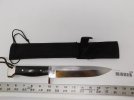
I picked up the Blank shown, because I am interested in the Boye Dendritic Steel. It does not come up for sale often in blank form often so I jumped on it. Since then I have found an example of what the finished knife is supposed to look like. I want to use some special Rosewood scales for the handles. I'm Ok with the Bolster and Butt plate parts. With an exposed full tang and the flat bottom of the blank, there is no belly for the BP style handle. I could do something different I guess. With the BP shape, or finger grooves, it would seem like I will need to route out the scales and fit the handles then sandwich the scales together. My concern is gaps at the bottom, where the scales will come together. I read through Mr Boyes book looking for tips but I did not see this issue addressed. If anyone knows of a good guide on this method or some tips, could you let me know.

BDS Steel.jpegBDS Steel finished.jpeg
 
Interesting you've got Boye Dendritic Steel as the blade. I'd never heard of that before. I've done some research and do I understand this is a 440C steel that is cast into knife size billets rather than large sheets? If anybody can comment more on this steel I'd like to read about it.

On the idea of finger grooves in the handle - years ago I did a couple of knives like that, and found "IF" you hold the knife exactly the same way, with the same size hands the grooves work ok. BUT it doesn't allow very good fit for different size hands. Looking at the blade it doesn't seem like the tang is wide enough to grind the "coke bottle" shape in the handle. I personally like a fairly large handle to fit my XXL hands (glove size).

Good luck - I'll be following this thread to see what you do with the blade and what other folks have to say.
Ken H>
 
Interesting you've got Boye Dendritic Steel as the blade. I'd never heard of that before. I've done some research and do I understand this is a 440C steel that is cast into knife size billets rather than large sheets? If anybody can comment more on this steel I'd like to read about it.

On the idea of finger grooves in the handle - years ago I did a couple of knives like that, and found "IF" you hold the knife exactly the same way, with the same size hands the grooves work ok. BUT it doesn't allow very good fit for different size hands. Looking at the blade it doesn't seem like the tang is wide enough to grind the "coke bottle" shape in the handle. I personally like a fairly large handle to fit my XXL hands (glove size).

Good luck - I'll be following this thread to see what you do with the blade and what other folks have to say.
Ken H>
It's a bit murky from my perspective. In the press, there are references to his material as "440C," as you stated, but 440C contains no cobalt. And on Boye's webpage, he calls it "Boye's Dendritic Cobalt (BDC)" -- no mentions of steel at all. It appears to be a cobalt matrix rather than iron, with some kind of metal carbide (again, not specified). One clue is that he says it is non-magnetic, which highly suggests no iron at all. So, calling it steel is a stretch and calling it 440C is even more of a headscratcher. It looks like Boye is treating the composition as a trade secret rather than seeking patent protection (it was most likely already covered under an expired patent anyway).

Lots of talk about the edge retention with zero mentions of toughness. I'll leave you to draw your own conclusions there...

*edit*
I stand corrected. It looks like the dendritic steel was a real product which really was cast 440C, but that he no longer makes it (hence why it's not on his webpage anymore).
 
Last edited:
FWIW, David Boye at one time had both “dendritic steel” which was CAST 440c, and well as the cobalt product which was basically similar to Stellite….the latter was not magnetic and in fact “heavier” than steel of equivalent size.

Bill
 
billf is correct, he did both.

They were cast by a company in Salt Lake City.

Low toughness, moderate edge holding. Kind of a fun idea.

Hoss
 
Easier way to do the handle is to find material the same thickness as the tang and use that as a half frame handle instead of routing out a slot. So if the tang is 3/16" thick, find some 3/16" micarta or G10 and use that to take up the gap between the 2 scales on the edge side of the handle. You could also remove some of the birds beak area and make that a straighter cut, or remove completely and use the same spacer material through the end of the handle. Tricky part is fitting up the guard to the shoulders of the tang (and squaring those off a bit) and then getting the spacer piece to fit cleanly there at the guard.

Or you could have someone to slot the block of material like others have said, which may be harder with the birds beak area and guard. Removing the birds beak will make it easier. Many kitchen knives were made similar to this with the edge side of the handle removed so the spine of the tang only showed along the back (or partway down the back even) and the wood was slotted (with a table saw??) to fit around the tang.
 
I received the knife today it is large. I haven't figured out the handle design yet. I want to be able to retain the logos but I think the guard, if I use one, will cut off part of the Rocky Mtn logo but not the BDS. The knife was a blem as there is goof up at the back of the handle and the logo is too close to handle by about an 1/8". I may very well grind some or all of the beak off. I want to use a guard but I may go with a bolster instead.
For those interested here is some information on the steel.
My take away that is that the cast 440C performed better than regular 440C by a wide margin back when. Now steel advancements have resulted in better steels. Apparently though the BDS takes an acid etch very well and apparently Boye knife still produces some knives, mainly a folder for made for boating, and some etched kitchen knives. The low toughness may not be a desirable trait for a blade of this size and stature. It is thick stock so that may help.
 
Back
Top