Questions about designing a HT oven

Joined
Jan 1, 2026
Messages
13
Hi all! I'm designing a HT oven for myself. I've read tons of threads on here about people who have done it, and I've watched all sorts of videos on youtube. I have a couple of questions I was hoping you guys could answer...

1) When I use the formulas on Kanthal's website to determine the diameter of the wire I should use for the element, it looks like for a power of between 4.2kW and 4.8kW (18-20 amps at 240v), and an oven that can go up to 1100C, the appropriate diameter of wire should be about 2mm. This would equate to 12awg. But it looks like nobody here uses wire that thick? As far as I can tell, the thickest anyone is using is 13awg. Am I missing something?

2) Also according to the Kanthal website, it looks like if I wanted to use 12awg wire and wrap it around ceramic rods, the ceramic rods would have to be 1inch in diameter to fit Kanthal's recommended geometry. Is this correct? Is anybody using 1inch diameter ceramic rods? I searched for those online, and they are ridiculously expensive. It looks like people who are building ovens with elements wrapped around ceramic rods are using 1/2inch rods.

3) The oven I'm designing will have a 6"x6" chamber. The length is dependent upon the element coil design. If I route grooves in the walls and don't use ceramic rods, then according to Kanthal the 12awg element would need to be formed into a coil with a 1/2" diameter. If I build an oven with grooves in just the walls (a "U" shaped coil on each side, with the sides wired in series), the oven interior would end up being 6x6x31.5" to fit the length of 12awg coil I would need. If I route grooves in the sides and also the top, then I would use 3 elements and the oven interior would be 6x6x22.5". I'm a little concerned about putting an element in the ceiling, as I worry about sagging over time... My goal is to make kitchen knives for friends and family. I don't see any swords in my future... Anyone have any recommendations or advice on these oven sizes? The smaller oven would be 0.46875 cubic feet, and the larger one would be 0.656 cubic feet. At 4400W, that equates to about 9400 and 6700 Watts per cubic foot respectively.

Thank you for your advice!
Darren
 
I've lost your post on the forum, so I'm posting this to bring it back to top.

I've not built an oven - but there are some designs I really like. One is the oven using the ceramic rods routed on top, but are they not using Fused Quartz Tubing for wire support? Something like this item 127591881247 on ebay? $50 for 5 pieces would just about build the oven.

Here are a couple of links to WIPs on HT ovens. This one is really good. https://www.bladeforums.com/threads/heat-treat-oven-wip.1407817/

Here's a thread with basic info, which I think you already have: https://www.bladeforums.com/threads/heat-treat-ovens-some-basics.1022992/

This thread is a neat finished oven, not a WIP like the first link: https://www.bladeforums.com/threads/heat-treat-oven-completed.1776891/

Here's another WIP to look at: https://www.bladeforums.com/threads/diy-heat-treat-oven-build.1576402/

Good luck and have fun
 
Last edited:
Thank you for your reply. You did post a thread I haven’t seen before - the one with the complete oven. There’s some good ideas there.

I’m thinking I’m going to go with “coil in groove” rather than “coil over rod.” Yes, I really like the coil over rod ovens, but as I noted, Kanthal recommends a rod diameter of 10-14x the wire diameter. For 12awg wire, that means rods of 20-28mm in diameter. I don’t want to give up that much oven space. For coil in groove designs, Kanthal recommends a coil diameter of 5-8x the wire diameter. So I could do a 1/2” coil of 12awg wire in the walls.

Hopefully, here’s a quick video of my current plan (I’m not super great with forums and media sharing):
7Mj8g3J.mp4
 
Last edited:
I did 2 ovens recently, one this fall and one the previous summer. I used the Coil over quartz tube like Jarod Todd used for both; I got my tubes from Wale Apparatus. My oven is 7 wide, 6" tall and 27" long and made with 3" thick firebrick. First one was 7 x 6.5 x 27 and 2.5" firebricks, but the bricks themselves sucked.

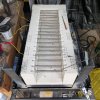
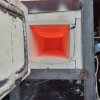
I found that Duralite and KilnParts both make a premade coil, 3600W, 12ga, 16amp, 110" long stretched 240V that pretty much fit my power/oven requirements perfectly, so I went with a pre made element and then measured the ID to order the glass tubes. First time, the tubes were too tight and broke. 33 degrees ambient to 1985 was around 95 minutes IIRC this past Thursday, around 2 hours to 2150. My first oven was like 3-3.5 hours to 2150. Get good K23 IFB!!! I have 18 tubes going across the top of the oven, around 1.5" apart. 1/2" end mill in a drill press works great to make the grooves and I filed channels in the tops of the brick to put the pigtails out the side to connect to the wires from the project box:

562576025_18068152070582960_552070514207990409_n.jpg

Made a jig to bend the wire back and forth. It's 3 pieces of all thread threaded into a piece of mild steel so each piece is 1.5" apart

Most guys use 14ga wire IIRC if going with in the wall groove construction; RedBeard has great youtube videos about the wiring and stuff that I followed!
 
Jarod Todd has done a few with coil over tube ovens and does commercial heat treating for people, and they are not 1" tubes and have lasted fine! Mine tubes around 8mm in outer diameter. I don't know if a ceramic tube is different than a glass quartz tube in terms of refraction and stuff? I have my coils with around 3/8" - 1/2" of distance between the top of the coil and oven IIRC. With the tube in wall, the coils are resting on the stone and the heat has a much smaller gap to escape out of and are more contained, where with the coils, they can radiate fully. I don't think we need the 1" tubes for coil over tube, but JTknives JTknives may be able to chime in and let us know how the coils are doing. The 12ga should be very durable coil wise and longevity!
 
T Taz , Thank you! Your oven and Jarod Todd's were a significant part of my inspiration to do this.

I agree with you that the coil in groove design is not so great because, as you mentioned, the heat has to travel through a gap rather than be unobstructed like in the coil over rod configuration. I also agree that with the relatively light use we use these compared to how much I imagine industrial ovens get used, using a smaller rod is probably going to be ok. I would imagine the Kanthal engineers are optimizing their specs for industrial rather than hobby usage.

I think I'll start a build thread when I make this oven, so maybe others can see the parts I get right or wrong and use that info for their builds. I'm still deciding how I want to do the door, so we'll see how that goes...

What do you think of mortar between bricks vs. no mortar? And which mortar to use if I go the mortar route?

Thanks again,
Darren
 
First oven, I didn't use mortar. It was a PITA to get everything lined up and stay that way when doing the elements, insulation, etc and would shift and open up gaps. I tried the Kanthal staples, but those just fell out.

2nd oven, I did sections of 3 bricks mortared together for the bottoms and sides and that worked so much better. Mine is 6 bricks long and it would have been hard to maneuver a 6 brick stack! Top bricks I believe I left individual, but put sides on to make it squared up with the walls; I cemented the little blocks to the full size brick. I can lift up and move if needed, but they are pretty stable. Bricks at the back of the oven are also mortared. RedBeard showed the mortar he used; there are 2 different types that he talks about. One works, one didn't hold together well. I think the Rutland Furnace Cement worked for him? I used the same and had to redo a couple bricks. I may have had too much dust or not enough moisture to get a good bond between some pieces.

I also used the method to rub the bricks against each other to seat them in better and it worked pretty well to get a better seal than my first oven.

I did a simple door; first one was a self closing 4" hinge, 2nd was 2 normal, smaller hinges. The non self close is nice (I don't need to hold the door open), but I need to work on a better latch system. I am using an eye bolt and hook on a spring, connected to a tab on the door. The 2nd oven, the door doesn't fully close on it's own, so I may elevate the front end so it will swing further shut to keep the heat in while I am grabbing another blade to put in or going to the quench plates. The spring latch gives a tighter seal to the door closing, but I need to push the door to there and hook the eye bolt, which is tricky with gloves and a hot blade in tongs...lol. I may put the handle itself onto the hook so I can hook it with the handle instead of having the handle and hook separate.
 
Thank you for your replies! I think I'm probably going to go the mortar route. I'm currently thinking I'm going to mortar it into a long tube (do all four sides) and have the back as a separate piece that clamps on with the metal frame. That way the back will be removable if I need to replace the elements in the future.

I'm seeing a lot of doors that are brick on brick (no gasketing or anything). I guess that works well enough since so many people do it that way. I was thinking that to get a better seal, I would have the door be brick like everyone else, but on the oven side of the door, have kaowool covering the brick so that as the door is squeezed to the oven body with a spring clamp of some sort, the kaowool will compress to make the seal and that would be squishy enough to allow for brick expansion with heat.
 
Heh, I tried the ceramic rope insulation and cementing it into a groove in the door of my first oven. Fell out after a couple uses! I bought a 12x12 square of 1/4" Kaowool sheet to screw onto the face of the bricks on the oven and cut a hole out for the chamber, but haven't done so yet.

20240730_192455.jpg


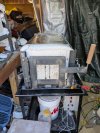
Dowel handle and a steel tab to hit the door switch and the eyebolt/hook/spring as a spring latch to close the door tightly.
Oven 2.jpg

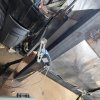
Better shot of the door switch. Most guys use a plunger style, but this has a lot more leeway is setting it up:

452481900_10102302755721270_7439758613123430039_n.jpg
 
I've got those same limit switches I was going to use for that purpose. Have them left over from when I built my CNC.

hp5PvIjl.jpeg
 
Back
Top