Questions about liner materials

Joined
Oct 8, 2009
Messages
163
I have been wearing out the "search" button over the last couple of days.
Read alot, but still didn't get the definitve answers I was hoping for. So let me ask a few questions. I am somewhat a newbie with traditional folders.
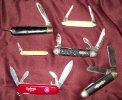
Concerning liner materials....I have seen very old folders (used to be my Dad's) (He was born in 1916 and passed away in 1990.) that seemed to use iron liners. Some of the slipjoints I have since obtained use brass and some seem to use nickel plated silver.
Is there a preferred material choice? Is one considered better than the others? Or is it more important how thick the liners are? I have noticed some are thicker than others.
Thank you all for indulging my questions.
 
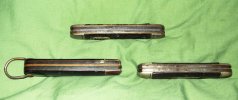
Historically, liner material has been: least expensive, iron; Next is brass, and finally nickel silver. Nickel silver is actually more like a white brass than anything, and has nothing to do with the metal silver. The metallurgists should show up sometime and point up my inadequacies in this area.
 
Nickel silver liners are typically used in a higher quality production run,my opinion anyways. The old time steel bolsters in a quality knife of that era is not to be ignored either. Brass is the norm. Thickness? Depends on the pattern, like a scout would have a thick center liner.
Can you post up some pics of your dads folders? I know I would like to see them.
 
Stainless steel liners are pretty much standard on custom slipjoints. Titanium on liner locks.
 
I like brass liners on production knives. On customs, I require stainless liners.
 
I was thinking about this the other day. I got to wondering why Case used NS liners during certain time frames, and brass for most others ?

Was it cost only that made them do this, or did they have another reason ?
I still have a few Case knives with NS liners and really like them. To me it adds a little touch of class to the knife.
 
I was thinking about this the other day. I got to wondering why Case used NS liners during certain time frames, and brass for most others ?

Was it cost only that made them do this, or did they have another reason ?
I still have a few Case knives with NS liners and really like them. To me it adds a little touch of class to the knife.

Appearance comes into play. With proper fitting, nickel silver liners make the back of the knife look like one piece of steel- I've a Buck 301 where it's nearly perfect.
 
Stainless liners are showing up more and more....

My Canal street half moon has stainless liners.
Mike ,I know what you mean about Case. I should have hung on to this one.

P1010011-1.jpg


P1010013-2.jpg


P1010015-2.jpg


P1010008-5.jpg
 
Brass often lends a good colour contrast, and, presumably is easier to work with than iron or stainless, being softer. There can be a tendency for 'brass bleed' or verdigris whereby a green corrosion can stain light coloured scales rather unpleasantly though.
 
Everyone, thanks for all the insight!
Much appreciated!

Navihawk--I'll try to take photos of my Dad's knives--they are quite well worn and the blades worn down from poor sharpening techniques and years of abuse.

Willgoy--That's a very good point and one I did not think of.
 
My grandfathers knives were like that. He used a grider or electric sharpener to edge them.Except for one. he had a tortouse shell Scrade pen swithchblade.
 
Yep, my Pop used a electric double wheeled bench grinder with a stone wheel. Too bad they didn't have a Spyderco Sharpmaker back then eh? I would venture to say they would be in better shape today if he used one.
Those folders got alot of daily use back then. My Dad was a Paperhandler in a Printing Company and had lots of need for cutting various items.
 
Blade sharpened on a grinder would have a serrated edge to them. the type for heavy cutting chores.
 
I was thinking about this the other day. I got to wondering why Case used NS liners during certain time frames, and brass for most others ?

Was it cost only that made them do this, or did they have another reason ?
I still have a few Case knives with NS liners and really like them. To me it adds a little touch of class to the knife.


In my book I discuss the topic of Case liner materials in some detail. When it comes to Case knives there are no 100% rules, but here is the general story.

In the years from the pre WWII era until the late 1970's, both brass and nickel silver liners were used on Case pocket knives. In general , brass was used on one and two blade jack patterns that were of more basic or inexpensive construction and on large folding hunters.

In general, nickel silver was used on most three-blade stockman patterns, the 54 trappers and on most small pen knife patterns. Nickel silver was also used on two blade jack patterns that were made on stockman frames (like the 087).

There are of course exceptions to the above. The only logic evident is that nickel silver was deemed a superior lining material for the stockman knives that might be used for veterinary purposes, since nickel silver does not oxidize like brass does (lowering the prospects for contamination).

Nickel silver may have been used on the small pen knives just to provide a more jewelry like appearance. It is interesting that when Case began to make more knife patterns with stainless steel blades in the 50's, the majority of the patterns to be made in SS were not the larger stock and trapper knives but the smaller pen knives. Runs counter to logic in a way.

During the 1977 to 1980 time frame, Case converted almost 100% of the pocket knife line to brass liners. Nickel silver was not used for many years but has been brought back on pearl handled knives and other premium knives.

Steve
 
Back
Top