
Questions about paper based phenolics

Joined
Dec 7, 2008
Messages
7,187
A couple weeks ago one of my regular customers called me and pointed out a plastics manufacturer selling black paper based phenolics.
Similar to Westinghouse's paper mycarta. Mycarta being a trademarked name, the manufacturer is calling it paper based phenolic.

I have always been anti-manmade handle materials because I am a prejudiced bigot calling it fakey looking plastic stuff.
Not really, but it is in my job description. OK, enough nonsensical rambling.

I bought some 1&1/2" thick black paper slabs thinking to use it for ferrule material on kitchen knives and possibly full hidden tang handle blocks.
I had searched knife suppliers and only saw scale thickness pieces for sale. In hindsight, maybe there is a good reason for that.
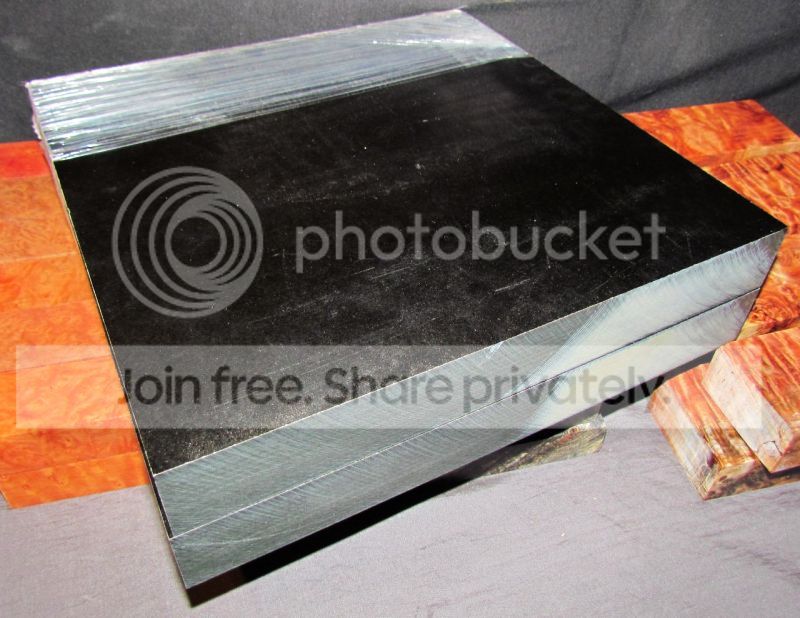
p001.jpg


My questions;

Is there any demand/need for thick stuff like this?

Is it a durable material that will hold up under hard use?

What sort of blade should I use on my bandsaw to cut it with?

Am I a dummy who now owns some heavy black slabs of fakey looking plastic stuff?

Input from those of you who have hands on experience using paper based phenolics or paper mycarta is greatly appreciated.

I am not trying to sell this. I probably won't be able to do anything with it for a few months anyways. I am just checking to see if my customer advising me to get this, may have been a case of the blind leading the blind.

Maybe I could use it to make chopsticks, drawer handles or the big plugs those body piercing guys put in their ears.
It is really heavy. Works great as a door stop.

Thanks in advance,
Mark
 
Last edited:
In my experiences, paper phenolic is much tougher than, most woods, but much less tough than linen or canvas phenolic. It tends to be more brittle, especially when drilling so go slow and have a "base board" such as wood underneath it. Other than that, when done right it looks great(I prefer a dull smooth look, or "carved") and is very functional. If you want supreme toughness go with linen or canvas phenolic, or G10.

Oh, almost forgot, I buy sizes like this often(get more for my money most of the time), and I just cut it into scales myself.
 
Dave, .....or anyone
What do I cut it with?
Will bi-metal wood blades work or should I use metal cutting blades?
 
I've cut it with a bimetal wood blade, but never in a production capacity like you might need. So there might be a better method in that circumstance. I've also cut it with a table saw.
 
I have used both, they both work, the bi metal seems to cut a little better though. If you cut the tougher stuff, use bi-metal, but in some cases even those will wear out quick. I just cut up the toughest Canvas micarta I have ever encountered yesterday, it was 2 5"x12"x 3/8" and it used up two brand new blades cutting it into 2.5"x12" sections.
 
Use metal cutting blades as the resin is pretty tough. I had to use hack saws on the stuff I had (paper, linen and canvas) as my wood and coping saws would tend to chip it and get dull. Treat it as you would metal, cut slow. Making other things out of it would be cool but I would stay away from the ear plugs just because of the type of resin used in the mycarta.
 
Is there any demand/need for thick stuff like this? Yeah. It would certainly make nice spacers, the black paper micarta I've used can be polished up to a pretty high level. It might also be great in larger pieces for hidden tang handles.

Is it a durable material that will hold up under hard use?I believe so, yes. I agree with Dave that the larger fibers in canvas micarta seem to make it even stronger, but paper micarta is pretty durable.

Personally I prefer canvas micarta, for all the reasons Dave mentioned, plus it's super easy to get a very grippy handle with it. Having said all that, I like G10 even more. Super tough, can be left rough or sanded very fine, plus available in lots of pretty colors and patterns. Who needs stabilized wood, anyway?

just kiddin about that last part :D
 
I think you did good to diversify your offerings a bit. I hate ordering bits and pieces from several online stores when I could just order it from one place, and cut down on shipping and hassle. I often order from one place or another based solely on the criteria that I can get everything I need at once; even if they don't have the best prices on everything, once you count the reduced shipping it makes good sense. In the future I think Canvas is much more popular than paper, and G10 is also good.
 
Paper based stuff "burns" easily at the point of contact when grinding, you have to use fresh belts when working it and I imagine the same applies to blades. Also, it looks different from the edge than the face even when finished. With thick blocks like that you might want to resaw them thinner at some point. Maybe cut it into smaller chunks that are short enough to fit through the saw nicely upright without flexing the blade. Who knows, maybe the edge on look will be cool instead, I'd try it before doing a bunch of cutting.
 
Paper based stuff "burns" easily at the point of contact when grinding, you have to use fresh belts when working it and I imagine the same applies to blades. Also, it looks different from the edge than the face even when finished. With thick blocks like that you might want to resaw them thinner at some point. Maybe cut it into smaller chunks that are short enough to fit through the saw nicely upright without flexing the blade. Who knows, maybe the edge on look will be cool instead, I'd try it before doing a bunch of cutting.

That could be interesting! Mark - when you do get around to cutting these up you should try that out. I've only played with canvas, burlap and G10 and have really liked working with them (except the smell, even through the repirator...).
 
I agree with most of the above. Phenolics and G10 just tear up wood blades in my experience. If I had to resaw or block up a slab like that, I'd start with fresh bi-metal blades on the fastest pulley setting of my metal bandsaw. An aggressive blade like a 6 or 8 tooth per inch.

I've worked a fair bit with white paper micarta, which has to be finished very cleanly and sometimes has inclusions- I've not tried black, but it can't help but be easier.

I occasionally will get a customer who just stipulates black micarta on a handle, no particular texture. While I often use linen for this, black paper would be just as well most times. I've made a few knives the past year with handles out of black block micarta. Actually, I may be in the market for a chunk or two soon- maybe I should inquire?
 
It certainly has a place in knife making. It has supreme durability and can be an excellent material for kitchen knives. I'd much rasther use it on lower priced folding hunters than wood. As well the price does help to keep the cost down for the buyer. Frank
 
Most of the knife supply companies sell micarta blocks that measure 1 1/2" x 5" x 1 1/8". These blocks are used for hidden tang knives.
Personally, I don't care for black paper micarta. I much prefer linen or canvas micarta. I also much prefer the beauty of woods like you work with.
I have used black paper micarta for a thin spacer behind the guard and in front of the handle.
As for cutting micarta, I have always used a regular wood bandsaw blade, but the micarta I cut is 1/4" or 3/8" thick, not 1 1/2" thick.
 
It sounds interesting. If the slab is 1,5" thick you could cut the block so that seen from the side you see the layers.
If you would offer them I'd be interested in a block cut that way. I'd prefer a large block out of wich I can cut one or two handles and mayde some spacers or bolsters.
A singe block that would fill an $12,-international flat rate box would be good if the price is right.
 
When comparing the aesthetics, it's all about the knife's role for me. In a knife I'm going to use a lot I'd rather one of the synthetics. Micarta or G10 preferably. They just plain hold up extremely well and as long as the look matches the knife and is well done it doesn't give up anything to a basic wood. Really nice wood is a whole different category. The materials cost and the time to do it justice means it's going to cost significantly more while being more vulnerable to damage that mars the beauty which was the whole reason for the additional investment. For a knife that may see a lot of use but not the kind of use that gets a knife all beat up that may be just fine. Kitchen knives in particular fit in this category. That doesn't mean I think nice wood on a working field knife is not nice, just that to me it seems like a lot of money spent on additional eye appeal that fades quickly and requires more care to make pretty again. I can easily see where someone would want to make that investment anyway, even if after a few weeks or months the handle has lost some of that perfection it is not going to be ugly and some folks just really prefer wood.

I think it also depends on the wood. Some wood patterns will hold up better to getting knocked around. All the little dings, dents and scuffs won't be as obvious.
 
Back
Top