Quick question regarding the Sage II

Joined
Oct 30, 2011
Messages
1,648
For those of you who have one, take a look at your lockface (on the blade, not the lockbar). Is it flat or radiused? The first Sage II I owned had a flat face. But I bought it used on eBay and I sold it off and recently bought a NIB one on the forums. This one has a radiused lockface.

So presumably at some point they switched they switched from one to the other. I would guess that the flat lockface is the modern design and I just happened to buy a NIB version the seller had sitting around for a few years from the early production. Normally I wouldn't care. But mine is developing lock rock. It comes and goes, but I'm not happy with it. I HATE lock rock with a passion and Ti Framelocks are hands down my favorite type of folding knife.

Strider recently switched to a flat lockface to address stick issues with their knives, so I'd assume flat is better than radiused on the Sage as well.

The hunt continues for a perfect specimen...
 
Mine has a radius so shallow it almost looks flat until viewed under magnification. Just purchased it NIB 5/13. Lock-up is approx. 40% and is solid at every axis. I would assume mine is a fairly recent build. A Techno I have is a more noticeable radiused tang face also with a solid lock-up.

FWIW Sal stated that Spyderco *(See attached link...post #19) would fix this "one way or another" if lock problems arise on the Sage 2...

http://www.bladeforums.com/forums/showthread.php/1001391-Sage-2-lock-wear
 
Mine appears to be flat, purchased in march. Lock-up is solid at 30%.
 
I wouldn't say flat is better than radiused. A mixture of the two was introduced on the Military and it was called the "fail-safe linerlock". It is practically a flat lock-tang that transitions into a radius. A properly fitted lock is a properly fitted lock, regardless of the lock-tang cut.

My Strider SnG has lock-rock (new lock-tang), but the lock still doesn't fail. I don't notice it in use, so I've decided it's not a problem.
I just saw a thread about the CRK Sebenza 25 with the ceramic lockface and even that knife suffers from lock-rock.
Lock-rock doesn't mean a lock is unsafe.
 
Based on an overview of all my Ti framelocks most of the ones that have lock-rock have radiused lockfaces. But I agree, a properly fitted lock is indeed a properly fitted lock.

The true source of lock rock, in my opinion, is when the contact area is too small. If the lockface and lockbar do not mesh together with a large contact patch, than all the forces are concentrated on a very small region. The PSI in that case is enough to deform or wear the titanium. You can see from the wear pattern on the the tang, just how much material is actually coming in contact with the lockbar. Every knife that has ever had lock rock has had a very small contact patch. My Kershaw Ti JYD has a huge contact patch. The two surfaces are matched perfectly. The lockup has NEVER moved a bit, I can't even push the lock bar over no matter how hard I try. The lock up has never had even the slightest amount of stickiness. And I can detect even the most minimal amounts of stick. It's an irrational pet peeve of mine that I just cannot get over. It drives me crazy.

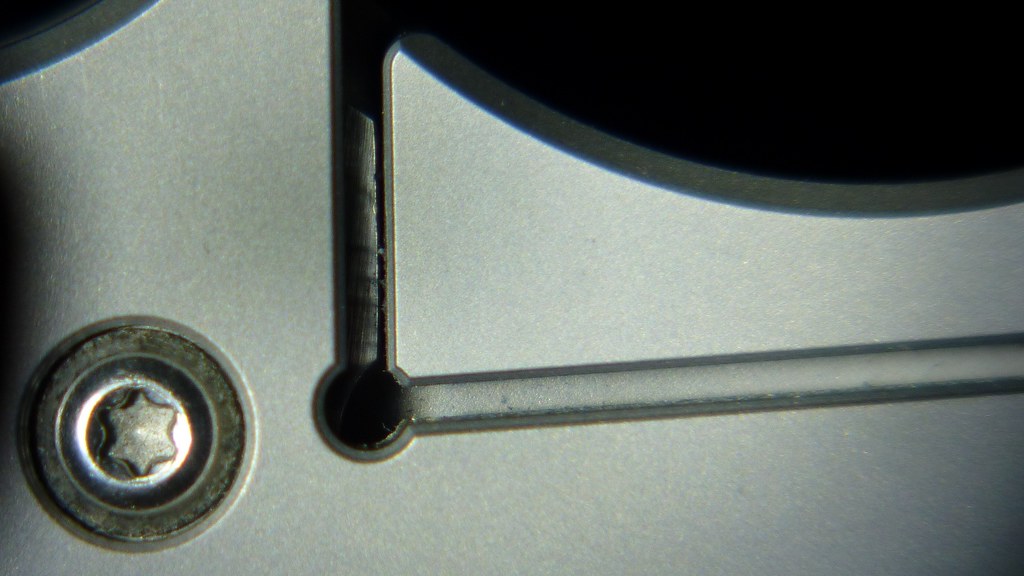
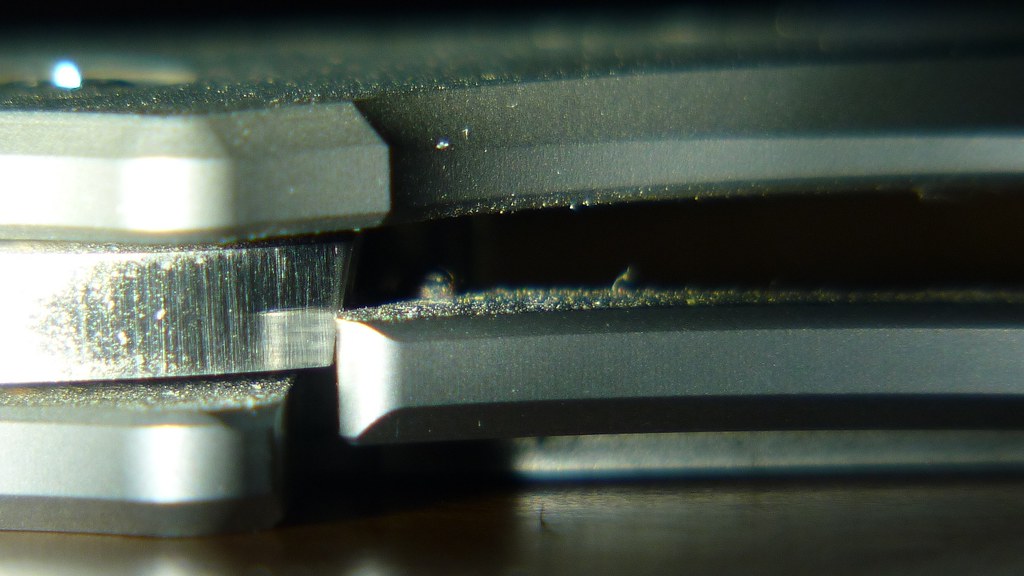
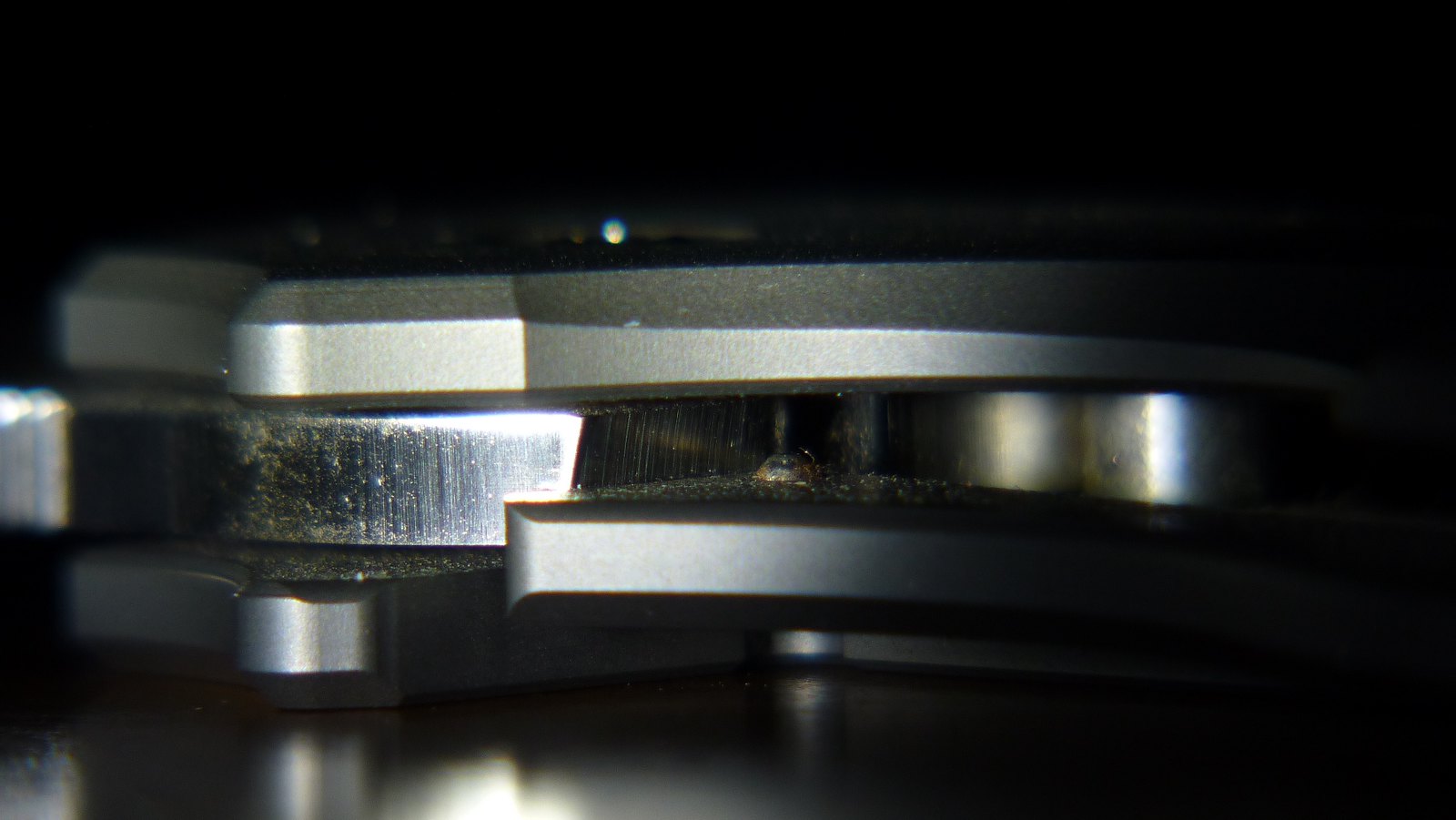
Here is a picture of my sage illustrating the problem. My old sage was not like this. It was in perfect contact since the two surfaces are perfectly parallel. Most people wouldn't complain about this. Like I said the lockrock comes and goes. But inconsistency is another thing that irks me. I wouldn't expect Spyderco to address this or even consider this to be a problem. The gap tapers down to a very fine area, more so than can be seen in the picture. So only that line of titanium on the lockbar will ever come in contact with the blade tang. Less contact = considerably less life span and stickiness. Every sticky lock I've ever inspected has had this tapered gap. Every one thats been perfectly parallel does not ever wear and never develops lock-rock. Just my $0.02.

 
Last edited:
Every bit of trustworthy literature on linerlock construction says that a small contact patch is best. (Terzuola's book, Emerson's website, emails with CRK, and a few linerlock geometry threads in knifemaker forums.)

A large contact patch is not a correctly designed liner/framelock.

I don't know the reasons for your lock-rock, but that contact point is designed correctly.
 
We will have to disagree on that point. From my experience the opposite is in effect.
A small contact patch will grow larger as the knife wears in anyway. Thats why lock rock is semi common with new knives and most of the time it goes away once broken in. Thats why lock up percentage is early for most knives when they're new and then wears in a bit and stops. The larger the contact is the more material will have to wear away before the lockbar can move any further. Meaning lifetime is improved.
 
We will have to disagree on that point. From my experience the opposite is in effect.
A small contact patch will grow larger as the knife wears in anyway. Thats why lock rock is semi common with new knives and most of the time it goes away once broken in. Thats why lock up percentage is early for most knives when they're new and then wears in a bit and stops. The larger the contact is the more material will have to wear away before the lockbar can move any further. Meaning lifetime is improved.

Let me cite some of my sources.
The Tactical Folding Knife: A Study of the Anatomy and Construction of the Liner-Locked Folder - Chapter 4
http://emersonknives.com/blog/emerson-knife-anatomy/

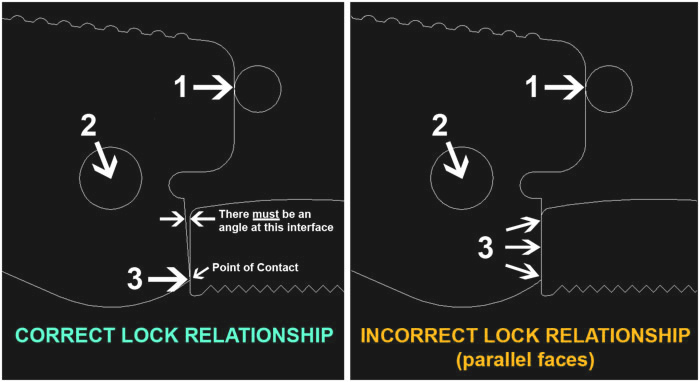
Here's a picture from Emerson's site.
LockInterfaceDiagram.jpg


Here's a quote from Mr. Emerson.
"Cheap Chinese imports and others who do not understand the mechanics of the liner lock system may think that the lock face on the blade and the face of the liner lock should be parallel, face to face, with full engagement of the lock face against the back of the blade. They are incorrect. As both aerospace mechanical Engineer and the third knife maker in the world to use the liner lock system almost thirty years ago, and having made several thousand custom knives and several hundred thousand production knives I assure you that I know of what I speak."

Don't argue with me, go tell the established knifemakers that they don't know what they are doing.
 
Just a guess, but your comment that your Sage 2 lock-rock "comes and goes" has me thinking that the random nature of your problem could possibly be addressed by trying some graphite/pencil lead or sharpie on the interface area, if not already performed, to determine if this area simply needs some lube aiding the interface to properly seat in a consistent way?
 
Just a guess, but your comment that your Sage 2 lock-rock "comes and goes" has me thinking that the random nature of your problem could possibly be addressed by trying some graphite/pencil lead or sharpie on the interface area, if not already performed, to determine if this area simply needs some lube aiding the interface to properly seat in a consistent way?

and you could also try cleaning the lock-tang with an alcohol/acetone soaked Q-tip, because it may have got a little lube on it.
To clean the lock-face the easiest way I have found is to get some paper wedged between the lock-tang and lock-face until the piece of paper comes out clean.

There are some other things to try but disassembly is required. :eek:
 
I'm not here to tell other knife makers how to construct their knives. Nor am I insinuating that they're incorrect and I am right. That article makes the point very clear even though it offers no reason why a parallel face is inferior, or why a three lock point geometry is superior. Nor does it make any mention of longevity or the cause of lock sticking. I'm not saying the article is wrong, but it isn't very clear.

As far as lock rock, and lock travel are concerned, every single knife I've ever owned that has been parallel has been perfect. No travel and no stick. Again, I'm very peculiar about those things. Neither of my Sebenzas have ever moved a millimeter or have ever been sticky. I'm looking at them right now and both have parallel lock faces. My old Sage II had parallel faces, so does my Ti JYD, my Kershaw Ti Mini Cyclone, and my Benchmade Mini Skirmish. My strider SnG does have a tapered gap and did suffer from stickyness at first, and after the lockbar wore in a bit, it went away. The contact area has enlarged. Cite all the articles you want, I'm not trying to discredit them, and it doesn't change my experiences. BTW, the Emerson's I've owned and handeld in the past all had sticking issues, same with some Striders.

EDIT: After a bit of Googling, the reason knifemakers opt for that 3 point contact geometry, illustrated by Emerson above, is because it is desirable to have the point of contact as far away from the pivot as possible. The larger the distance between the point of contact on the lockbar and the pivot, the less force is exerted on the lockbar. It makes for a stronger lockup. Thats just simple lever mechanics.

That's fine, I agree with that, but that doesn't explain why a flat (or flatter) face is necessarily a bad thing. There is still contact at the far edge of the lock bar, far away from the pivot, but there is also more contact inward as well. If the point is to minimize the load on the lockbar, then distributing that already minimized load a short way across the lockbar would also have the same effect. The contact patch doesn't have to be the entire surface of the lockface, a 3mm x 3mm square's worth of area is plenty. But a pin prick of contact has poor performance in my experience.

Even if I'm dead wrong (this seems like a no-brainer to me, but hey, who am I to argue), I'd rather have the lockbar cope with slightly more force from the blade and have a stick free and zero travel lock up, instead of having a minimal risk of bending the lockbar at the base and yet having to deal with stickiness and a shorter lifespan... but thats just me.
 
Last edited:
I wouldn't argue with knife makers with tons of experience, many times in industry practice and iterations find the best solution even if on it's face it doesn't seem like it would be. Intuitively it just seems that an angled lock bar interface with a smaller contact patch would be inferior to a larger contact area. I'd sure like to understand the science behind it's better performance. If it was for ease of manufacturing I could understand it, it would be infinitely easier, faster, and more forgiving of poor tolerances to produce two different angles that only need a small contact patch and one being softer quickly mates to the other surface compared to two larger surfaces that have to match up perfectly over their entire surface. Could be that doing the later is just way too labor intensive to get two larger areas to match perfectly or that the angle lock bar allows for a more secure interface over time as the parts wear and mate to each other.

It's interesting because I found my oldest 3 liner locks that I've used hard a BM stryker, BM 975, and on old EDI genesis, and not one of them has an angled lock bar interface, at least they all appear to fit perfectly flush. All of the newer liner locks I have from the last few years have various angled lock bar interfaces. Whatever the reason it appears most manufacturers have gone to the angled version.
 
I'm not here to tell other knife makers how to construct their knives. Nor am I insinuating that they're incorrect and I am right. That article makes the point very clear even though it offers no reason why a parallel face is inferior, or why a three lock point geometry is superior. Nor does it make any mention of longevity or the cause of lock sticking. I'm not saying the article is wrong, but it isn't very clear.

As far as lock rock, and lock travel are concerned, every single knife I've ever owned that has been parallel has been perfect. No travel and no stick. Again, I'm very peculiar about those things. Neither of my Sebenzas have ever moved a millimeter or have ever been sticky. I'm looking at them right now and both have parallel lock faces. My old Sage II had parallel faces, so does my Ti JYD, my Kershaw Ti Mini Cyclone, and my Benchmade Mini Skirmish. My strider SnG does have a tapered gap and did suffer from stickyness at first, and after the lockbar wore in a bit, it went away. The contact area has enlarged. Cite all the articles you want, I'm not trying to discredit them, and it doesn't change my experiences. BTW, the Emerson's I've owned and handeld in the past all had sticking issues, same with some Striders.

If the lock has a large, parallel contact patch, when you put closing pressure on the blade and the lockbar compresses slightly, the blade will pivot slightly causing the once parallel contact patch to now be only touching on the contact point farthest from the pivot. This causes play.

Your CRK may look like it is parallel, but it is not. For example, think of the evolved locks CRK has now with the ceramic ball lock-faces, like the Umnumzaan and Sebenza 25.
Look at wear marks on the tang or lock-face and you will see a small area of wear, not the entire tang or lock-face.
The lock may appear parallel, but it is not.

There's also the importance of lock strength. The farther away from the pivot that the contact point is, the stronger. Simple rules of leverage.

This is well established information about linerlock geometry from knifemakers. Go search Google, read Terzuola's knifemaking book.
 
You're right, perfectly parallel would be inferior. As I said, I never meant to fly in the face of established makers with years of experience. And I did do a little research and found support to what you explained here, as I annotated in my post before I saw yours.

Suffice it to say, the shallower the angle the better. All those knives I thought to be perfectly parallel could in fact have a very very shallow angle instead. In any case, a larger contact is still desirable. And again, I don't mean it has to be huge. My Sebenza has spot, which has worn in clear across the entire lockface by the way (although Sebs lockfaces are tiny), with an area about the size of this asterisk *. But my Sage II, and its stick, comes from the very edge of the lockbar making a pinprick of a contact with tang.

I'd say ToddM is correct, and my new Sage happened to be an outlier on one of the tails of the binomial distribution. My old sage had a seemingly parallel contact.

And the hunt still continues for a perfect specimen...
 
Last edited:
9305349634_da00afa103_b.jpg

9302568407_4a9245cd99_b.jpg

9305349980_1ff449135e_o.jpg

9305349862_83e407c86a_h.jpg


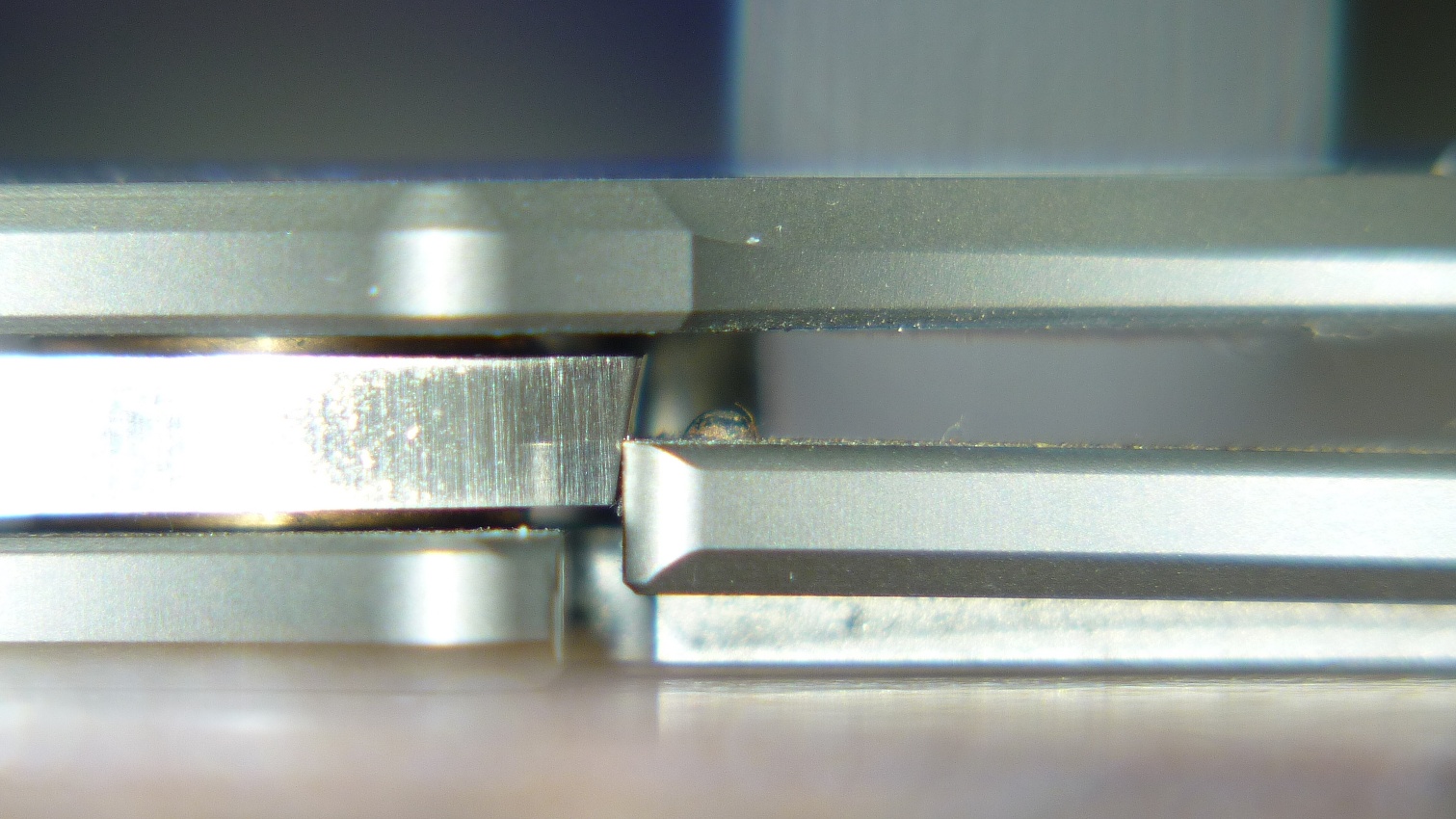
Here is my Sage. It has been used for about 8 months. Never hard use, but it's been opened a lot. I tried to get a picture of the gap between the lock bar and tang but there is NONE at all. The lockup is 100% solid and it doesn't stick at all. The contact is 100% as evidenced by the wear mark on the tang. I know that it should only touch at the far side of the lock bar for strength, but I think mine is perfect. The lockup has not changed at all since new. I hope these pictures help a little.

Also, I have seen another person with a Sage like yours. He complained of rapid lockup change. If it was mine, I would prefer it just like mine!
 
Thank you for the great pictures. That is exactly what I'm talking about. That's how my old sage was. It had full contact, maybe even from day one. In my mind that seems like it would out last one with a slight gap, whether or not it's the traditional way of doing things... I can't say, but I'd rather have one like yours.
 
This thread has me interested. Hoping Sal will chime in with his thoughts on the subject.
 
Back
Top