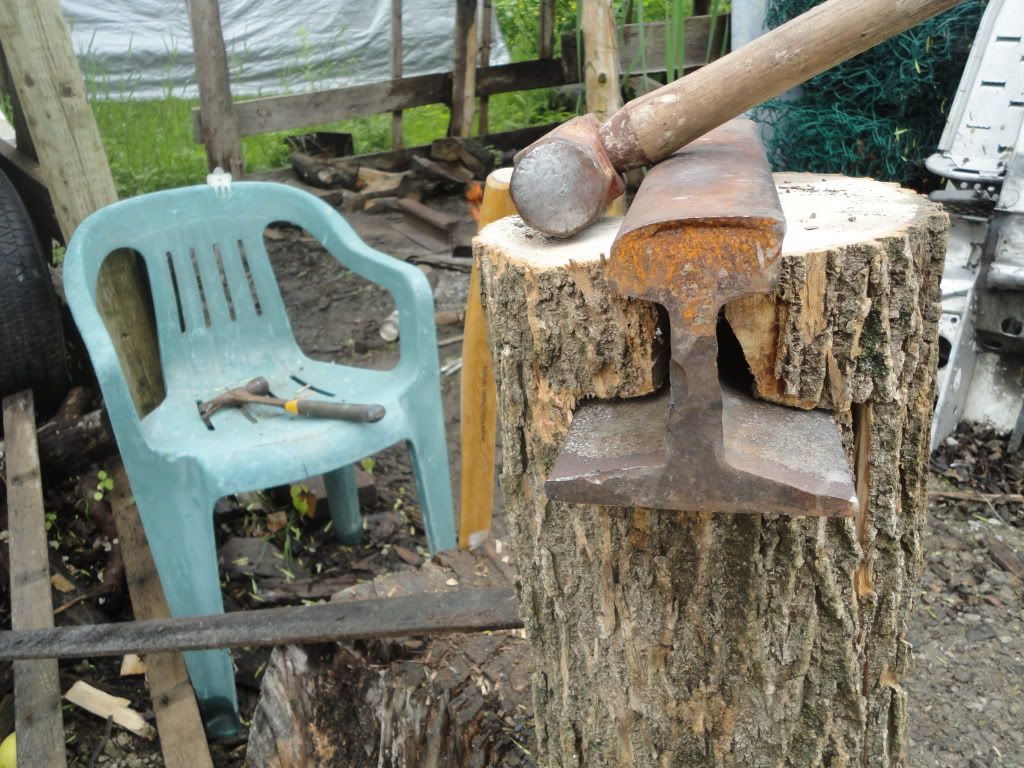
Rail road anvil stand pics

Joined
Jun 16, 2008
Messages
3,415
I have a rail road anvil that I just came across. Its all I can afford until I save up for something better. How have you guys who had or have one mount it? I am going to get a couple 4x4 studs and stand 9 pieces, tie them together with 2x8s and then fill in the top and the base of the anvil with concrete. I am using a 16lb sledge hammer as an anvil since patience is not my virtue. So if you got any better ways to mount this rr anvil, please post up some pics or describe what you did. Thanks!
 
I found a good size stump on the side of the road. I put mine down in the center of the stump. And screwed in some long wood screws with some washers on the screws. I think it was two per side and on ends as well. Holds pretty well. Sorry, no pics.
I'm also hoping santa will put an anvil in my stocking, along with some coal:D
 
You're going through a lot of work to make a stand out of 4x4's when all you really need is a shell of some sort to hold the cement. My personal favorite is to take the bottom out of a metal or plastic bucket so the end of the track sits on the ground. Then simply fill the pail with concrete, throwing in some coat hangers or scrap metal for extra weight and strengthening.

Works every time.
 
Rail side up. Its around 17lbs and around 11" from the end to the tip of the horn. Its not much, but it is gonna have to do while I learn to move the hot metal in the directions I want it to move. I watched the Tai Goo video I ordered and learned a thing or two.

attachment.php
 
I think if it were me, I would just get a wooden stump or section of a felled tree. Use 4, maybe 6 lag bolts with washers to secure the flange of the anvil to the stump. I would drill the pilot holes close to the edge of the flange so that the washer overhangs. The lags will likely loosen up over time, so, you'll have to check them from time to time but that shouldn't be a deal killer.

Good luck,

Bob
 
Yep, that's the way to mount one of these anvils.
You want the anvil face about wrist high, which is between 30" and 36" for most of us.
After it is mounted, take a disc sander to it and clean up the face.
 
Ive been thinking about getting one of these myself. Is it best to mount it horizontal like this, or vertical. The vertical mounting provides a much much smaller face, but it puts all the mass underneath that small area?
 
Interested in this too. If a guy had a raw chunk of rail is there an advantage to rail up, base up or on end?
 
While you're looking for a stump, look for a heavier chunk of steel too. If you can find something with more mass, you'll REALLY appreciate it!
 
Last edited:
I am looking and hoping for some thing better. This is all I could find in my budget for now until I can put away enough pennies to get me a real anvil.
 
A word about going out and "finding" a piece of rail. If you see guys working on the rail, stop and ask them. Couldn't hurt to have some extra cash on hand or maybe a six pack or something. Offer to trade.

If you are walking down the tracks and pick up a small piece of rail and walk off, the guy in the dirty jeans and work shirt you pass on the way to your truck just might be railroad police. Officially, one doing this would be trespassing and could be arrested.
 
Hey Panch0, I got a buddy not far from you with a length of track 50 sumthin inches long, let me get in touch with him and get back to you if he's willing to part with it (if you have a way to cut it).


-X
 
I once saw some guys working on some rails. Stopped to talk and for $100 ended up with a 30 ft piece of 135# to the yard rail. They let me use their torch to cut it into 3 pieces and helped me load it. Did I really need that much rail, no, but, I am a steel junky and hope I got a lifetime supply (1350#) of good 1080 carbon steel.

ASTM specified 0.55 to 0.77 percent carbon in 70-to-90-pound-per-yard (35 to 45 kg/m) rail, 0.67 to 0.80 percent in rail weights from 90 to 120 pounds per yard (45 to 60 kg/m), and 0.69 to 0.82 percent for heavier rails. Manganese increases strength and resistance to abrasion. AREA and ASTM specified 0.6 to 0.9 percent manganese in 70 to 90 pound rail and 0.7 to 1 percent in heavier rails. Silicon is preferentially oxidised by oxygen and is added to reduce the formation of weakening metal oxides in the rail rolling and casting procedures.[12] AREA and ASTM specified 0.1 to 0.23 percent silicon. Phosphorus and sulfur are impurities causing brittle rail with reduced impact-resistance. AREA and ASTM specified maximum phosphorus concentration of 0.04 percent.[13]
 
Last edited:
If you can get some heavy rail here is a great idea for a post anvil. You may have to look around and call the rail maintenance yard, but the heavy rail is twice the size of regular rail. big industry and ship yards have rolling cranes and equipment moving on it. Some of the really big stuff has a rail face the size of a standard anvil. When you find the piece, try and get enough for a 24-30" piece and a 12-16" piece.

The post anvil should have the face a tad higher than a work anvil. About 36" is good.

Get a small galvanized trash can about 24" tall. Find a piece of steel plate that will fit in the bottom of the can ( it doesn't need to be round, square is fine). 1-2" thick is great, but even 1/4" will work. If needed, stack several sheets to get the anvil top about 36" high. Center the rail on the plate and brace it vertical. Pour the can full of concrete and let cure. You have a basic 200-300 pound post anvil.
Now comes the fun - a hand held 3" belt sander with a metal cutting belts and an angle grinder will help a lot here.
Grind the top rail part into a small anvil face. Make it smooth and flat.
Grind the web into a rounded drawing/fullering die. It should be smooth.
Grind one side of the foot into a flat and square edge for bending and striking plunges.
Grind the other side of the foot into a 45° angle for cutting. It should not be too sharp, just an even and minutely rounded edge.

You will be amazed at how well this post anvil will perform 90% of all forging tasks.

Next project, take a 12" section of the same heavy rail type to make a flat work anvil.
Note - If you have a friend with a machine shop or large mill, have the face milled flat first.
Pour a matching trash can of concrete so the face will be about mid-wrist high. You want to pour it so the anvil will be the right height when set on the concrete ( do this in layers if needed). Once you are up to the right concrete depth, let it set a bit, place the anvil on the mostly set concrete, and wiggle it to make sure it seats well.Checking that the face is level. Then pour two more inches of concrete to lock the the foot solid. The final step is to grind the rail face flat and smooth. With this two-piece RR anvil set, you can make most any blade you want.

 
This may not be the best set up, but it works for the poor man, about 5 mins with a chain saw, and 2 min with a sledge, and it works fairly well, for me anyway
DSC01359.jpg
 
I saw those on anvil fire as well. The piece i have is to small to put like the one one the left.
 
Back
Top