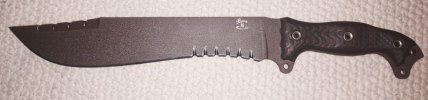
Recurve, plain or partially serrated?

Joined
Feb 24, 2015
Messages
20
It seems like there are a lot of recurves out now. Just to name a few zt0350,0200,0300, Benchmade 710, etc. Just about all of my knives are all plain edges but I am thinking about a zt0200 in partially serrated. I have a 710 now and find the recurve challenging but doable with a slip stone or the lansky serrated edge sharpeners and strop with mothers billet paste on balsa bent around the corner of the bench. Are there any benefits from having a recurve plain or serrated. If im going through the trouble of having a recurve serrations may be nice.

Also, not too familiar with the serrations on a zt but they look inverted. Is there much to sharpening these other than just facing the opposite side.
 
I have never had a problem sharpening a recurve.

If you have a need for serrations they're priceless.
 
Recurved blades, like Emerson's Commander and ZT's 0200, have a great synergy with serrations. The inside curve keeps the serrations over whatever you're cutting, pulling the material into the teeth.

Like Mark said, those who need serrations need them, they aren't for the envelope opening EDC crowd. I think that the partially serrated Emerson Commander is one of the best general emergency use folders ever devised.
 
I've move away from serrations for the most part. I keep all my knives razor sharp, so I don't really see much benefit for serrations. I do have serrated H1 blades though.

One benefit of serrations is that they always cut.
 
I've move away from serrations for the most part. I keep all my knives razor sharp, so I don't really see much benefit for serrations. I do have serrated H1 blades though.

One benefit of serrations is that they always cut.

Yeah- I love my serrated pac salt! ;)
It's the only serrated blade I have/need- and IMO spyderco does serrations best (also I'm not a spyderco fanboy- just calling it out like I see it)

As far as recurves, they are aesthetically my favorite, but provide little functionality outside of being on a larger chopper (ie. bolo).

Partially serrated- it sounds great in theory, but you end up with half of the cutting edge you need on either. Either you need a serrated blade, or you need a straight edge in a situation. If you're unsure, go with a sharp straight edge, but I would NOT recommend getting a 3-4" ttl blade that ends up being 1.5-2" of useless serrations
 
I have owned a few recurves ZT 0350, 0301, and long ago a Kershaw Storm II. The Storm was partially serrated.

I prefer plain edge, but in the end it doesn't really matter to me. They both cut stuff.
 
Partially serrated- it sounds great in theory, but you end up with half of the cutting edge you need on either. Either you need a serrated blade, or you need a straight edge in a situation. If you're unsure, go with a sharp straight edge, but I would NOT recommend getting a 3-4" ttl blade that ends up being 1.5-2" of useless serrations

This is the benefit of a partially serrated re-curve: the inward curve is perfect to keep whatever your sawing under the teeth, while the plain edged outward curve makes for easy slicing. It's like having both a serrated hawkbill and a curved plain edge knife.
 
This is the benefit of a partially serrated re-curve: the inward curve is perfect to keep whatever your sawing under the teeth, while the plain edged outward curve makes for easy slicing. It's like having both a serrated hawkbill and a curved plain edge knife.

im not saying you cant make it work, and to your point it can work better in certain designs, but at best youre talking about 1-1.5" of plain edge on the outward curve, which just isnt enough knife for most of my uses- food prep being a main use for my folders.

If im just looking to slice open packing tape and have a serrated recurve for twine- it will work perfectly for that. I guess like any question on here- "it depends on your intended use" is the answer
 
This is the benefit of a partially serrated re-curve: the inward curve is perfect to keep whatever your sawing under the teeth, while the plain edged outward curve makes for easy slicing. It's like having both a serrated hawkbill and a curved plain edge knife.

This is exactly what im thinking. The 710 is a good example where all of the entire hollow/concave curve is serrated but you still have the plain outward curve for the second half of the blade. Looks great for rope, cardboard, food prep and whatever else you can throw at it. The zt0200 on the other hand desnt have the serrations for the full hollow/concave portion (close but not quite to that tagency point) which seems like you are almost better of with a sharp plain edge.
 
I like my blades plain and strait. I have problems maintaining things so anything easier to clean and sharpen works better for me.
 
Also, not too familiar with the serrations on a zt but they look inverted. Is there much to sharpening these other than just facing the opposite side.

Sorry I missed this earlier.

Not all serrations are created equally. Some sharpen easier than others, and some cut better than others. Generally, you need a rod of the correct side to sharpen the teeth themselves, but I've only ever had to do that when something chipped or rolled dramatically inside the teeth.

I really don't like ZT's uniform serrations.

I do love Emerson's serrations, because of the flat sections between the teeth I just sharpen them like the rest of the blade. The rest of the blade is also only beveled on one side, so the whole blade is the same to sharpen, from the handle to the tip.

Chris Reeve makes the best serrations out there, with the teeth staggering up each side of the blade with long flats between teeth. You just sharpen both sides on the stone as you would a plain edge.
 
Plain or Recurve, no problem with a Lansky Turn Box or Spyderco Sharpmaker, but I dislike serrated blades - it seems like everything I need to cut they drag and catch. I suppose they are one of those things that if you need them then you really need them. Funnily enough the knife that comes closest to being the perfect serration for me is the serrated Enlan EL-01BA, Black Coated or the EL-01AB Plain.
I do keep all my knives very sharp and any serrations that need sharpening go on my Lansky Hone's Serrated set.
 
I always keep a serrated blade for cutting fibrous plant material. It just zips through that stuff!

Recurves like on a blur just really dig into material as well and also serve a good purpose!
 
Back
Top