Reprofiling in reverse

Joined
Aug 3, 2009
Messages
1,575
Hoping my title gets your attention; my question is about reprofiling a blade to a *thicker* angle, rather than a thinner one. I've got a friend/coworker's case knife that I previously set a 15 degree angle on, with a 20 degree microbevel. The steel is soft-ish and sharpens really quickly. It's also thin and gets extremely sharp. But he uses the blade hard sometimes and has given it back to me with the blade visibly rolled over in several spots.

I can take it back to 15 easily enough and put the microbevel back on it. It'll be sharp again. But I wonder if I wouldn't do a better job by putting a 20 degree bevel on the blade with a 22.5 or 25 degree microbevel.

Thinking about the geometry of this, it should be possible to do it, I'll just need to keep grinding at 20 degrees until the microbevel becomes the primary bevel. BTW, all of these angles are one side, NOT inclusive. I.E. it has a 30 degree primary bevel on it now. So it seems like this might be quite a bit of steel removal. Perhaps 1/16 of an inch along the entire blade.

Does this make sense? Am I missing anything?

Thanks for reading.

Brian.
 
Maybe a less refined edge might last longer under that kind of use - maybe stop at 400-600 grit. 30 degrees inclusive should hold up to just about any sort of EDU.
 
What Case knife is it? Case grinds their blades quite thin, to a high hollow grind (in most of them, anyway). Depending on the model, and how thick or thin the blade is, that could make a significant difference in what shape the bevel should take. If it's a thin, high hollow grind, the steel behind the edge bevel might be too thin to hold up to real hard use (the kind that rolls the edge over). I'm assuming it's a stainless blade (Case Tru-Sharp)?
 
What Case knife is it? Case grinds their blades quite thin, to a high hollow grind (in most of them, anyway). Depending on the model, and how thick or thin the blade is, that could make a significant difference in what shape the bevel should take. If it's a thin, high hollow grind, the steel behind the edge bevel might be too thin to hold up to real hard use (the kind that rolls the edge over). I'm assuming it's a stainless blade (Case Tru-Sharp)?

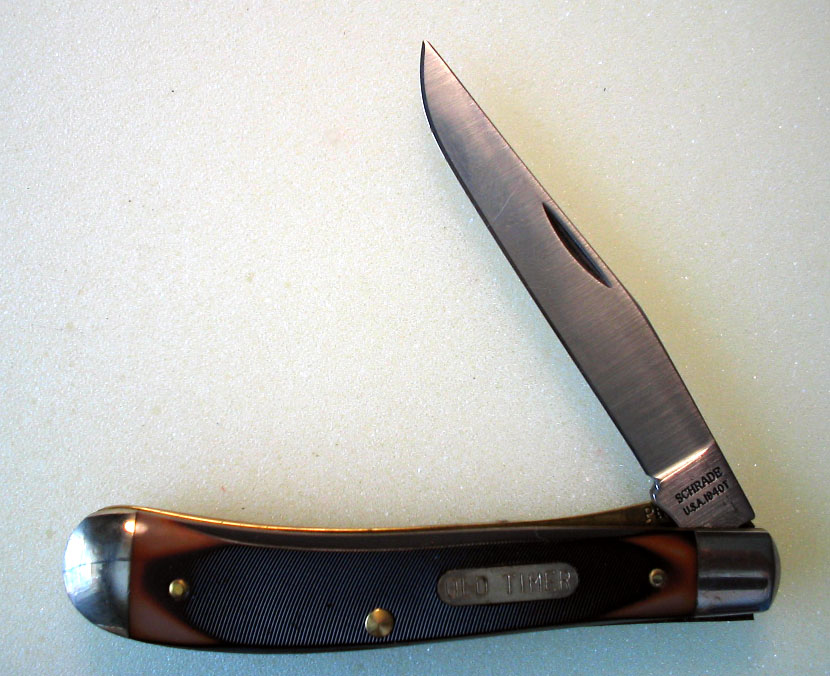
Ok, it seems my observational skills weren't exactly 100% this morning. It's a Old Timer knife, and says:

SCHRADE
U.S.A. 1940T

On the blade choil.

AFAICT it is a full flat grind, and yes it's thin enough behind the edge that it doesn't seem very durable. The owner was cutting some sort of fire proof automotive carpet or liner with it and "pressing really freaking hard".

Any suggestions on reprofiling with a bigger edge angle or something else?

Thanks,

Brian.
 
Ok, it seems my observational skills weren't exactly 100% this morning. It's a Old Timer knife, and says:

SCHRADE
U.S.A. 1940T

On the blade choil.

AFAICT it is a full flat grind, and yes it's thin enough behind the edge that it doesn't seem very durable. The owner was cutting some sort of fire proof automotive carpet or liner with it and "pressing really freaking hard".

Any suggestions on reprofiling with a bigger edge angle or something else?

Thanks,

Brian.


Ouch. I cringed when I read 'fire proof carpet or liner'. Wouldn't be surprised if there's some really tough glass fiber in that stuff, maybe in the backing for it. Carpet-cutting in general is really hard on knife edges, for the same reason. All the more so, if pressing into the floor with the blade.

194OT.jpg


The 194OT has good carbon steel in the blade (1095, I believe). Schrade's USA-made Old Timer knives had relatively thin blades with springy temper. Great slicers, but not really made for that sort of hard use. The 194OT is a single-blade 'Trapper' model, a pattern intended for hunting/fishing/game-dressing type use. I don't know that putting a thicker bevel on that thin blade would help him much, in that assigned task (carpet-cutting). It might minimize edge rolling, but the cutting would probably be harder in that tough material.

If it were me, I'd resharpen that knife as per the 'norm' for a simple pocket knife, and recommend to him that he use a dedicated carpet/utility knife for those other tasks. Heck, it'd be worth buying one for him, just to protect that Schrade. Utility & carpet blades will wear out too, but they're cheaply replaceable (for good reason).
 
This forum amazes me sometimes. I guess I gave the right info, but I never expected anyone to recognize the exact knife I was working on.

Indeed it's thin and slices and shaves really well. The owner really enjoyed slicing through the jackets of car wiring for tapping into circuits, or just smoothly removing the jacket to strip off the end. But he seems to use it for a wide variety of tasks. In the mean time I've put a fairly good edge on a 1996 Buck 110 he's got and he's been using that in the mean time. That's got a really beefy edge, though honestly I've never liked the profile. Anyway.

I'll go ahead and put the 15 degree primary and 20 degree microbevel back on it as you suggested. He claims he's going to put this knife away for a long time now, but the last time he said that he was using the knife inside of 3 weeks. We'll see. :)

Thanks for the advice.

Brian.
 
You're welcome, Brian.

I have a couple of USA Old Timers myself. Two stockman models, 8OT and 108OT, and I really like 'em. That's another reason I winced a bit, when I read what that knife had been doing. The USA models are getting harder to come by, and usually pricier, when you find one in new/good shape. Their carbon steel blades really are excellent, but all the new imported Schrades are stainless, I believe. That's why I'm hoping he'll save this particular knife for more 'worthy' use. ;)
 
Back to the original question for a moment:

Do my statements about reprofiling from a thinner edge to a thicker edge make sense? I've been wondering about this for a few years when thinking of doing edge experiments. For example, if you find that your edge is not workable at say 10 degrees per side and you need to raise it back up to 12.5 or so, you'll have to take off a lot of steel in the process, as I outlined above.

Or am I missing something?

As Unit said here, this stuff should be really simple, but for some reason the details make it FAR from simple. I like it here. :)

Brian.
 
I think it makes sense, if you want to eliminate the entire thinner bevel all at once. As an alternative, this could also be done over time. It's essentially the same thing as 'touching up' a factory edge on most knives. More often than not, most will do touch-ups at a slightly elevated angle (more obtuse) anyway. After a few sharpenings this way, it will produce two distinct bevels. The net result is the same, as the more obtuse secondary (edge) bevel eventually works all the way through the original (primary) bevel.

Even a microbevel on an otherwise thin edge will improve durability somewhat, within limits. You don't have to completely erase the older bevel immediately, unless it's appearance concerns you. Functionally, it'll still cut well enough, assuming the edge is completely apexed, of course.
 
Given the circumstances you've described, I believe that a straight 25 degree per side bevel (50 inclusive) would serve the owner quite well.

A new knife, of higher quality steel, would of course, serve him far better. Perhaps S35VN, or CPM D-2? Not overly expensive, yet considerably higher quality.:thumbup:
 
I have tried doing this several times. Instead of taking out the metal from the edge, I just leave the fraction of millimeter of old bevel at the top of the new bevel. Does this make sense to you?

It's like the bit of old bevel will be at the shoulder of the new bevel. When you polish up the new bevel, it just tends to blend in with the old bevel and won't be really obvious unless you examine closely.
 
I have tried doing this several times. Instead of taking out the metal from the edge, I just leave the fraction of millimeter of old bevel at the top of the new bevel. Does this make sense to you?

It's like the bit of old bevel will be at the shoulder of the new bevel. When you polish up the new bevel, it just tends to blend in with the old bevel and won't be really obvious unless you examine closely.

Yeah, I think you and David (OWE) are saying the same thing: You don't have to grind the entire new bevel all at once.

Thanks for the help guys. :)

Brian.
 
How deep ois the rolling? If it is goes into the 15 degree bevel, you would jus need to widen the 20 degree becel to the depth of the damage. Then resharpen at the 20/25 comination you mentioned. If hes going to put the knife away for a while it wont really make any difference unless this solution will change his mind.
 
I will have to deal with the same thing lately.
On one of my first attempts at freehand sharpening, I put a very low edge angle on a knife. But, due to poor skills, it was uneven, etc.
So now I'm going to sharpen it again to a wider angle (40° inclusive), making it even.
I know this will produce a double bevel initially, but I don't care. Time and subsequent sharpening will set the thing.
Also, I assume it's not going to be that evident, unless inspecting the blade.

:cool:
 
Back
Top