

- Joined
- Sep 14, 2006
- Messages
- 4,409
My wife and I recently had the opportunity to do a bit of camping up in southern WY, in the Medicine Bow Na'l Forest. We wanted to try to do something different in terms of sleep arrangements. My wife suggested we try hammock tents, so I did some research and decided on the Lawson Blue Ridge Camping Hammock. Cost was a big factor in choosing this particular tent.
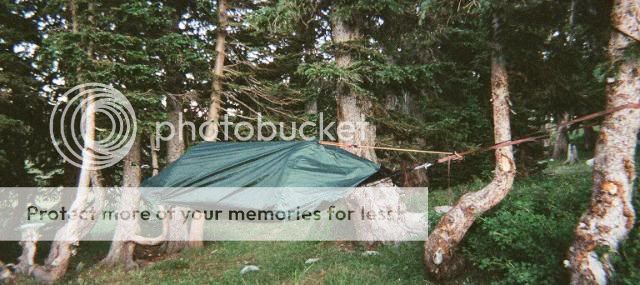

All I can say is, the things must be made for Tinkerbells.
First, the good things.
The tent is lightweight. It is relatively easy to set up. It isn't terribly expensive, we bought ours through Cabellas for about $135-140.
The tent sleeps very comfortably. I am used to getting up after a morning of sleeping on the ground feeling like I had been beaten with broom sticks all night long, sore hips, shoulders and neck.
After a night in the hammock tent, I felt great. No sore spots, no stiffness.
I was also warm enough. We slept in the tents at altitudes of about 9,000 to 10,000 feet. The nighttime temps would drop to the high thirties. We laid our backpacking mats (self inflatable) in the bottoms of the tents, after sliding them into cloth bivy sacks. We then slept in our sleeping bags, as normal, with a pillow.
I was always warm, as was my wife. So, I would rate the tents high on comfort.
It didn't rain much while we were out, so the waterproof-ness of the tents wasn't tested, but the rain flies seemed well designed. We did take along some tarps to stretch over the tents, but they weren't needed.
Now for the bad news.
The tents are supposed to be rated up to 250lbs. Now, I weigh about 220-225, so I suppose that I was pushing the system a bit, but normally, a bit of cushion is built into the design of most products, just for safety.
My wife and I set up our tents here on our property for several days before we left on our trip to get a feel for how to set them up and etc. Good thing; we discovered several design deficiencies that we had to address.
First; the tents do not come with any kind of rope attachments to secure them to trees. Evidently these have to be purchased separately, but we made our own fix. Since we were car camping rather than backpacking, we went to Home Depot and bought two sets of heavy duty cargo straps, the kind used to strap down loads to trailers. These straps can be had in various lengths and various weights. We bought four rated for 3,000 lbs load, each 20 ft. long. We felt this would give us plenty of room to fit between even widely spaced trees. This proved to be a good choice.
Next; a real weak point in the Lawson hammock design is how they attach the tent support webbing to whatever is attached to the tree. Tied into the webbing was a small loop of pretty lightweight cord. Cord, not rope. The tree attachment was to be attached to the cord, which attached to the tent itself, which supported the tent.
We duly hooked the tie down straps to this loop and put tension on the tent. Five minutes after climbing into the tent, my wife found herself on the ground; the cord had simply broken. My wife is no tinkerbell, but she weighs quite a bit less than I do.
Rather than dick around with half measures, I went back to Home Depot and bought six feet of 3/16th plastic covered steel cable, high tension. I also bought eight cable clamps.
Returning home, I cut the cheap ass cord out of the hammock rigging and replaced it with the steel cable, cut into 1 foot pieces and looped to make a ring, secured with two cable clamps each. The cable was rated for 3,000 lbs, so I figured that should be strong enough to hold me up, let alone my wife. This proved to be a fix for the problem, but someone who wants to save some weight might want to look for something else to solve this problem.
Lastly; while using the tents at home, we discovered that the zipper openings in the tents were a bit finicky. They were difficult to zip closed when we were in the tents. They seemed to catch and bog, but determined tugging and etc. could get them closed.
Fast forward to the camping trip; the tents are set up, the day is over, time for bed.
We put in our mats and bags and pillows, climb in, and get ready to zip up. We experience more problems with the zippers. They catch, stick, and refuse to cooperate. Eventually the zippers start to break and come apart behind the zipper.
Luckily, the temps usually had dropped enough to make the skeeters go dormant before we went to bed. But in warmer climes, with active bugs, this would be an unacceptable shortcoming.
We felt that the zippers were too lightweight for the purpose. The design also has the zipper coming in a right angles to the floor of the hammock, so when someone is in the hammock, the ends of the zippers are being pulled apart making it very difficult to get them started.
In all, I'd say on a scale of 1-10 with 1 being worst and 10 being best, I'd give my experience with these hammocks about a 5. Good sleep, but poor materials and construction.
I'd like to try another manufacturer, myself.
Andy
All I can say is, the things must be made for Tinkerbells.
First, the good things.
The tent is lightweight. It is relatively easy to set up. It isn't terribly expensive, we bought ours through Cabellas for about $135-140.
The tent sleeps very comfortably. I am used to getting up after a morning of sleeping on the ground feeling like I had been beaten with broom sticks all night long, sore hips, shoulders and neck.
After a night in the hammock tent, I felt great. No sore spots, no stiffness.
I was also warm enough. We slept in the tents at altitudes of about 9,000 to 10,000 feet. The nighttime temps would drop to the high thirties. We laid our backpacking mats (self inflatable) in the bottoms of the tents, after sliding them into cloth bivy sacks. We then slept in our sleeping bags, as normal, with a pillow.
I was always warm, as was my wife. So, I would rate the tents high on comfort.
It didn't rain much while we were out, so the waterproof-ness of the tents wasn't tested, but the rain flies seemed well designed. We did take along some tarps to stretch over the tents, but they weren't needed.
Now for the bad news.
The tents are supposed to be rated up to 250lbs. Now, I weigh about 220-225, so I suppose that I was pushing the system a bit, but normally, a bit of cushion is built into the design of most products, just for safety.
My wife and I set up our tents here on our property for several days before we left on our trip to get a feel for how to set them up and etc. Good thing; we discovered several design deficiencies that we had to address.
First; the tents do not come with any kind of rope attachments to secure them to trees. Evidently these have to be purchased separately, but we made our own fix. Since we were car camping rather than backpacking, we went to Home Depot and bought two sets of heavy duty cargo straps, the kind used to strap down loads to trailers. These straps can be had in various lengths and various weights. We bought four rated for 3,000 lbs load, each 20 ft. long. We felt this would give us plenty of room to fit between even widely spaced trees. This proved to be a good choice.
Next; a real weak point in the Lawson hammock design is how they attach the tent support webbing to whatever is attached to the tree. Tied into the webbing was a small loop of pretty lightweight cord. Cord, not rope. The tree attachment was to be attached to the cord, which attached to the tent itself, which supported the tent.
We duly hooked the tie down straps to this loop and put tension on the tent. Five minutes after climbing into the tent, my wife found herself on the ground; the cord had simply broken. My wife is no tinkerbell, but she weighs quite a bit less than I do.
Rather than dick around with half measures, I went back to Home Depot and bought six feet of 3/16th plastic covered steel cable, high tension. I also bought eight cable clamps.
Returning home, I cut the cheap ass cord out of the hammock rigging and replaced it with the steel cable, cut into 1 foot pieces and looped to make a ring, secured with two cable clamps each. The cable was rated for 3,000 lbs, so I figured that should be strong enough to hold me up, let alone my wife. This proved to be a fix for the problem, but someone who wants to save some weight might want to look for something else to solve this problem.
Lastly; while using the tents at home, we discovered that the zipper openings in the tents were a bit finicky. They were difficult to zip closed when we were in the tents. They seemed to catch and bog, but determined tugging and etc. could get them closed.
Fast forward to the camping trip; the tents are set up, the day is over, time for bed.
We put in our mats and bags and pillows, climb in, and get ready to zip up. We experience more problems with the zippers. They catch, stick, and refuse to cooperate. Eventually the zippers start to break and come apart behind the zipper.
Luckily, the temps usually had dropped enough to make the skeeters go dormant before we went to bed. But in warmer climes, with active bugs, this would be an unacceptable shortcoming.
We felt that the zippers were too lightweight for the purpose. The design also has the zipper coming in a right angles to the floor of the hammock, so when someone is in the hammock, the ends of the zippers are being pulled apart making it very difficult to get them started.
In all, I'd say on a scale of 1-10 with 1 being worst and 10 being best, I'd give my experience with these hammocks about a 5. Good sleep, but poor materials and construction.
I'd like to try another manufacturer, myself.
Andy


