Rockwell Hardness Tester

Joined
Jan 1, 2026
Messages
23
Hi all,
Im getting back into knife making after some years and trying to set up my shop. Ive finally obtained a proper HT oven and Grinder with a VFD and am curious about technology nowadays to measure RC. I see some cheaper options online now for measuring hardness of a blade after HT but wanted to get some opinions on the tools. I can find a “Hardness Tester” on Amazon for around $200 but it just seems way too good to be true. Id like anyones knowledgeable input on the subject. Years ago I just used RC files for the purpose if I didnt send the knife out to be professionally heat treated. Whats the situation now?

Regards,
Alex
 
I have a set of hardness chisels from dragon's breath forge and used them for a couple of years. IMO, chisels and files are tools to help you make a guess at the hardness. In theory it could work.

I ended up getting tired of guessing and bought a hardness tester from Grizzly.

As a more experienced knifemaker told me when I was first getting started, you can make knives without one but if you want to heat treat your own knives and you want to make the best knives you can, you need a hardness tester.

There's still a learning curve with the hardness tester but it's basically just making sure you've ground off any decarb and making sure the blades are flat and parallel.
 

Get one of these! Surprised they are still available honestly!

The Chisels work OK to give you a ball park and can work better on San Mai blades since you can go on the edge of the piece. I picked up a used Wilson 1JR tester with manuals, multiple anvils, indenters, test blocks, etc for under $400 on FB marketplace, so deals can be found there locally as well!
 

Get one of these! Surprised they are still available honestly!

The Chisels work OK to give you a ball park and can work better on San Mai blades since you can go on the edge of the piece. I picked up a used Wilson 1JR tester with manuals, multiple anvils, indenters, test blocks, etc for under $400 on FB marketplace, so deals can be found there locally as well!
Thanks Taz! Ill look into it.
 
I have a set of hardness chisels from dragon's breath forge and used them for a couple of years. IMO, chisels and files are tools to help you make a guess at the hardness. In theory it could work.

I ended up getting tired of guessing and bought a hardness tester from Grizzly.

As a more experienced knifemaker told me when I was first getting started, you can make knives without one but if you want to heat treat your own knives and you want to make the best knives you can, you need a hardness tester.

There's still a learning curve with the hardness tester but it's basically just making sure you've ground off any decarb and making sure the blades are flat and parallel.
He was right. I really want to be able to test my blades after HT to see what im actually ending up with.
 
My HRC tester has more than paid for itself! I got my Parks 50 too hot and the blades didn't harden properly on a few occasions, so if I had let those go out being a lot softer than they should have been, that would not have been good! Found 10 blades between 2 batches where the oil was too hot and didn't harden properly, including a bunch of Damascus blades!
 
Hi all,
Im getting back into knife making after some years and trying to set up my shop. Ive finally obtained a proper HT oven and Grinder with a VFD and am curious about technology nowadays to measure RC. I see some cheaper options online now for measuring hardness of a blade after HT but wanted to get some opinions on the tools. I can find a “Hardness Tester” on Amazon for around $200 but it just seems way too good to be true. Id like anyones knowledgeable input on the subject. Years ago I just used RC files for the purpose if I didnt send the knife out to be professionally heat treated. Whats the situation now?

Regards,
Alex
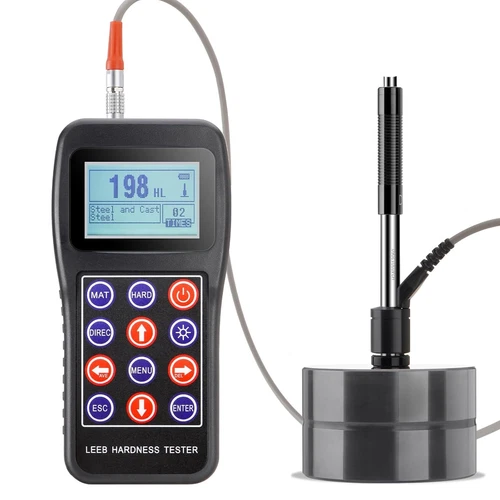
I purchased one of the LEEB testers with the "D/DC" lead for testing. ($159 USD)The books stated the material needed to be at least 5mm thick.
No problem, I have a few knives with a thick spine, including mu Buck 119 Classic. It is made of 440HC with an HRC of around 58.

s-l500.webp

These are not good for testing knives already made or forged.
If you have stock steel, it needs to be flat and placed on a flat piece of steel 10mm think or more. And pressed or clamped down.
The flat part of the blade below spines on the knives were 5mm, so with them on the testing steel block, it should have read easily.

I tried it on those blades on the flat part on of a couple of knives and only got 1 reading that was anywhere near close.
Also, these will not read HRC on stainless, so I had to do the test in Vickers HV and convert.
Most of the time, the reading ended up being in the 120 - 230 HV range, which converted to HRC 23 max.
One reading was HV 539 (54 HRC), and I got that only once. Same problems with all knives.
Most times, the unit wouldn't even read anything. I did over 20 tests with varying position and clamping of the blades.

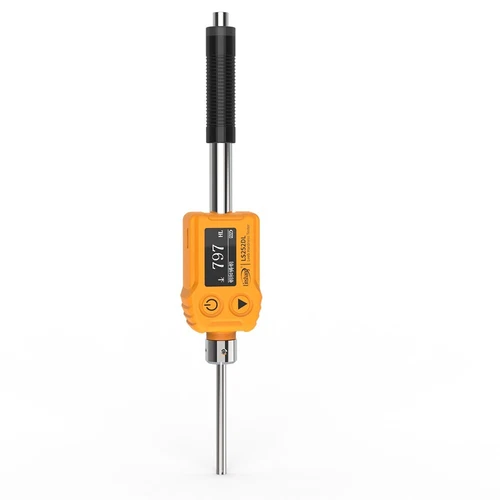
So I have ordered a tester with a "C" probe, which the seller claimed will read stainless from HRC 19 to HRC 68.
Again, it must lie atop a thicker 'base piece', but they claim as long as it is lying flat, even at an angle (so the knife blade can be held flat against the base) the unit will auto adjust to the blade. And as long as the testing material is in contact with the base, any thickness can be measured.
s-l500.webp


So I will report back once I receive it with the results (probably 2nd week of March.
 
Just my humble opinion Without an accurate RH tester your just guessing. If you think your temps on heat treating are accurate and following heat treat procedures you're just guessing on the actual RH test. There is ONLY one way to prove your heat treatment is spot on is a RH harness tester. Sadly harness files or spark testing is worthless
 
Last edited:
..................................
So I have ordered a tester with a "C" probe, which the seller claimed will read stainless from HRC 19 to HRC 68.
Again, it must lie atop a thicker 'base piece', but they claim as long as it is lying flat, even at an angle (so the knife blade can be held flat against the base) the unit will auto adjust to the blade. And as long as the testing material is in contact with the base, any thickness can be measured.
s-l500.webp


So I will report back once I receive it with the results (probably 2nd week of March.
Please do report back on how well that works. It would be GREAT if somebody could come up with a Rc tester that didn't cost so much as the HR-150 clones and not be so heavy!
 
I believe there was another member here with one of these type LEEB setups that had good results? I believe they put it on an anvil, granite reference plate or something as the base? May work on an anvil as well as the base as long as it has good contact. Interested to see the results!

I found an old Schlereoscope a while back and found a conversion chart that a previous owner had made with various steels tested, including tool and Carpenter steels and their HRC values. I had to clean it up a good bit, but never really used it; results were inconsistent testing blades I received back from heat treating and then I picked up a Wilson used for a great price on FB marketplace, so I never tried getting better with it.
 
I’d look for a used tester in good working condition I got mine for $400 and it’s rock solid. I’ve had some surprises over the years with getting mislabeled steel and the only way I caught it was because of the Rockwell tester.
 
Back
Top