I have been look for en explanation of RC values. I understand that it is a hardness test etc. What I dont know is how much hard a value is compared to another. Is 100 twice as hard as 50? How much better is harder is a knife that is say 64 over one with a RC of 60

-
The BladeForums.com 2024 Traditional Knife is available! Price is $250 ea (shipped within CONUS).
Order here: https://www.bladeforums.com/help/2024-traditional/
You are using an out of date browser. It may not display this or other websites correctly.
You should upgrade or use an alternative browser.
You should upgrade or use an alternative browser.
Rockwell Value explained
- Thread starter deruitem
- Start date
It is a logorithmic scale (I am guessing), so that an increase of 2 rc is a lot. Harder means better edge retention, but it can make a knife more brittle. I would not want 1095 at 64, since it would be a brittle steel. Very few steels will work well that hard.
RC 54 is pretty soft for knife steel, but not for a machete. RC 57-59 is typical for 1095 or 440C, and lots of 154CM is at 59 or 60.
Harder steel is fine for a pocket knife, but not for a fixed blade that is intended for rougher use.
RC 54 is pretty soft for knife steel, but not for a machete. RC 57-59 is typical for 1095 or 440C, and lots of 154CM is at 59 or 60.
Harder steel is fine for a pocket knife, but not for a fixed blade that is intended for rougher use.


- Joined
- Jul 30, 2006
- Messages
- 44,639
Howdy,I have been look for en explanation of RC values. I understand that it is a hardness test etc. What I dont know is how much hard a value is compared to another. Is 100 twice as hard as 50? How much better is harder is a knife that is say 64 over one with a RC of 60
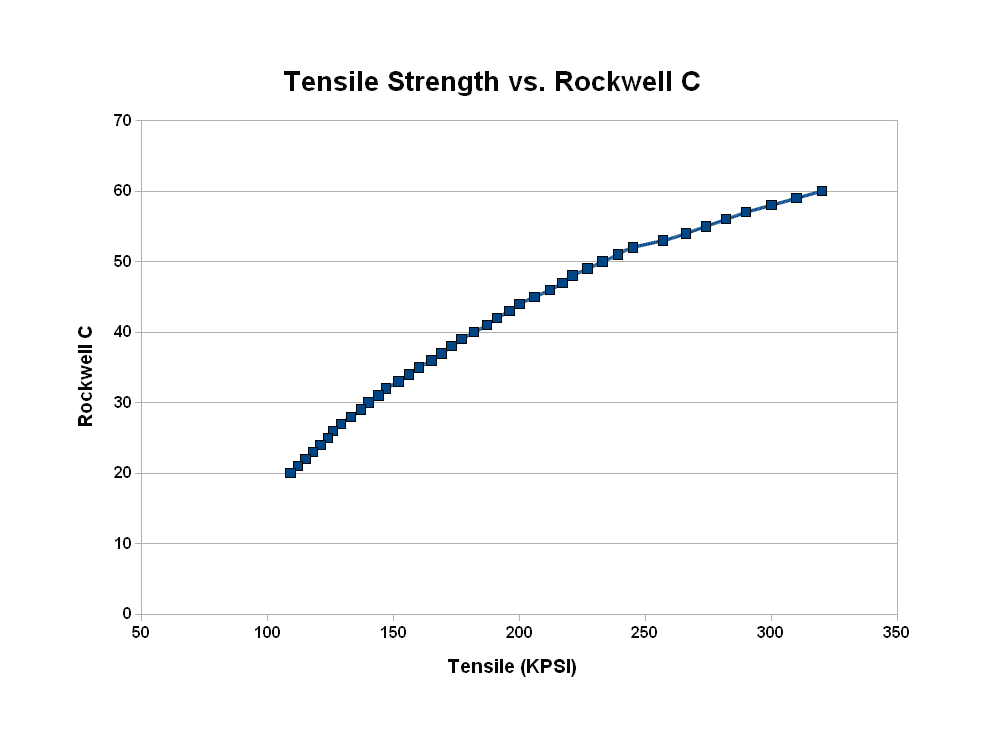
I was unable to find data for Rockwell C values above 60, but, judging by what I did find, I'd guess it is fairly linear over the range of interest. I made a plot of the data I found. I have included it below.
However, I think the chart is misleading, because I think the question is not, "how much harder is it?" I think the question is, "how much difference in edge retention does it make?" IMO these questions are related, but not really the same.
I've done a fair amount of side by side edge retention testing, cutting manila rope. While my method is not numeric, it does allow me to see differences in edge retention due solely to alloy. Based on my test results, I'd guess that you have to have about a 1.5-point real difference in Rockwell to see a difference in edge retention that would be apparent in everyday use. This assumes same alloy and edge angle. I base this on a pair of S30V blades that I tested. Their hardnesses differed by about 1.5 points, and I was just barely able to see the difference.
http://www.bladeforums.com/forums/showthread.php?t=769447
I say "real difference" because, in comparing hardness results from one test machine to those from a different machine calibrated to a different calibration standard, the measurement itself is only good to ±1. If you measure on the same machine, and have not changed the calibration, the measurement can be good to a couple of decimal places.
If I were comparing two knives from two manufacturers using measurement data provided by those manufacturers on their own machines, I think I would want to see a difference of two points before I started getting excited.
Does anyone know if glass has a Rockwell rating? For some reason I remember seeing a chart as a youngster listing glass being harder than stainless steel but I can never find the HRC value. Don't mean to threadjack, but I've Googled it a lot in the last few months, so i thought I'd take the opportunity to supplement the conversation and ask.
- Joined
- Jul 30, 2006
- Messages
- 44,639
Does anyone know if glass has a Rockwell rating? For some reason I remember seeing a chart as a youngster listing glass being harder than stainless steel but I can never find the HRC value. Don't mean to threadjack, but I've Googled it a lot in the last few months, so i thought I'd take the opportunity to supplement the conversation and ask.
Glass cannot be measured using the Rockwell method. The Rockwell method measures the amount of force needed to deform a substance by a set amount. Glass just shatters.
You can use other methods to measure hardness. And those methods can be used on both glass and steel. Steel is harder. See "Mohs scale" on wiki.
http://en.wikipedia.org/wiki/Mohs_scale_of_mineral_hardness