- Joined
- Sep 19, 2001
- Messages
- 8,968
With all the patina talk, I thought you guys might want to try something else as well. To rust blue, you need your piece of steel, sandpaper, something that will clean it, something that will corrode it, boiling water, and steel wool. I use ferric chloride, gotten at Radio Shack, because I already had it on hand for restoring damascus.
The sandpaper may not be necessary, just depends on the condition of your steel. If it needs it, sand at around 400 grit until the surface is an even condition. The bluing is not a coating, it is the actual steel, so make sure it is in good shape if you are going for looks and not just rust retardation.
Then clean it, to be free of all oils and debris. I use 91% isopropyl alcohol, again cause I already had it.
Now apply a thin coat of your rusting mechanism. There are formulations made specifically for this, but I read about someone using ferric chloride, tried it, and found it works great. All you need is something to make the steel rust.
Depending on your area, you may need to speed thing up with added heat/humidity. Here in S. Louisiana, not an issue. Anyway, you want to let it sit until you get a nice even coat of very light rust, pitting is of course a very bad thing. Just a bit of orange coating your whole piece, the time will vary with environmental conditions. My parts would be ready to boil after a single evening, a couple if things were cooler/dryer than normal.
When it is in this state, simply boil it in water. Distilled is supposed to be the best, but I use drinking water. It is clean enough to not contaminate the process with a lot of minerals like in hard water. How long to boil depends on the piece. I was doing razors, so I could do it in a glass with a beverage heater, and see the color change. I would let it go 10 to 20 minutes, not much metal or water to deal with, so not a lot of time.
When it is done, it will be very black. Dry it off, and 'card' it. Well, I don't use a carding brush, but 0000 steel wool. The black coating is like soot, and you polish it off with the steel wool. The bluing will be pretty light on the first go-round, just repeat the whole process (sans sanding ) to deepen the color. Finish off by oiling, and it shines like new money.
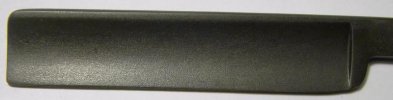
Here is a razor I practiced on. Three passes, and you can see how dark it is. The surface is in bad condition because it is old as dirt, and you can't sand down a full hollow much and have any steel left over. The corrosion took this one before I got it, but it was fun to play with.
The sandpaper may not be necessary, just depends on the condition of your steel. If it needs it, sand at around 400 grit until the surface is an even condition. The bluing is not a coating, it is the actual steel, so make sure it is in good shape if you are going for looks and not just rust retardation.
Then clean it, to be free of all oils and debris. I use 91% isopropyl alcohol, again cause I already had it.
Now apply a thin coat of your rusting mechanism. There are formulations made specifically for this, but I read about someone using ferric chloride, tried it, and found it works great. All you need is something to make the steel rust.
Depending on your area, you may need to speed thing up with added heat/humidity. Here in S. Louisiana, not an issue. Anyway, you want to let it sit until you get a nice even coat of very light rust, pitting is of course a very bad thing. Just a bit of orange coating your whole piece, the time will vary with environmental conditions. My parts would be ready to boil after a single evening, a couple if things were cooler/dryer than normal.
When it is in this state, simply boil it in water. Distilled is supposed to be the best, but I use drinking water. It is clean enough to not contaminate the process with a lot of minerals like in hard water. How long to boil depends on the piece. I was doing razors, so I could do it in a glass with a beverage heater, and see the color change. I would let it go 10 to 20 minutes, not much metal or water to deal with, so not a lot of time.
When it is done, it will be very black. Dry it off, and 'card' it. Well, I don't use a carding brush, but 0000 steel wool. The black coating is like soot, and you polish it off with the steel wool. The bluing will be pretty light on the first go-round, just repeat the whole process (sans sanding
) to deepen the color. Finish off by oiling, and it shines like new money.Here is a razor I practiced on. Three passes, and you can see how dark it is. The surface is in bad condition because it is old as dirt, and you can't sand down a full hollow much and have any steel left over. The corrosion took this one before I got it, but it was fun to play with.