Rust or patina?

Joined
Jan 19, 2010
Messages
2,312
The other day I cut up some sausage with my new Izula. I thought I had wiped the blade dry when I put it back in the sheath, but apparently there was some left over because when I took it out of the sheath again ( literally like 15 minutes later ) there were rust spots on the edge and little streaks of water across the blade. Didn't expect it to rust that fast.

I scrubbed most of it off with a Q-Tip and some Benchmade BlueLube Cleanser, but I don't have any WD-40 or Barkeeper's Friend around. In any case, it's barely noticeable now except as little brown stains that look like patina.

Did I even have it go long enough to get the really bad stubborn rust? This stuff pretty much rubbed off with the abrasive of the Q-Tip and a little solvent, but since there's the little stains left, I wonder if they'll rust over again easily?

Also, I was thinking of buying something like a Tuf Glide pen applicator to tape to the bottom of my Izula sheath so I could oil and wipe it off with each use, but from reading the product description it says it doesn't wash off? is it safe to use for food? That's generally the situation I've found myself using it for the most in lately, and I don't want to worry about what would happen if I forgot to dry it off completely and put it back in its sheath for a whole night versus the 15 minutes I forgot.
 
Just the edge? Do you have a strop?

Tuf Glide is not food safe if not dried, though I've ignored that :foot: Mineral oil from the drugstore could work for you.
 
I Tuf-Glide (well, Marine Tuf-Cloth) all my outdoor blades, and have been doing so for years. I use many of them for food and have never had any problems. I wouldn't chew on the cloth though..


Stitchawl
 
Last edited:
Just the edge? Do you have a strop?

Tuf Glide is not food safe if not dried, though I've ignored that :foot: Mineral oil from the drugstore could work for you.

Yeah, I've stropped it for a while too, but I've mostly just got it down to a level where the metal where the rust was is just slightly darker. There's also one area of the recurve that I didn't touch up when I redid the bevels of mine, so it's kind of in an area the strop won't touch on the face of the bevel. If that make sense...

Anyway, I haven't really had a lot of experience with carbon blades, at least not for EDC use. Most of the time I just use them a little bit, reoil them and put them up and it's fine. For actual EDC use, oiling it every time I use it isn't really convenient because it's kind of hard to keep oil on-hand everywhere.

Also, is 76% humidity high for carbon steel knives? I never really figured where I live had a high humidity level because it's basically an irrigated desert, but apparently the annual average is about 76%. Currently it's at about 85%.
 
Sausage generally has a lot of sodium (salt) content, which is very corrosive on metal, so that's probably why you saw such a rapid development of corrosion. Be careful of what lubricant you're putting on your blade if you plan on using that knife for more food prep. While it may not make you sick immediately, the long term effects may not be pleasant. A wipedown with a vegetable or cooking oil impregnated cloth would be a much safer alternative to whatever lubricant is in Tuff Glide or other lubricant products.
 
Patina can set in pretty fast...if you stick a 1095 made knife in warm vinegar, you can see it turn dark immedietly.....rust takes much longer.....I would call your condition patina......
 
Sausage generally has a lot of sodium (salt) content, which is very corrosive on metal, so that's probably why you saw such a rapid development of corrosion. Be careful of what lubricant you're putting on your blade if you plan on using that knife for more food prep. While it may not make you sick immediately, the long term effects may not be pleasant. A wipedown with a vegetable or cooking oil impregnated cloth would be a much safer alternative to whatever lubricant is in Tuff Glide or other lubricant products.

The salt in the sausage was the first 'culprit' I thought of too. Moisture alone is one thing, but the salt will accelerate rust in a big way. Whichever lube or treatment you wipe the blade with is up to you. If it were me, I'd first make sure that all of the salt is off the blade first. I've long been in the habit of wiping down my blades used for food with a paper towel moistened with some Windex or dish soap & water, if I don't otherwise completely wash and dry the blade. It's been working great for me in cleaning food oils, finger oils and salts off of the blade.
 
Yeah, I've stropped it for a while too, but I've mostly just got it down to a level where the metal where the rust was is just slightly darker. There's also one area of the recurve that I didn't touch up when I redid the bevels of mine, so it's kind of in an area the strop won't touch on the face of the bevel. If that make sense...

Anyway, I haven't really had a lot of experience with carbon blades, at least not for EDC use. Most of the time I just use them a little bit, reoil them and put them up and it's fine. For actual EDC use, oiling it every time I use it isn't really convenient because it's kind of hard to keep oil on-hand everywhere.

Also, is 76% humidity high for carbon steel knives? I never really figured where I live had a high humidity level because it's basically an irrigated desert, but apparently the annual average is about 76%. Currently it's at about 85%.

It sounds like rust. It's not out of the realm of possibility that because it happened in so little time that it isn't corrosion, I would think that for it to be a patina you would need something with more acidic value - like an apple. On humidity, I'm in Washington near the Puget Sound right now, the humidity is well above 50% and it's been raining almost everyday, as long as I keep my knife oiled I haven't had any issues. In a pinch I'll use olive oil, but typically I use a more viscous clove oil.

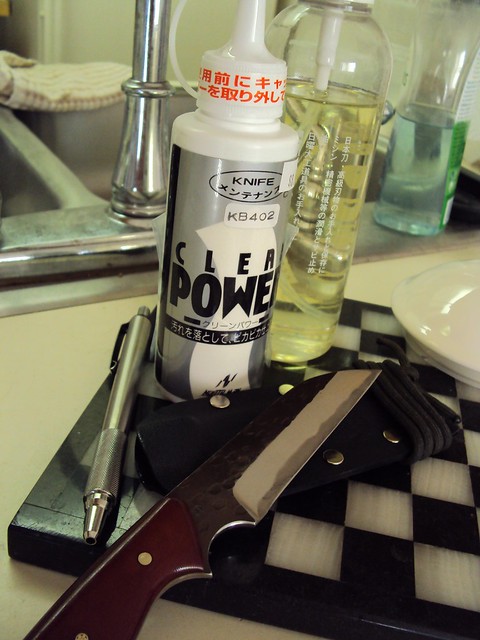
What you should do for next time is go to your local chef shop, they should have something called Clean Power, it comes from Japan and it's used specifically for carbon steel knives. I had a lot of rust on my Carter from an ice tea spill, just two applications of the clay like liquid and rubbing it in with a paper towel and the rust was gone. It'll take your edge and remove the patina (if you have one on your knife) but also the rust as well.

4604882129_a630209b25_z.jpg


I thought the Izula was a drop point, where does it have a recurve? Did you mean the belly?
 
To each his own, but I just prefer to let the patina exist. Keeping it mirror like is okay, but takes work. And then you have to worry about rust. A nice patina helps prevent the bad rust. Then again, your just talking about the edge of a coated knife.
 
It sounds like rust. It's not out of the realm of possibility that because it happened in so little time that it isn't corrosion, I would think that for it to be a patina you would need something with more acidic value - like an apple. On humidity, I'm in Washington near the Puget Sound right now, the humidity is well above 50% and it's been raining almost everyday, as long as I keep my knife oiled I haven't had any issues. In a pinch I'll use olive oil, but typically I use a more viscous clove oil.

What you should do for next time is go to your local chef shop, they should have something called Clean Power, it comes from Japan and it's used specifically for carbon steel knives. I had a lot of rust on my Carter from an ice tea spill, just two applications of the clay like liquid and rubbing it in with a paper towel and the rust was gone. It'll take your edge and remove the patina (if you have one on your knife) but also the rust as well.

4604882129_a630209b25_z.jpg


I thought the Izula was a drop point, where does it have a recurve? Did you mean the belly?

Recurve might not be the best word, but I mean this curved section at the butt of the blade. I marked it in red here on a knife I found on Google. I don't have a good camera to take a picture of my own.

izularecurve.jpg


After I reprofiled the bevel (I kept the same edge angles as the factory grinds ) I noticed that I couldn't touch the entire edge bevel at this portion of the blade, I'm assuming because or the recurve, but it might just be that this part was ground at a lower angle than the rest of the knife since I did actually get an edge on there, it's just right above where I ground my new edge there's the original factory finish on the part of the bevel I could not hit.

That was a mouthful... Anyway, it wound up rusting on one of these spots that my stone couldn't touch up, and so now the strop won't touch it either. I suppose I could go and grind on the bevels again until the entire factory edge face is ground out, but that would make my edge bevels pretty wide. I wish I had a good camera to show what was up with mine...

Anyway, I think that what's left is probably some patina that formed from the sausage being on there. It would make sense too considering the rust I found rubbed off so easily (I've experienced that while forcing a patina) and it wasn't totally red, but more of a reddish/brown.

Either way I haven't been developing more rust so far, and the spots I do have haven't been getting worse so I think it will be okay as long as I pay more attention to getting the knife completely dry and wiped before sheathing it.

My big concern is if it is rust, and I can't get it out, will it "grow"?
 
Back
Top