
S30V in Various Knives

Joined
Sep 5, 2005
Messages
2,826
Many knives considered the "best" use S30V and reports on this steel's superiority is becoming widespread. But do all knives that sport S30V blades have similar properties when blade styles are similar? For example, a Sebenza uses S30V in a titanium frame lock. Other knives in the same price range also sport S30V or other high end steels, and though many are delighted with the cutting performance of their knives, what sort of differences can one expect in blades of varying cost?

I recently purchased my second Spyderco Native. It's a great knife, very comfortable and easy to use and to sharpen. I also have an Alaskan Buck with an S30V blade. Both knives are significantly more inexpensive than the higher end knives like the Sebenzas. So is the S30V in the Sebenzas substantially better than the same steel in other knives? Are they treated to higher Rockwell hardnesses or are they more durable?

One thing I noticed with my Natives is that neither came out of the box as sharp as my Cold Steel Voyagers. Sure they would shave, but my Voyagers would take far more hair off my arm than the Natives or the Buck. Perhaps it's the way they come from the factory, but I tend to like razor sharp knives, and I was disappointed to find that they weren't a bit sharper. I know the Bucks are intended more for hunting and outdoors use, where a shaving edge probably isn't optimal; however, the Natives should have been as breathtakingly sharp as my Voyagers.

Is S30V known for taking wicked sharp edges? People who own Sebenzas report that their knives are razor sharp. So is it the sharpening or does S30V come in varying treatments based on the cost and size of a knife?

If there are any weaknesses in an S30V blade, what would they be?
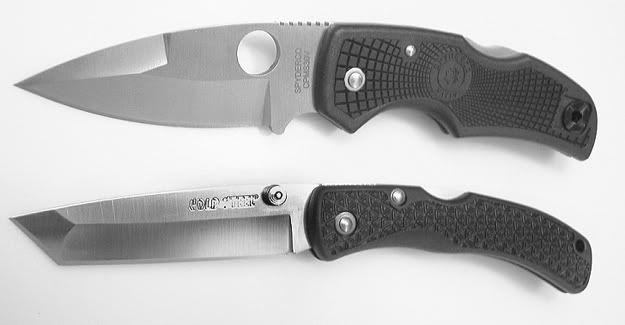

NativeandVoyager_Sm.jpg


Out of the box, the Voyager, with an AUS8 blade, was sharper than
two Spyderco Natives. Can S30V blades take razor sharp edges?


.
 
I have a BM 610 rukus in S30v. It came truly "razor sharp" from the factory. It also cost twice, or more than twice, what the comparable Buck cost.

A Chevrolet and a Cadillac are made from the same steel. But the similarity ends there. You simply can't excpect a Spyderco, or Buck to have the same quality as Chris Reeve. That isn't a criticism of Spyderco or Buck, that's simply reality.
 
Well, a Chris Reeve has a smaller, thinner blade. My Cold Steel has plain ol' AUS8. Buck is known for its steel quality, or at least the heat treat, and it's primarily a hunter/outdoor knife, which means a working edge goes much further than a razor edge. If I were going out camping, I wouldn't want my primary knives to have razor edges; however, if I'm to have a pocket knife, I do want it sharp as a razor.

I reckon the question I'm asking is, if I sharpen my Native to shaving sharpness, will I have any problems? Does its edge retention hold with razor edges? Also, does a small Sebenza, for example, have a harder S30V blade than more inexpensive knives with S30V blades? I've heard one fellow complain of edge rolling, but that might be a problem with a particular knife and not representative of all.

With blade dimensions being identical, can an S30V blade take as much of an edge as, say, a good AUS8? The former's edge holding superiority cannot be questioned, but initial sharpness is what I'm most interested in at the moment.
 
I have two knives with blades made of S30V, a Spyderco Manix and a Native.

The Manix came "scary sharp" out of the box. The Native out of the box was sharp, but not as sharp as the Manix. Different blade grind angle? Maybe.

However a few passes of the Native on my Sharpmaker quickly fixed that. Both will “pop hair” now.

I have also found that both tend to keep an edge, even with heavy use. (Cutting wire, wood, cardboard, paper, kitchen tasks and occasionally skinning small game.)

I only have two knives with AUS8 blades, a tanto CS Recon 1 that was given to me and a CRKT M16-13T that I bought new. Neither were as sharp new as my Spydercos, nor can I seem to get them as sharp. This is not a concern to me, as I only carried the M-16 for about 6 months, and I've never carried the Recon 1. (I like my Manix better.) When I carried it, I found that the CRKT M16's blade also tended to rust. Outside of the "tactical" considerations, maybe that is why the Recon's blade is painted black?

I've not found rust to be a problem with S30V. (or VG-10 for that matter….)

Your question - "does a small Sebenza, for example, have a harder S30V blade than more inexpensive knives with S30V blades?" - is a good one. I would think it would greatly depend on the heat treatment of the steel. I see that Chuck Buck posted a link to the RC hardness of S30V blades made by various makers - "Sebenza 58-59 RC"

Now I don't have a Sebenza to check this, but I do have my Manix and Native, and I have access to a Rockwell Hardness Tester at work. I think I'll check the hardness of Spyderco's S30V steel. For that matter, I think I'll check CS’s and CRKT’s AUS8 blades as well.


TR Graham
The Glocksmith
 
Last edited:
Is S30V known for taking wicked sharp edges? People who own Sebenzas report that their knives are razor sharp. So is it the sharpening or does S30V come in varying treatments based on the cost and size of a knife?

If there are any weaknesses in an S30V blade, what would they be?

Can S30V blades take razor sharp edges?


Every bladesteel will have variances in heat treatment, even within the same company and knife model. Some users here have reported chipping with S30V in their Natives while I've batoned with my reprofiled UKPK and sustained no damage to the blade.

It is more expensive than other steels, it is not as tough as other steels, it takes longer to sharpen than other steels.

Yes. http://youtube.com/watch?v=ryfslOiA9eY

http://www.bladeforums.com/forums/showpost.php?p=5707570&postcount=93


Well, a Chris Reeve has a smaller, thinner blade. My Cold Steel has plain ol' AUS8. Buck is known for its steel quality, or at least the heat treat, and it's primarily a hunter/outdoor knife, which means a working edge goes much further than a razor edge. If I were going out camping, I wouldn't want my primary knives to have razor edges; however, if I'm to have a pocket knife, I do want it sharp as a razor.

Why? In what specific knife use is a less than razor sharp edge going to out perform a razor sharp edge? Could you elaborate on the statement I bolded, is does not make sense to me.

I reckon the question I'm asking is, if I sharpen my Native to shaving sharpness, will I have any problems? Does its edge retention hold with razor edges? Also, does a small Sebenza, for example, have a harder S30V blade than more inexpensive knives with S30V blades? I've heard one fellow complain of edge rolling, but that might be a problem with a particular knife and not representative of all.

What does sharpness have to do with the ability to retain an edge? Any knife made out of quality steel that holds an edge should hold it regardless of how well it is sharpened.

S30V seems to have a spotty track record, but many members including myself have had no negative experiences with it. I have no idea what others are doing to damage their S30V, or if it was a case of bad HT, but I have been happy with using it over the years.

With blade dimensions being identical, can an S30V blade take as much of an edge as, say, a good AUS8? The former's edge holding superiority cannot be questioned, but initial sharpness is what I'm most interested in at the moment.

I've never had issues getting my S30V knives sharp compared to my AUS8 knives. The lower grindability means you'll have to hold that consistent angle for more strokes, which can increase the difficulty of sharpening S30V to a good edge. Really though it shouldn't give anyone problems. I can get hair popping sharp without even trying on my Para and UKPK.

What I don't like about AUS8 is it usually feels soft to me when sharpening. I get large burrs that flop back and forth a lot. So for me, despite the low grindability of S30V, I could for example put a hair whittling sharp edge on my UKPK quicker than my Spyderco Salsa, because working with S30V I don't have to deal with a persistent burr that takes a lot of work to eliminate completely.
 
The whole idea of the high-end steels is that, it can be "tempered" to a hardness that will hold an "edge" longer than a softer one.
It aint rocket-science.
 
Holding an edge is due to the carbides .With 4 % vanadium in S30V those vanadium carbides give high wear resistance.
 
... I recently purchased my second Spyderco Native. It's a great knife, very comfortable and easy to use and to sharpen. I also have an Alaskan Buck with an S30V blade. Both knives are significantly more inexpensive than the higher end knives like the Sebenzas. So is the S30V in the Sebenzas substantially better than the same steel in other knives? Are they treated to higher Rockwell hardnesses or are they more durable? ...

Spyderco has an excellent reputation for it’s implementation CPM-S30V. It is unlikely that another company makes better use of this steel. I own only a few folders with this steel, but I have discussed this with a friend who has far more knives with S30V (including two by Chris Reeve). In my opinion the steel in a Sebenza is not better.

With Spyderco the out of the box sharpness has been hit and miss for me. I never bought a Spyderco with a bad or dull edge, but some of the knives were not as sharp as expected.

Some might argue that a simple touch up on the Sharpmaker will cure this, but I like out of the box shaving sharpness. :-)

On a similar note: some of my Spyderco knifes needed cleaning and breaking in of the lock for smooth action.

Rafael
 
I have never had a bad experience with S30V in the Spyderco or Bucks I have bought, excluding sharpening, of course. I did see a CR Sebenza so bladed that looked different - and I don't believe it was the lighting. The edge looked more shiney - I couldn't see the fine-grind marks. Of course, I was looking through a display cabinet atop a display cabinet, not directly through my trusted 8X loupe. Still, with the attention to detail on the rest of the Sebenza that is so apparent, it would seem reasonable to expect a finer ground/polished edge. I'm betting that their HT is similar to Buck's - and, probably, Spyderco - leaving it no harder than 59 Rc. Their thinner profile - and polished edge - help.

It seems that the extreme hardness may be where the chipped edge reports came from. My extremely abused Native showed no chipping from it's first year of tough use and EDC. I admit to tiring of sharpening it with the Sharpmaker before it became a hair-popper, but it still is an excellent cardboard crate/box reducer (I know, that's what box-cutters are for!). I guess the old basic Buck 420HC, like a $25 110 comes with, still spoils me - initial sharpness, edge retention, and ease of resharpening all being excellent. Still, I am impressed with what S30V I've tried. Too bad Wally World dropped the Spydie Native - great bargain in S30V (<$40).

Stainz
 
The whole idea of the high-end steels is that, it can be "tempered" to a hardness that will hold an "edge" longer than a softer one.
It aint rocket-science.

...But I demand my high-end steels hold an edge for twice as long as anything else available, AND sharpen more easily that 420J2! :rolleyes:
 
knives look good I just don't like stainless steels. Give me carbon the more the better . hadori
 
The Sebenzas that I used (one re-heat treated to 60.5 RC due to the original owner's dislike of the edge qualities of the knife, I think it was 57 RC from the factory) haven't been overly impressive in their ability to take or hold a fine edge compared to some of my other knives. Yes, they got sharp to the point of whittling hair, but my Manix (tested at 58 RC) got sharper with less burring. The Manix always seemed a stone ahead in sharpness (at Spyderco medium it could push cut better than the Sebbie at Spyderco fine), and I believe that extra sharpness is what let it hold it's edge longer in side by side cardboard cutting. Maybe the samples of the Sebbies I tried weren't up to the usual standards, but that was my experience. My Native (also tested to 58 RC) initially chipped, but has had no problems since. The edge was probably a bit overheated when it was sharpened at the factory, as after a few sharpenings the chipping stopped. It was reground by Tom Krein and is now an excellent cutter. Anyway, I think S30V is a decent steel, but I actually prefer CPM D2 and VG-10 to it for my EDC knives.

As for out of the box sharpness, it really isn't a good way to judge a knife. They are all sharpened by hand, and some will be sharper than others. Just because the knife has a good or bad factory edge doesn't mean the steel is good or bad, it just depends on if the person that sharpened it did a good job or not. One of the first things I do is rebevel and resharpen any new knife I get so I can put on an edge that I like. That said, Spyderco has been consistently very sharp out of the box for me, though I have had a couple that weren't overly sharp. Most of my Spydercos have been excellent push cutters while still having a toothy edge. Only my regrinds and my Ultimate Caper from Tom Krein have come sharper from the "factory" than Spyderco, as Tom can put truly astounding edges on with his 120 grit belt. Tree topping with ease and huge teeth for slicing are what make Tom Krein's edges so legendary.

Mike
 
As for out of the box sharpness, it really isn't a good way to judge a knife. They are all sharpened by hand, and some will be sharper than others. Just because the knife has a good or bad factory edge doesn't mean the steel is good or bad, it just depends on if the person that sharpened it did a good job or not. One of the first things I do is rebevel and resharpen any new knife I get so I can put on an edge that I like.

Mike

That should be a sticky for all newbies to read.
 
And let's not forget the importance of heat treat! Some do it better than others, and THAT makes a big differnce.
 
Well, a Chris Reeve has a smaller, thinner blade. My Cold Steel has plain ol' AUS8. Buck is known for its steel quality, or at least the heat treat, and it's primarily a hunter/outdoor knife, which means a working edge goes much further than a razor edge. If I were going out camping, I wouldn't want my primary knives to have razor edges; however, if I'm to have a pocket knife, I do want it sharp as a razor.
:confused:
:confused:
the sharper the better i'd say
 
hell i even want my kukri and axe to be as sharp as possible, and i dont even cut with them

i use them to hack stuff
 
Back
Top