salient features of yatagans

Joined
Mar 27, 2026
Messages
8
hello sword experts. i have a question i was hoping someone may be able to answer. I'm reading a text written around 1600 in which a person is compared to a yatagan, and i can't tell from context what that is supposed to imply about his character. i read somewhere that yatagans are notoriously hard to defend against because the curved blade makes it look like it's moving in opposite directions at the same time, and that would make sense because the character can talk his way out of anything, but is that really something yatagans are known for? is there another feature you'd consider more salient? the text was written by an Englishman who had visited Constantinople and had most likely seen a yatagan in action, if that matters.

thanks!
 
I think the statement is the 15th century version of todays social media. Anyone can state their opinion as a fact.

The curvature of a yatagan tip is to deliver increased force in cutting by making the impact spot smaller.
References to a yatagan being "silent" is referring to the intended use of the sword. It is for slashing and thrusting, and not made to bang together as long swords were often used in battle.
 
if someone described you as a yatagan, what would you think they were implying about your character?
 
The yatagan:
1) has a forward aligned thrusting point
2) can effectively slash cut
3) when used as a bayonet, drops the blade away from the barrel, making it easier to reload your muzzle loader.

N2s
 
I am no expert but just from the form of the blade you can tell a few things: 1) it’s light, it’s not like a kopis, it’s a stabber and more of a light sword, 2) making a thin curved blade that is strong would not be an ordinary thing to produce—it’s associated with elite troops (later) and a very early version is made for a court 16th C court member, it reminds me a bit of how courtly sidearms in Europe went from Rapiers to light swords, 3) if it’s courtly you’re talking about a European writer describing a foreigner (in several senses) for a European audience so I would guess it’s unlikely to be free of whatever cliches of Ottomans were prevalent at the time. I would follow what other books were available and popular at the time to find what was being thought about the Ottomans by reading members if European society.

If this character speaks his way out of things, were talking about cunning and subterfuge. Again, this is not an area I’m widely read up on, but I think the general untrustworthiness of Ottomans is fairly pronounced in lit of this time. You’re talking about foreign invaders to parts of “Europe” after all. I think they started occupation of Budapest in the mid-16th, which is kind of making a stab at “central” Europe rather than “eastern” Europe. It wouldn’t surprise me at all if this context informed the characterization of a member of that empire.

I don’t know, this is just off the top of my head. It’s interesting that this style persisted among members of the court for so long. I can see examples starting as early as 1520-1566 and going up to the early 19th Century. That’s a 300ish year stretch. They must have been popular and formalized.
 
there are no actual ottomans involved, only englishmen and women. calling this englishman a yatagan is meant to imply something about him or his style of rhetorical combat, and I'm sure it's an aspect of the sword itself that's being referenced, not ottoman people. i don't think there's any broader political context.

i guess it could be as simple as "his tongue is sharp," but there are plenty of sharp things in England so i suspect yatagans have some special characteristic that makes it an insightful comparison. i just don't have any idea what it could be.
 
there are no actual ottomans involved, only englishmen and women. calling this englishman a yatagan is meant to imply something about him or his style of rhetorical combat, and I'm sure it's an aspect of the sword itself that's being referenced, not ottoman people. i don't think there's any broader political context.

i guess it could be as simple as "his tongue is sharp," but there are plenty of sharp things in England so i suspect yatagans have some special characteristic that makes it an insightful comparison. i just don't have any idea what it could be.
You’re talking about a 1600 characterization of an Englishmen by comparing him to a weapon of the Ottoman court, a foreign court, expanding towards its zenith by invading parts of Europe. The writer knew something about all this, otherwise he would not compare one of his characters to a yatagan. This is probably not an innocent comparison to make.
 
dude i appreciate the help but I know my source, and I'm telling you the allusion is to some aspect of the sword that makes it particularly formidable and nothing more.
 
My wife owns one, a cheapie but the steel has proved to be good, one of the APOC swords and I own one of their cutlasses, so I can say a few things about it.
Despite a nice distal taper, it is still very front heavy though it's not very long. It seems to be made for chopping to an extent but I can see the value of slashing as well. To be honest it almost looks like a slightly curved machete overall, and works amazingly well as such. But it's balance is not good, swinging feels strong and deadly, but clumsy, it's difficult to recover and even more difficult to stop a swing once started, it's not for quick work and the single-hand grip means you can't get both hands on it or even hand-and-a-half. Heckuva brush/limb cutter though.

Contrast that with my cutlass which is extremely well-balanced and swings almost effortlessly and has a longer grip, if I was going to be in a fight I would much rather have it.

So I don't know what that says about in person in that context, maybe sharp and deadly, but clumsy and a bit brutish/unsophisticated, more axe and less scalpel.
 
dude i appreciate the help but I know my source, and I'm telling you the allusion is to some aspect of the sword that makes it particularly formidable and nothing more.
Welcome aboard. Post your source. :) I don't speak the area languages but it makes sense to me. Common terms as adjectives, seen in many languages.

SNM2YFi.jpeg

1800ish, Turkish Walrus


Cheers
GC
 
dude i appreciate the help but I know my source, and I'm telling you the allusion is to some aspect of the sword that makes it particularly formidable and nothing more.
Putting aside the lit crit aspect of exoticness, which literally has piles upon piles of books and papers written about it, I’ll just say that the first appearance of yatakan in English is 1819. You’re likely using a much later translation of a 1600 work.

Also, we have two of these swords on display at my work. I remember them decently well—I saw them a few weeks ago but I thought they were just variants of scimitar. I could send you pictures on Monday. The older you go, the more Ottoman and knife-like they get. As they get newer the style elongates as it’s carried north- and westward into the balkans. By the 19th century they are actually associated with the balkans despite being a longstanding Ottoman weapon.
 
It's not a translation, it's written in English by an Englishman who had visited Constantinople and I'm sure had seen one in action and wasn't just regurgitating orientalist stereotypes. He spells it yatagan or yataghan in different places, and it's a manuscript from a private collection so it's never been published and I guess it beats that 1819 reference by a few hundred years. I'm positive it was written between 1590 and 1600, the author was dead by 1620.

so they were shorter and more knife-like than sword-like around 1600? were they known for being hard to defend against for any particular reason? were they curvier, more S-shaped? the context is basically that getting into an argument with this guy is like being attacked with a yatagan. it could just be as simple as "he's sharp and nasty" but I feel like there's something more specific about his style of argumentation being implied.
 
It's not a translation, it's written in English by an Englishman who had visited Constantinople and I'm sure had seen one in action and wasn't just regurgitating orientalist stereotypes. He spells it yatagan or yataghan in different places, and it's a manuscript from a private collection so it's never been published and I guess it beats that 1819 reference by a few hundred years. I'm positive it was written between 1590 and 1600, the author was dead by 1620.

so they were shorter and more knife-like than sword-like around 1600? were they known for being hard to defend against for any particular reason? were they curvier, more S-shaped? the context is basically that getting into an argument with this guy is like being attacked with a yatagan. it could just be as simple as "he's sharp and nasty" but I feel like there's something more specific about his style of argumentation being implied.
Can you share the title and author?
 
It's just a series of private letters by no one of importance, not anything meant for publication. His wife called him a yatagan when they were fighting and I don't think she meant it as a compliment, but he seemed to embrace it as a nickname so whatever she was implying seemed to mesh with his self-image, which is why I think it's something more nuanced and personal than "sharp and from Asia Minor"

I'm hoping the thing about it looking like it's moving in opposite directions at the same time might be true because he was fascinated with paradox. That's exactly the kind of thing that would flatter him, even if it was said by his wife as she was walking out the door.
 
It's not a translation, it's written in English by an Englishman who had visited Constantinople and I'm sure had seen one in action and wasn't just regurgitating orientalist stereotypes. He spells it yatagan or yataghan in different places, and it's a manuscript from a private collection so it's never been published and I guess it beats that 1819 reference by a few hundred years. I'm positive it was written between 1590 and 1600, the author was dead by 1620.

so they were shorter and more knife-like than sword-like around 1600? were they known for being hard to defend against for any particular reason? were they curvier, more S-shaped? the context is basically that getting into an argument with this guy is like being attacked with a yatagan. it could just be as simple as "he's sharp and nasty" but I feel like there's something more specific about his style of argumentation being implied.

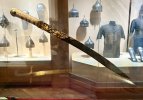
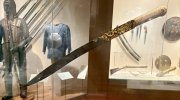
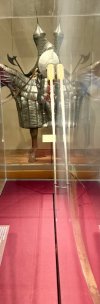
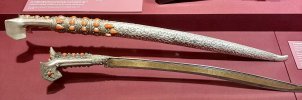
Sorry for the delay. I just finished looking over the ones on display and reviewing the database of the non-display ones. Prominent features: 1) single-edged double recurve, 2) Older ones are 18-ish inches; newer ones go up to 24 inches. Still very short, considering. 3) All had a strong distal taper starting at around the midway point of the blade. Thicknesses by the guard were as high as 1/4" and as low as 5/32", tapers are to about 1/8". 4) Older versions have a smaller knob at the pommel, later versions highly accentuate the pommel into a broad winged shape. Later versions we have (ie 1802-1822) are clearly more ornamental with these wings but all our yatagans have something to stop the hand from slipping out during swings. 5) Association with courts, higher-end retainers, and higher-quality troops, probably cavalry, start very early in the 16th century Ottoman near east. Overtime this becomes a more commonly seen weapon, and therefore the more exagerated its defining features become, as the Ottoman influence expands into the balkans.

So what to make of all these facts. I am thinking that this is a thin, fast, sharp, and very nasty weapon for anyone not sufficiently armored. The pommel is going to secure your hand during the very fast swings you will be doing--fast because the blade is so short and light. It's sharp because of the distal taper, thin grind, and recurve that will all concentrate your high speed into as thin an edge as possible. In terms of fighting, we're talking about a very scary sidearm for the sorts of undefended people encountering these around the better-off men who would carry them. On a battlefield there would be numerous more deadly weapons with longer reach--pikes, ranged weapons, guns, that sort of thing. But in a more settled area like I am thinking it is not so different from an edo-era samurai carrying a katana. You could actually carry this around a city. It's not very large. Even not being very large, it's going to be a larger and more dedicated weapon than anyone else is going to have. So there's some interplay here between where it's likely to show up, ie a court, a city, a sidearm on cavalry, and it's actualy killing power.

The speed thing and the recurve is interesting. I do not know how one would fight with this except to say that the pommel design is obviously for cutting. One thing I can tell you for certain is that a recurve is going to appear a bit strange to a defender because the striking tip is slightly ahead of the body of the blade. You could feasibly rotate to turn the blade to hit slightly differently on the wrist than it looks like it might (during a parry, the blade will slide down and the recurve will bite past the defending guard onto the wrist) but I wouldn't go so far as to so this is likely because the recurve is not so pronounced that it's an obvious strategy. So I don't know. It's probably more about the elite who would have this weapon and the training they would have vs the more common people and soldiers. One thing that is up in the air for me is the role of thrusting. The handles are quite straight, which is interesting because that allows for easier thrusting, as does the recurve. Modern fencers put a curve in their blades to facilitate the sort of dropping in shot that comes with turning the point towards a target during a lunge. But are these stabbers? They might be, because they are short and that makes stabbing quite a bit easier. But they seem to be primarily for slashing because of the pommel design.

These are just my random thoughts. As I said, I am no expert. I took pictures of the two we had on display, which, lucikily, included what I think is the most wonderful and oldest example we have. I will post them later.

 
It's not a translation, it's written in English by an Englishman who had visited Constantinople and I'm sure had seen one in action and wasn't just regurgitating orientalist stereotypes. He spells it yatagan or yataghan in different places, and it's a manuscript from a private collection so it's never been published and I guess it beats that 1819 reference by a few hundred years. I'm positive it was written between 1590 and 1600, the author was dead by 1620.

so they were shorter and more knife-like than sword-like around 1600? were they known for being hard to defend against for any particular reason? were they curvier, more S-shaped? the context is basically that getting into an argument with this guy is like being attacked with a yatagan. it could just be as simple as "he's sharp and nasty" but I feel like there's something more specific about his style of argumentation being implied.
They were worn up front, across the belly.

QmLRlck.jpeg


The entomology of the word might describe a group, or action.

Manouchehr Moshtagh Khorasani is the fellow you need to speak with.

Cheers
GC
 
Last edited:
His wife called him a yatagan when they were fighting and I don't think she meant it as a compliment, but he seemed to embrace it as a nickname so whatever she was implying seemed to mesh with his self-image, which is why I think it's something more nuanced and personal than "sharp and from Asia Minor"

Sharp but crooked; attacking from odd angles but more nasty than smooth.
 
Back
Top