Sanding/Shaping Handles After Etching?

Joined
Dec 9, 2015
Messages
392
When making a full tang knife that will be etched, and the scales will be fastened in a non-removable manner (pins and glue), what is the best way to go about shaping the handles without ruining the finish on the metal?

If I go glue them on now, and do the last little bit of sanding, I'll probably scratch away the finish on the tang. Can this be re-etched after gluing and sanding without ruining the wood? (Walnut and vinegar in my case)

Ideally I'd have my sanding 100% done BEFORE I glue, but my pin holes ended up just a hair too big, so there is a slight bit of wobble, making it hard to get the handle scales exactly right.
 
Oversize holes make it a little tougher to do, but when I need to shape handles in the manner you're talking about I like to pin them in place with roll pins, do the handle shaping and finishing, finish the edges with the scales, then disassemble and etch.

In your case, with oversize holes I can think of two options though I'm sure there are more. The first being using a dab of CA glue to help hold the pinned scales in place while shaping, if you think you can nail the alignment on final glue up. If the oversize holes allow too much wiggle room to be confident of final alignment, I would likely add 2 hidden pins of small size. That way your alignment would be dependent on the hidden pins, while the larger visible ones would work as your mechanical fasteners.
 
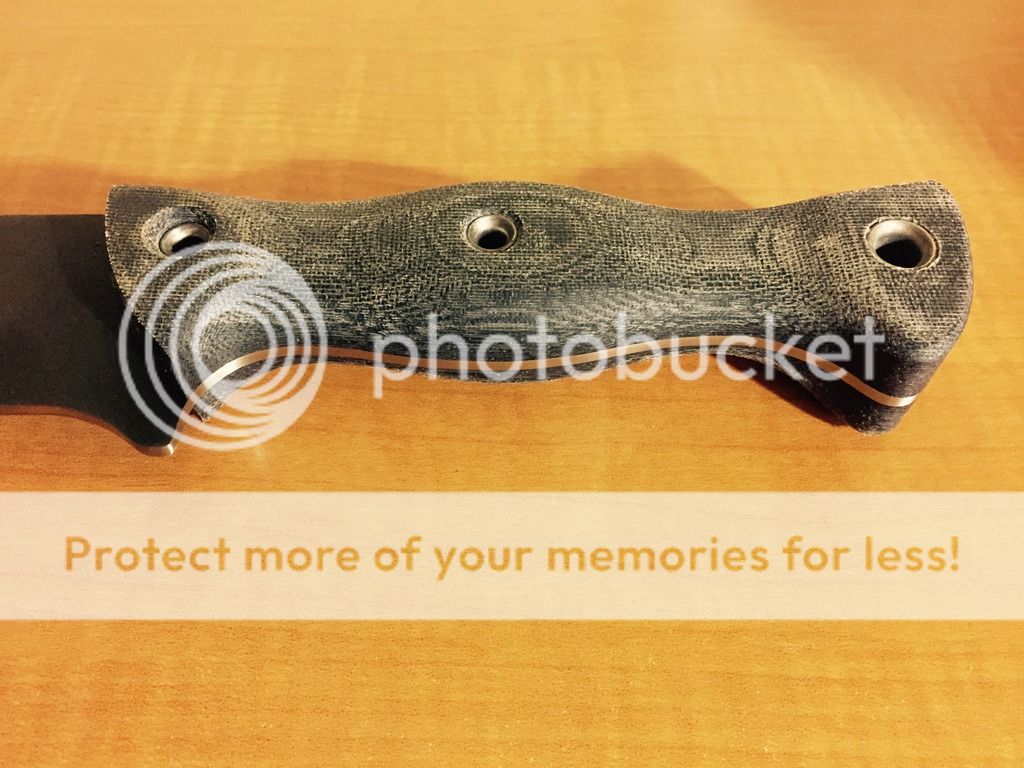
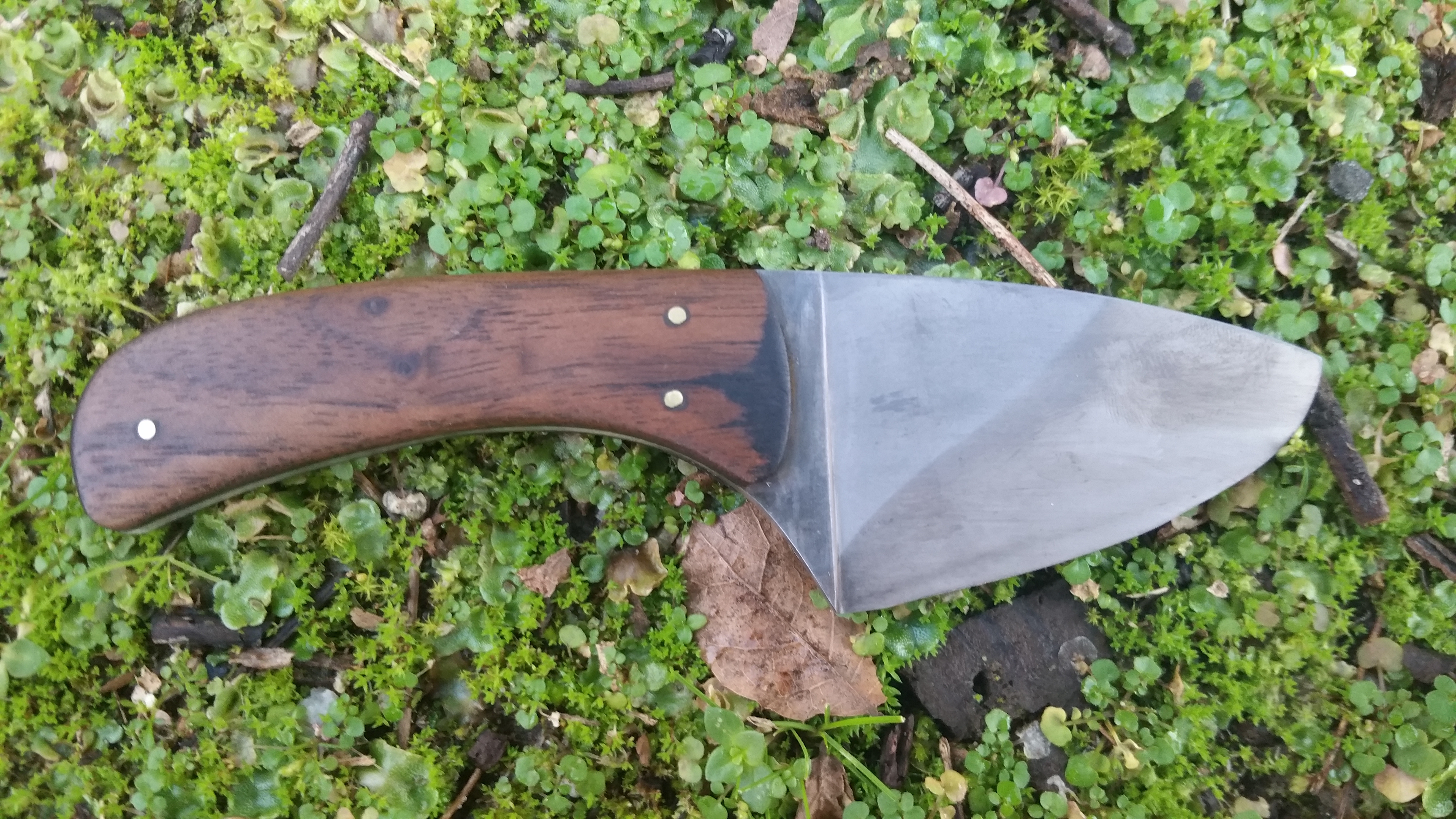
Well, getting vinegar on the wood was pretty much unavoidable. I thought I had put enough oil in the wood to keep it from sucking up vinegar but I was wrong.

Where the vinegar soaked in the wood turned black and rotten. I think I'm just going to chalk this one up to lessons learned. When I say rotten, I mean that the grain got rough and hairy, like an old fence.

Next time I get oversized holes, I'll just re-drill for bigger pin stock. And wood and vinegar don't mix, unless you want the rotten wood effect. I could see it having it's place somewhere, but not on this particular knife.

Luckily I only re-etched part of the knife, I'll just let the rest of it patina naturally.
 
Best thing to do with a wooden handle is to simply etch the knife, then glue and shape the handles and leave the tang satin. This is what I do and I think it works aesthetically.

FullSizeRender%201_zpsmg3dnye6.jpg
 
Best thing to do with a wooden handle is to simply etch the knife, then glue and shape the handles and leave the tang satin. This is what I do and I think it works aesthetically.

FullSizeRender%201_zpsmg3dnye6.jpg

Yeah, that does work. I think as long as whatever I do looks intentional, it'll look decent. But luckily I'm not making it for anyone, just practice. Now that I've re-sanded and re-oiled the handle, the black part looks kind of neat and feels the same as the rest of the wood. I'm going to mess around with this and see what I can come up with on the next one.

The etch on the blade came out pretty bad though, I sanded to 800 and I thought I did a good job de-greasing (dish soap was and dry, then brake cleaner) and before I wiped the oxides off they were perfectly smooth and even, but was blotchy underneath. I used a sponge to wipe off the oxides instead of a paste polish like everyone else recommends, and I think that might have played a part in it.

1eF0OO9.jpg
 
If you want to get a killer etch that sticks on the blade and wont wipe off try this protocol. Note it involves sulfuric acid so its very dangerous and requires a respirator and excellent ventillation/ being outside + wearing nitrile gloves. I've used everything out there including vinegar, ferric chloride, mustard and lemon juice etc...

So here's my set up

1. sulfuric acid in the form of Drain cleaner. They sell it at lowes for $10.
2. baking soda for your neutralizing agent.

3. Get a PVC or similar acid resistant tube and fill it with a mixture of 3 parts water 1 part sulfuric acid. Always add acid to the water and not the other way around.
4. Clean your blade well and then submerge it in the solution for a few minutes. You should see a visible reaction and bubbling after just a few minutes.
5. Remove your blade, pour off the excess acid that is lingering on it and then immediately neutralize by pouring baking soda on the blade.
- I pour straight baking soda powder on it. I used to stick it into another tube with a baking soda/water mixture but the etch doesnt stick as well.

6. Clean your blade off with warm running water and soap and then oil it. You will get the deepest blackest etch you've ever seen.

- Tips
- The acid reaction works best when warm. If you put the blade into the acid when its below freezing you will end up getting rust
- Always make sure your blade is completely clean. Small particles of steel dust can badly pit the blade in a short amount of time.

Heres a blade done with this protocol

763fce7e-91fe-4aef-90f2-b44dd8a4dd79_zpsahvelqa0.jpg


Here's another with the same protocol + time in the tumbler

20150520_235500_zpsd7suprxe.jpg


Another + tumbling

ad665ad1-1fd6-49fa-b298-b04cdbee56ce_zpsc3b9124f.jpg
 
I would etch it prior to glue up and get the scales fitting perfectly afterwards then just leave the spine and tang with a belt finish.
 
Wow, those look great!

As a chem student, I know all about handling dangerous chemicals. At school we say "Do as you aughter (otter), add acid to water"

Does hand washing wear away the etch enough to worry about? Have you ever tried etching a hamon with that method?
 
Great to have a chem student on here! I think you background will really help you excel as a knifemaker. I wish I could go back to school and get an engineering degree.

Washing the blade does not seem to wear away the etch. I've noticed when I neutralize with the solid baking soda it really seems to make the patina stick.

And in the bottom picture, the 3 blades are differentially tempered and the etch really brings out the temper line. The very bottom blade in particular shows a strong temper line. I cannot speak for a hamon however as I never use that HT method in my blades. Maybe some more experienced guys can step in and drop some knowledge on how to make a hamon pop with an etch.
 
And in the bottom picture, the 3 blades are differentially tempered and the etch really brings out the temper line. The very bottom blade in particular shows a strong temper line. I cannot speak for a hamon however as I never use that HT method in my blades. Maybe some more experienced guys can step in and drop some knowledge on how to make a hamon pop with an etch.

Ha, you know I was looking at those pictures on my tiny little phone screen, and I thought that the temper line was the grind line! But now I see, and it looks good, nice and strong!
 
If you want to get a killer etch that sticks on the blade and wont wipe off try this protocol. Note it involves sulfuric acid so its very dangerous and requires a respirator and excellent ventillation/ being outside + wearing nitrile gloves. I've used everything out there including vinegar, ferric chloride, mustard and lemon juice etc...

So here's my set up

1. sulfuric acid in the form of Drain cleaner. They sell it at lowes for $10.
2. baking soda for your neutralizing agent.

3. Get a PVC or similar acid resistant tube and fill it with a mixture of 3 parts water 1 part sulfuric acid. Always add acid to the water and not the other way around.
4. Clean your blade well and then submerge it in the solution for a few minutes. You should see a visible reaction and bubbling after just a few minutes.
5. Remove your blade, pour off the excess acid that is lingering on it and then immediately neutralize by pouring baking soda on the blade.
- I pour straight baking soda powder on it. I used to stick it into another tube with a baking soda/water mixture but the etch doesnt stick as well.

6. Clean your blade off with warm running water and soap and then oil it. You will get the deepest blackest etch you've ever seen.

- Tips
- The acid reaction works best when warm. If you put the blade into the acid when its below freezing you will end up getting rust
- Always make sure your blade is completely clean. Small particles of steel dust can badly pit the blade in a short amount of time.

Heres a blade done with this protocol

763fce7e-91fe-4aef-90f2-b44dd8a4dd79_zpsahvelqa0.jpg


Here's another with the same protocol + time in the tumbler

20150520_235500_zpsd7suprxe.jpg


Another + tumbling

ad665ad1-1fd6-49fa-b298-b04cdbee56ce_zpsc3b9124f.jpg

New here:

Whats your tumbler set up? I'm wanting to tumble a hatchet after acid bath but haven't found a practical solution. Any advice would be much appreciated!
 
Back
Top