
-
The BladeForums.com 2024 Traditional Knife is available! Price is $250 ea (shipped within CONUS).
Order here: https://www.bladeforums.com/help/2024-traditional/
You are using an out of date browser. It may not display this or other websites correctly.
You should upgrade or use an alternative browser.
You should upgrade or use an alternative browser.
Sandpaper without mousepad?
- Thread starter letsgo
- Start date
- Joined
- Nov 20, 2006
- Messages
- 268
People call it the Scary Sharp method. It's been around for a very long time. It began as an alternative way to sharpen woodworking tools, but many have been able to adapt it for knives as well.
http://web.archive.org/web/20070702113741/http://www.shavings.net/SCARY.HTM
http://web.archive.org/web/20070702113741/http://www.shavings.net/SCARY.HTM

Jason B.
Knifemaker / Craftsman / Service Provider
- Joined
- Jun 13, 2007
- Messages
- 11,196
Sandpaper with a mouse pad or other soft backing is for convex edges. You can use sandpaper on a flat surface for V edges but its more common with convex as most everyone uses some sort of bench stone for V edges.
DennisStrickland
BANNED
- Joined
- Jun 24, 2009
- Messages
- 5,040
knifenut you are the man for sharpening. what grades of sandpaper should one pick up at the autostore?

- Joined
- Apr 14, 2007
- Messages
- 2,738
knifenut you are the man for sharpening. what grades of sandpaper should one pick up at the autostore?
Dennis, I once asked The Sharpening Dude, KN, the same question and he pointed me here.

- Joined
- Oct 2, 2006
- Messages
- 1,746
Wet-or-Dry sandpaper on any flat surface would work, but I've found that they can wear out faster than I thought and you end up buying a lot of sandpaper. It's called the scary sharp method. In the long term sharpening stones work better, they cut faster and the stone lasts.
Jason B.
Knifemaker / Craftsman / Service Provider
- Joined
- Jun 13, 2007
- Messages
- 11,196
I seem a bit worried to but convex edge on a v edge because I dont want to mess up my kershaw ram or NRG and soon to have spyderco. Would you recommend using sandpaper on like a glass table or on a mousepad?
Don't try and change a blade grind until you can understand the grind.
Convex has its place but with some knives its not worth the effort. Sandpaper can be used glued to glass, this is a well known way of sharpening and will produce very sharp V edges. I would suggest not trying your hand at convex before you learn how to properly apply a V edge, convex is IMO a bit more complex and requires a different mode of sharpening. Think of it as a completely new skill.

- Joined
- Dec 27, 2004
- Messages
- 2,270
Convex has its place but with some knives its not worth the effort. Sandpaper can be used glued to glass, this is a well known way of sharpening and will produce very sharp V edges. I would suggest not trying your hand at convex before you learn how to properly apply a V edge, convex is IMO a bit more complex and requires a different mode of sharpening. Think of it as a completely new skill.
There's no 'prerequisite' of learning V bevels before learning convex sharpening, and what about convex sharpening makes it more complex? In fact, some find it easier. Most knives freehand sharpened without the aid of a guide or jig end up somewhat convexed anyway. The basics apply to any method: decent abrasive, angle control, consistency, etc. Regardless of the method, it's best to practice on a couple of 'beater' knives to become familiar with it, before sharpening your 'good' knives.
cbw
Jason B.
Knifemaker / Craftsman / Service Provider
- Joined
- Jun 13, 2007
- Messages
- 11,196
Convex is a shape that must be understood, its a flowing of the blade and a understanding of what the shape should be for the blades existing grind. Putting on a convex edge is NOT as simple as holding one angle and using a soft backing with sandpaper, you have to know what your doing to do it correctly.
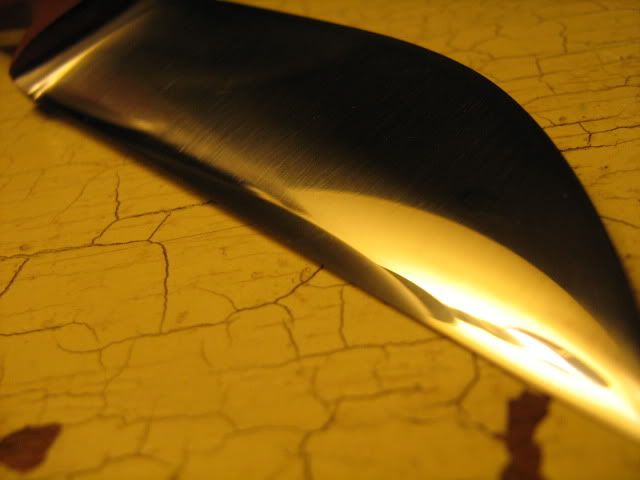
For example, this knife was once a V grind.
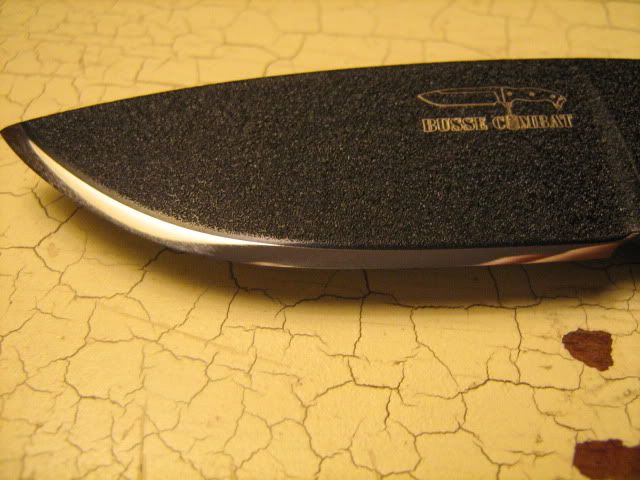
This was also V ground but this convex grind was done on benchstones to save the coating from being worn away. Though both convex one is a proper convex grind and the other is a convex bevel, big performance differences too.
Sure convex is easy but do most really know how to form them to a non convex blade? my guess is probably not because theirs not really any good information on how to do it and its constantly suggested to new sharpeners because its "simple". Truth is its not simple and requires previous knowledge of sharpening to even start to understand how and when to apply it to a knife. Their is less of a learning curve to V edges thus you learn them much faster, I started messing with convex edges 2 years ago and even with all the previous experience I have it still took me a good year before the light bulb finally came on.
Again why are we suggesting convex to a new sharpener for blades that would see no advantage from such grind?
For example, this knife was once a V grind.
This was also V ground but this convex grind was done on benchstones to save the coating from being worn away. Though both convex one is a proper convex grind and the other is a convex bevel, big performance differences too.
Sure convex is easy but do most really know how to form them to a non convex blade? my guess is probably not because theirs not really any good information on how to do it and its constantly suggested to new sharpeners because its "simple". Truth is its not simple and requires previous knowledge of sharpening to even start to understand how and when to apply it to a knife. Their is less of a learning curve to V edges thus you learn them much faster, I started messing with convex edges 2 years ago and even with all the previous experience I have it still took me a good year before the light bulb finally came on.
Again why are we suggesting convex to a new sharpener for blades that would see no advantage from such grind?
- Joined
- Dec 27, 2004
- Messages
- 2,270
I think you're right in that... "do most really know how to form them (convex) to a non convex blade, probably not"... because the mistake is often made of trying to "fit" a convex bevel into the V-bevel, which results in a more obtuse angle. So yes, there probably could be some improvement in that area. And I agree that it's more than just holding a knife at one angle and pulling it across sandpaper, but then, so is sharpening on a stone. I'm not sure that convex requires previous knowledge of sharpening a different way, or that there's less of a learning curve to V edges. Both require some knowledge of what you're doing. New sharpeners, regardless of method, seem to make similar mistakes... improper angle, not reaching the edge, burr removal, etc. Learning one method would help learn the other, but the order they're learned in, I can't see as that important. (Feel free to expand on this... maybe it's just a point I don't see).
I really don't think either one of us could debate the advantages of one grind over the other, unless specific goals are set. For the most part, a knife used under normal circumstances will perform adequately with either type.
Convexing an entire blade is a bit different... even that though is not much different than, for example, what some sharpeners demonstrate when they lay a knife flat on a stone, thin it, then set the edge. You're just thinning the blade. But yeah, it is a bit harder to get it right.
My question is, (and just to be clear here, I'm not saying it's wrong, just looking for clarification), on the 2nd knife pictured, if the finish interfered with making a convex edge, why was it done?
cbw
I really don't think either one of us could debate the advantages of one grind over the other, unless specific goals are set. For the most part, a knife used under normal circumstances will perform adequately with either type.
Convexing an entire blade is a bit different... even that though is not much different than, for example, what some sharpeners demonstrate when they lay a knife flat on a stone, thin it, then set the edge. You're just thinning the blade. But yeah, it is a bit harder to get it right.
My question is, (and just to be clear here, I'm not saying it's wrong, just looking for clarification), on the 2nd knife pictured, if the finish interfered with making a convex edge, why was it done?
cbw
I would agree that learning how to sharpen a "v" bevel isnt a pre-requisite for leaning to convex a bevel.
Most people convex their bevels on stones naturally afterall.
Do people really convex entire blades on sandpaper?
Ill also throw out that convexing a blade on a grinder is "easier" then giving it a full flat grind.
To the OP: You can use sandpaper to sharpen a knife without a mousepad, yes indeedy. Dont do it to save money though.... paper costs way more then stones in the end.
Most people convex their bevels on stones naturally afterall.
Do people really convex entire blades on sandpaper?
Ill also throw out that convexing a blade on a grinder is "easier" then giving it a full flat grind.
To the OP: You can use sandpaper to sharpen a knife without a mousepad, yes indeedy. Dont do it to save money though.... paper costs way more then stones in the end.
Jason B.
Knifemaker / Craftsman / Service Provider
- Joined
- Jun 13, 2007
- Messages
- 11,196
I think you're right in that... "do most really know how to form them (convex) to a non convex blade, probably not"... because the mistake is often made of trying to "fit" a convex bevel into the V-bevel, which results in a more obtuse angle. So yes, there probably could be some improvement in that area. And I agree that it's more than just holding a knife at one angle and pulling it across sandpaper, but then, so is sharpening on a stone. I'm not sure that convex requires previous knowledge of sharpening a different way, or that there's less of a learning curve to V edges. Both require some knowledge of what you're doing. New sharpeners, regardless of method, seem to make similar mistakes... improper angle, not reaching the edge, burr removal, etc. Learning one method would help learn the other, but the order they're learned in, I can't see as that important. (Feel free to expand on this... maybe it's just a point I don't see).
I really don't think either one of us could debate the advantages of one grind over the other, unless specific goals are set. For the most part, a knife used under normal circumstances will perform adequately with either type.
Convexing an entire blade is a bit different... even that though is not much different than, for example, what some sharpeners demonstrate when they lay a knife flat on a stone, thin it, then set the edge. You're just thinning the blade. But yeah, it is a bit harder to get it right.
My question is, (and just to be clear here, I'm not saying it's wrong, just looking for clarification), on the 2nd knife pictured, if the finish interfered with making a convex edge, why was it done?
cbw
You got the idea just thinking about it too hard

You don't have to learn a V bevel first but it is the most common bevel and does not require such drastic changes in the sharpening technique or blade grind.
Why was it done? Its a busse and as usual its thick, the convex was done to increase cutting performance and because it was the customer preference of grind styles (most of his blades are convex).