Santoku handle Question

Joined
Aug 13, 2002
Messages
5,703
Is the tang on this just tapered and pressed in? I see no pin in the handle.
How about epoxy? I would think that you'd need some sort of way to keep humidity/water from entering the ferrule/tang area. :confused:

KS%20SANTOKU%20KS.jpg


Any input would be greatly appreciated.
 
Traditionally, with ho wood handles on Japanese knives, the tang is heated up and burnt into the handle. Fancier handles with harder woods (ebony, rosewood, etc.), nickel/silver, etc. are often epoxied in.

That knife is most likely either press fit in, or a small amount of epoxy is used to hold it in.
 
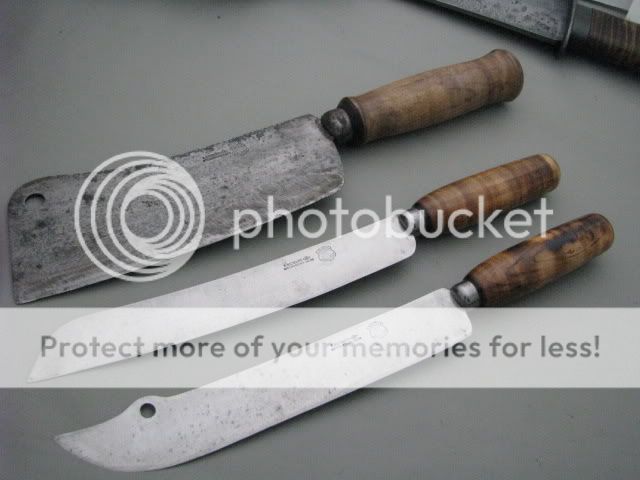
Most of the traditional Japanese kitchen knives I've seen have tapered tangs and rely solely on a friction fit. On the older ones there's actually a space between the top of the handle and the blade to tang shoulder so they can be tightened up by tapping the handle forward. The ferrule keeps the wood from splitting when the handle is tightened up, like a file handle. This style of construction is multi cultural and very common on old timey working knives… One nice thing about it is that the handles can be easily replaced.

It's hard to tell exactly how the knife in the picture goes together, since there's no space at the shoulder and the hole appears to be rectangular instead of round. It wouldn't surprise me if some epoxy or glue was used. In the old days, I'm sure some folks used cutlers rosin, which may also have had some antibacterial or biostatic properties.

Here’s some old European styled kitchen knives made by Ray Richard’s grandpa. Basically the same, but with the ferrules closed up on top. My guess is that he used some cutlers rosin (wood rosin and bees wax mixture) on them in conjunction with the friction fit. Needless to say,... they are still intact and look sweet!

IMG_2787.jpg
 
Last edited:
Patrice Lemée;9296289 said:
Is the tang on this just tapered and pressed in? I see no pin in the handle.
How about epoxy? I would think that you'd need some sort of way to keep humidity/water from entering the ferrule/tang area. :confused:

KS%20SANTOKU%20KS.jpg


Any input would be greatly appreciated.

Patrice, traditionaly they are heated and "burnt' in.
but, you're the maker;)

Sometimes they also use a pin. Epoxy is great to use.
 
Thanks guys, not sure I can pull off the ferrule but I'll give it a try. Those old knives look great. Probably in conjunction with epoxy.
 
On the one I have the end is sealed with goo. Probably something like the beeswax rosin mix Tai was talking about.
 
A lot of Japanese knives have an open hole where the tang goes into the handle. Theres usually a pilot hole drilled in, then the tang is burned and hammered in. This does in fact become a problem so the hole is often filled with epoxy or wax by the end user.

In case you're curious, the KAI Wasabi knives have a molded handle, similar to other plastic handled knives.
 
Back
Top