
-
The BladeForums.com 2024 Traditional Knife is available! Price is $250 ea (shipped within CONUS).
Order here: https://www.bladeforums.com/help/2024-traditional/
You are using an out of date browser. It may not display this or other websites correctly.
You should upgrade or use an alternative browser.
You should upgrade or use an alternative browser.
Serrated blades
- Thread starter Maprik
- Start date


- Joined
- May 17, 2012
- Messages
- 2,779
I think you might be confused. Spyderco will sharpen any knife they make. Also maintaining a serrated edge with the sharpmaker is very easy.
Thanks for the clarification, you are correct, I was misinformed. I see that they will sharpen the spyderedges so that, at least makes me feel much better about trying a serrated edge!! Now to research how to sharpen serrations on the sharpmaker..... I appreciate you all straightening out my misconceptions.
Thanks guys. My mind is being opened to serrations for certain situations. Now seeing the attraction to combo blades.
As soon as I get some extra cash I'll be getting Spyderco Tasman and EDCing it with a SAK,plain+serrated edges+several functions and the bonus of not freaking anyone out with a serrated claw,instead a nice gentlemans Swiss Army Knife to keep the sheeple at bay


Tsujigiri
Gold Member
- Joined
- May 25, 2009
- Messages
- 3,223
The reason for serrations is that it crams more cutting edge into the same blade length vs a plain edge. Since wear is distributed over more area, the edge retention is improved and the blade will stay sharp longer. However, you can't slice things the way you can with a plain edge. A serrated edge rips more than it cuts, and is only really useful for things like rope and cardboard. Additionally, it's a good choice for H-1 steel, since it is work hardened.
I've tried serrated edges, though, and still prefer plain edges. I'll gladly put up with the lower edge retention of a plain edge since I can so easily sharpen it up again, it gives me a more useable blade, and I don't have to worry about breaking off serrations.
I've tried serrated edges, though, and still prefer plain edges. I'll gladly put up with the lower edge retention of a plain edge since I can so easily sharpen it up again, it gives me a more useable blade, and I don't have to worry about breaking off serrations.
I thought combo-edges were interesting and I've owned this Benchmade Leopard for almost 15 years. I haven't carried it this whole time but in all the time I carried it I don't recall ever using the serrated portion to cut anything. I decided that the serrated part just reduces the amount of useable cutting edge that I have.

After reading more about serrated edges and thinking about it, I bought these 2 to experiment with, a Byrd Hawkbill and Spyderco Ladybug. I thought while a combo edge might not give enough actual serrated edge to be useful, a fully serrated edge might. I reasoned that most steak knives are serrated and while not very sharp they still work. I think this is one advantage of a serrated edge- it can still cut even when relatively dull. When sharp it should cut some things better than a sharp plain edge but I haven't been able to prove or disprove this yet.
I don't think it is difficult to sharpen serrations. I have a Spyderco Sharpmaker and I have the small diamond rod attachment that DMT sells, either of which should do the trick pretty easily.
One day at lunch I was with my daughter and I was showing her the little SE Ladybug. She had her plain edge Spyderco Tenacious and so we did an impromptu test. We were at a fast food restaurant so I tightly rolled a paper napkin, held it stretched between my hands, and had her cut it with the Ladybug. Then I had her do a similar cut with the Tenacious. In this comparison the Tenacious cut faster. I don't think this is conclusive because the Ladybug has relatively small serrations, I would like to repeat the test with the Hawkbill. I've read discussions about using the SE to cut normal stuff just like you would cut with a plain edge and I can't think of a reason that the serrations couldn't slice or carve just as well, except the cut might not be as smooth, but I still prefer a plain edge for that type of use. I would like to have a SE Delica to try out, I think it would make a good second knife to carry for cutting rough materials or for loaning to people.
I now have an aversion to combo edge knives and this can be a problem when trying to buy used knives because so many of them seem to be combo edge. I bought a used knife just a few days ago and it was supposed to be plain edge but when I opened it I saw that it was combo edge. I went to the trouble to send it back and try to get a refund.
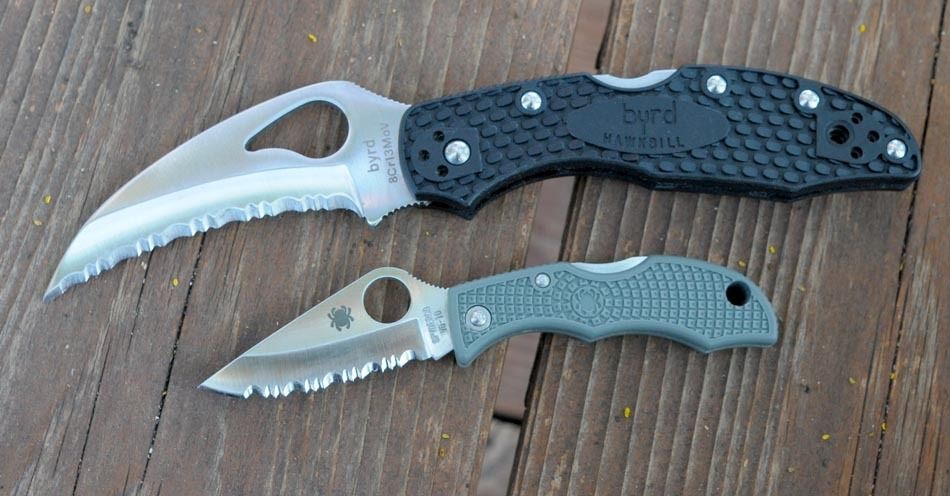
After reading more about serrated edges and thinking about it, I bought these 2 to experiment with, a Byrd Hawkbill and Spyderco Ladybug. I thought while a combo edge might not give enough actual serrated edge to be useful, a fully serrated edge might. I reasoned that most steak knives are serrated and while not very sharp they still work. I think this is one advantage of a serrated edge- it can still cut even when relatively dull. When sharp it should cut some things better than a sharp plain edge but I haven't been able to prove or disprove this yet.
I don't think it is difficult to sharpen serrations. I have a Spyderco Sharpmaker and I have the small diamond rod attachment that DMT sells, either of which should do the trick pretty easily.
One day at lunch I was with my daughter and I was showing her the little SE Ladybug. She had her plain edge Spyderco Tenacious and so we did an impromptu test. We were at a fast food restaurant so I tightly rolled a paper napkin, held it stretched between my hands, and had her cut it with the Ladybug. Then I had her do a similar cut with the Tenacious. In this comparison the Tenacious cut faster. I don't think this is conclusive because the Ladybug has relatively small serrations, I would like to repeat the test with the Hawkbill. I've read discussions about using the SE to cut normal stuff just like you would cut with a plain edge and I can't think of a reason that the serrations couldn't slice or carve just as well, except the cut might not be as smooth, but I still prefer a plain edge for that type of use. I would like to have a SE Delica to try out, I think it would make a good second knife to carry for cutting rough materials or for loaning to people.
I now have an aversion to combo edge knives and this can be a problem when trying to buy used knives because so many of them seem to be combo edge. I bought a used knife just a few days ago and it was supposed to be plain edge but when I opened it I saw that it was combo edge. I went to the trouble to send it back and try to get a refund.
The reason for serrations is that it crams more cutting edge into the same blade length vs a plain edge. Since wear is distributed over more area, the edge retention is improved and the blade will stay sharp longer. However, you can't slice things the way you can with a plain edge. A serrated edge rips more than it cuts, and is only really useful for things like rope and cardboard. Additionally, it's a good choice for H-1 steel, since it is work hardened.
I've tried serrated edges, though, and still prefer plain edges. I'll gladly put up with the lower edge retention of a plain edge since I can so easily sharpen it up again, it gives me a more useable blade, and I don't have to worry about breaking off serrations.
Cardboard is one place where I have found serrations to suck, at least when you are talking about cutting up a lot of it. Otherwise, I have found them very useful.
- Joined
- Oct 28, 2012
- Messages
- 107
I work in a marine environment. I've watched for many years what people use for their trades. A plain edge is best for me but I work with wood. Many tradesmen I know definitely benefit from serrated edges, especially divers. Marine grade stuff can be quite tough and dull the edge of a plain edge M4 blade quickly. Serrations are valid for many uses.
