
-
The BladeForums.com 2024 Traditional Knife is available! Price is $250 ea (shipped within CONUS).
Order here: https://www.bladeforums.com/help/2024-traditional/
You are using an out of date browser. It may not display this or other websites correctly.
You should upgrade or use an alternative browser.
You should upgrade or use an alternative browser.
Serrated edged knives?
- Thread starter rmeron
- Start date

Trail Edge
BANNED
- Joined
- Apr 23, 2011
- Messages
- 936
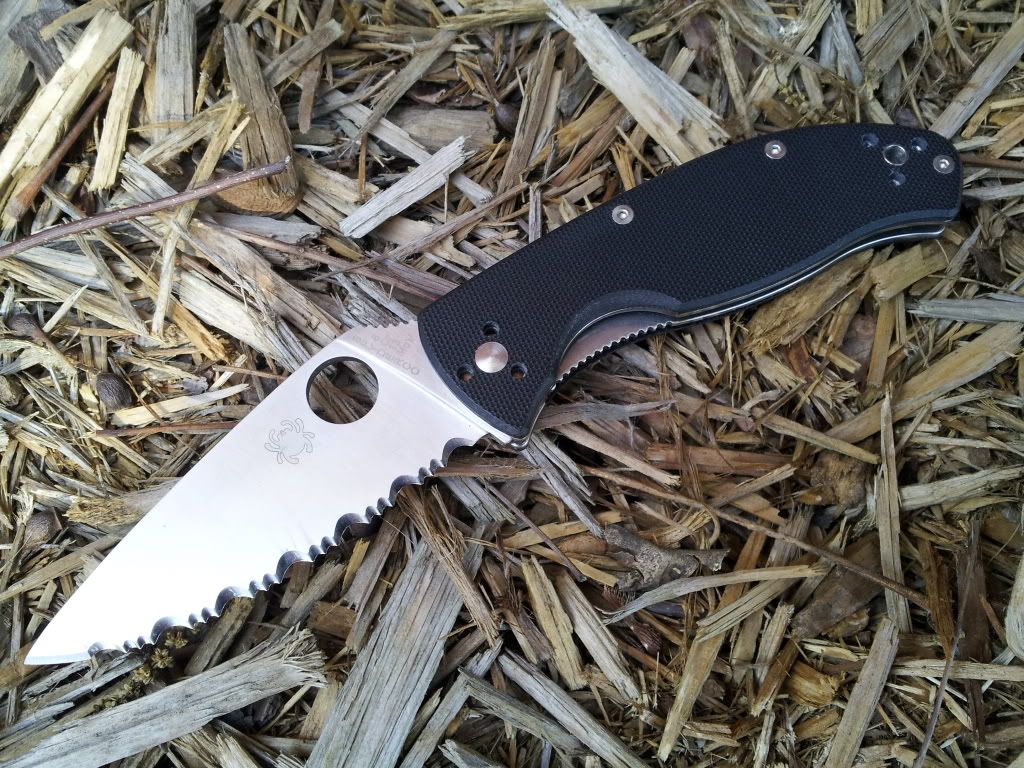
Here is a pic from Spyderco, there point is that a serrated blade edge is actually longer

- Joined
- Jun 30, 2010
- Messages
- 148
There was a time when I had to cut a lot of wet cardboard boxes. For that job the serrations on a Spyderco did a great job without needing resharpening. Most of my knives are straight edge but for prolonged cutting on fibrous material I've found serrations to be advantageous.

- Joined
- Aug 28, 2008
- Messages
- 296
I have actually started to like serrations since I have started carry my full spyderedge delica. I was skeptical at first too, but they really don't limit the knives capabilities that much.
Serrations are good for rope. Good around boats. Good for cutting seat belts. That's about it. The problem with serrations is while they may (or may not) excel and a few things they totally stink at most other things. If I were back on a boat (on which I spent a lot of time) I would have a serrated edge knife handy for the quick clearing of rope fouling on a propeller or other gear. I'd also have a plain edge for everything else.
In the woods, I see no advantage to serrations. In the kitchen, bread and angle food cake I suppose. That's about it.
In the woods, I see no advantage to serrations. In the kitchen, bread and angle food cake I suppose. That's about it.
I think there are three main attributes to serrations.
One, they encourage slicing action the same way and curved blade does. In effect, it's a bit like having a bunch of little hawkbill blades in a line. As the material being cut seeks the path of least resistance, it does so in each little valley of each serration. To do so, it must slide along the edge.
Two, they make the blade less immune to what I call the "cutting board effect". A cutting board a backing that's generally a harder material than what is being cut, and impact of this backing against the edge causes more blunting than the material actually being cut. Serrations elevate most of the edge above the backing. The result is that the edge is preserved longer, since it does not have to impact the backing.
Third, all those points aid in cut initiation. This can be demonstrated when cutting, say, a fruit, it's sometimes much easier to initiate cutting by penetrating the skin with the point of the knife than by push cutting outright. Each point in the serration along the edge does the same thing, aiding in initiating cuts.
One, they encourage slicing action the same way and curved blade does. In effect, it's a bit like having a bunch of little hawkbill blades in a line. As the material being cut seeks the path of least resistance, it does so in each little valley of each serration. To do so, it must slide along the edge.
Two, they make the blade less immune to what I call the "cutting board effect". A cutting board a backing that's generally a harder material than what is being cut, and impact of this backing against the edge causes more blunting than the material actually being cut. Serrations elevate most of the edge above the backing. The result is that the edge is preserved longer, since it does not have to impact the backing.
Third, all those points aid in cut initiation. This can be demonstrated when cutting, say, a fruit, it's sometimes much easier to initiate cutting by penetrating the skin with the point of the knife than by push cutting outright. Each point in the serration along the edge does the same thing, aiding in initiating cuts.
I agree with HoosierQ, rope. Especially old, weathered rope. A serrated edge cuts the dried rope fibers were as a plain edge tends to slide across the rope without cutting much. I think it's like trying to saw a piece of wood with a plain edge as apposed to a saw tooth blade.. I also find a large plane edge knife (machete), sharpened with a file will slice through a rope better than finely honed one.

chiral.grolim
Universal Kydex Sheath Extension
- Joined
- Dec 2, 2008
- Messages
- 6,422
Excellent diagram.Here is a pic from Spyderco, there point is that a serrated blade edge is actually longer
Not only is the cutting surface longer, but far more important are the penetration points, the teeth, whose purpose is the same on saws and mouths, each functioning as a talon which not only has increased metal support for prolonged strength & durability (vs. a plain edge) but also penetrates material MUCH more efficiently. And as an added benefit, these durable teeth protect the curved (and usually hollow/very-acute) cutting edge from impact on resistant materials.
Serrated edges possess superior cutting ability on ALL materials if you are making a slice-cut.
However, that superiority can be a problem if you are trying to cleanly shave just the surface of something - the teeth will penetrate below the surface before the rest of the blade (the curved portions) makes contact, resulting in gouging, and push-shaving results in these gouges tearing away at the sides from the material which the recessed sections of blade haven't managed to cut. For this reason, people prefer plain edges for carving/whittling wood, shaving/scraping hair or other materials from a surface, and for slicing very thin sheets of material.
For very stretchy material (e.g. skin, conjuctiva), serrations penetrate more easily but do not penetrate evenly along the entire cutting surface like a plain-edge does. Because of this, the plain-edge, while it takes more force to penetrate, produces a cleaner cut, which can be essential for some purposes like surgery (clean cuts reduce trauma to the material and heal faster).
On the other hand, if you want to maximize damage to such materials while cutting through as easily as possible, go with the serrated edge

To help you understand the penetration advantage offered by serrated edges, stand on some well packed earth and drive a flat-nosed shovel into the ground. Then do the same (with the same amount of force) with a spade of similar dimensions. Which one went in easier? Now use each to try and skim a thin layer of earth off the surface - which worked better?
Last edited:

- Joined
- Jul 25, 2011
- Messages
- 21
I saw a guy on youtube say that serrations were good for quickly making shavings for firemaking. I never thought about that but, it sounds like a good idea.


- Joined
- Jun 17, 2006
- Messages
- 4,090
Who really slices rope all day?
Serrations are for people who want an easy to use knife, but don't want to deal with taking care of a knife. Typically not knife hobbyists.
You can get better performance from a well sharpened & maintained straight edge.
I couldn't disagree more. I'm a knife hobbyist and I know how to take care of a knife. I also know that for working around the farm there are tasks that a serrated knife does much better than PE. I don't cut rope all day but I do cut a lot of vines, briars and stalks. I carry a fully serrated knife in my working pants all the time because it takes about half the effort to do those tasks than with a PE of equal length.
Serrations also make sense for a purely self-defense blade IMO because the can rip through clothing more efficiently than a plain blade.


powernoodle
Power Member
- Joined
- Jul 21, 2004
- Messages
- 11,977
A serrated edge excels at cutting fiberous material, and it retains a useable edge longer than a plain edge.
Does it suck at everything else? Absolutely not. You can do virtually anything with a serrated edge, from peeling an apple to sharpening a pencil. It goes through cardboard and clam shell packages like magic. I think that many folks who poo poo the serrated edge have never really given it try.
Does it suck at everything else? Absolutely not. You can do virtually anything with a serrated edge, from peeling an apple to sharpening a pencil. It goes through cardboard and clam shell packages like magic. I think that many folks who poo poo the serrated edge have never really given it try.

- Joined
- Nov 29, 2001
- Messages
- 3,283
Depends on who's serrations. Spyderco's Matriarch and Civilian demonstrate keenly how well serrations can go through some(one)thing.I'm sure many other manufacturers make excellent serrations, but some don't, they hang up more often than not on the material and make the slice harder, not easier. Some find them difficult to sharpen, others just take a ceramic down the back side of the blade and ..voila! ...sharp.
- Joined
- Mar 1, 2010
- Messages
- 268
Serrated edges are just much more aggressive cutters. They are not as precise as a PE but they get the job done quickly and easily. Serrated edges (specifically Spyderco) can cut materials that can't be cut with a PE. It's like having a saw and a knife. After I started carrying a SE Delica in the early nineties I will not EDC anything that is not partially or fully serrated. If you carry a knife for emergency use I really think serrations are a tremendous advantage. (with the exception of wilderness survival). Ernest Emerson says "always carry serrations". I do see the downside or rather the resistance from the knife purist because they really can't be maintained like a straight edge. Over time serrations get to where they just can't be reconditioned to factory sharpness or effectiveness. With this in mind I use my serrations sparingly and only when truly needed and use the SE part of the knife for mundane tasks.
Trail Edge
BANNED
- Joined
- Apr 23, 2011
- Messages
- 936
A lot depends on the serrations too. What got me into serrations was a Medium sized "Good Cook" serrated chef's knife that I bought at the local grocery store for my bachelor's pad that I used to have. The knife had perfect serrations where it would have the fine teeth (sometimes marketed as "micro serrations" saw bread or tomato skin awesome. here is A picture of a different brand, if you look close you can see the serration style
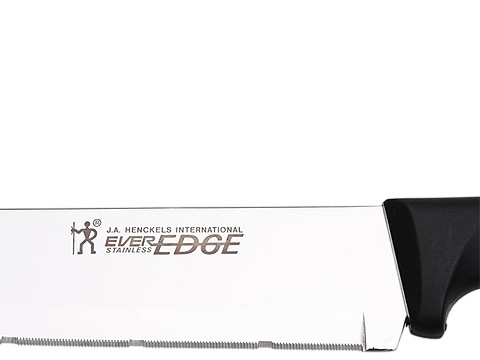
Then there's the common bread knife which I don't like where the serrations still slide over the food

Its all about what you like (or have tried) maybe some people just had a bad experience with the one thats in the second picture? personally I have found Spyderco's serrations handy, but still in a different category from the previously stated.

Then there's the common bread knife which I don't like where the serrations still slide over the food
Its all about what you like (or have tried) maybe some people just had a bad experience with the one thats in the second picture? personally I have found Spyderco's serrations handy, but still in a different category from the previously stated.
Last edited:

- Joined
- Mar 18, 2008
- Messages
- 3,371
A serrated edge excels at cutting fiberous material, and it retains a useable edge longer than a plain edge.
Does it suck at everything else? Absolutely not. You can do virtually anything with a serrated edge, from peeling an apple to sharpening a pencil. It goes through cardboard and clam shell packages like magic. I think that many folks who poo poo the serrated edge have never really given it try.
I think it all comes down to personal preference. I have "given it try", and I prefer non-serrated. I have never found serrations to cut fibrous material better than plain edge. I have cut rope, cardboard, fabric, cable, vines, etc., with serrated and plain, and I personally prefer plain. I find that, if properly sharpened, which my blades always are, I use less effort to cut with plain edge than serrations. And I know how to sharpen serrations. When I had serrated blades, they all whittled hair easily, just like my plain edge. I have never even found the problem some describe when cutting dirty, grimy, wet synthetic rope. My plain blades don't "skate" over the top, but sail through the rope with little effort. And, as far as the serrated knife supposedly being able to cut longer, first, my most carried knife right now is a D2 steel blade, that holds an edge like I sometimes can't believe, and second, I carry multi-blade traditionals almost exclusively, so I always keep at least one blade that has not been used in reserve, just in case.
I'm not trying to convince anyone that they should choose one over the other, or that my experience will be theirs, or that my opinion is more valid. I have noticed that this is a very polarizing topic, and that many forumites get a bit defensive if others don't share their opinion (Powernoodle, this is not directed at you). This is just my preference, and I'm secure enough to know that it may not be yours.
