what are the pros and cons of having a partially serrated blade? i am interested in getting a bradley alias 1 but can only find the style i like with the serrations. the knife would be used as an edc that would also be used for hunting and extreme camping. thanks also what do you guys think of the bradley?

-
The BladeForums.com 2024 Traditional Knife is available! Price is $250 ea (shipped within CONUS).
Order here: https://www.bladeforums.com/help/2024-traditional/
You are using an out of date browser. It may not display this or other websites correctly.
You should upgrade or use an alternative browser.
You should upgrade or use an alternative browser.
serrated vs non
- Thread starter big_chief
- Start date
- Joined
- Oct 30, 2005
- Messages
- 5,171
Partial serrations have there use, mostly when you deal with synthetic ropes, zip-ties, cutting thicker plastics, reinforced cording, reinforced fan-belts, etc.
If such cutting is a regular or expected activity, partial serrations have someting to be said for being justified as an EDC.
Most people just don't seem to be able to resharpen serrations right. Eventually, the serrations are ground away.
Further, many people find that the serrations are located in the "wrong" spot. I say adapt, but this has been brought up.
However, in case of the Alias I, I'd hold out for plain edge.
First, a plain edge appears to be what you want. Nothing more dissatisfying than "settling" for a knife you weren't enthused to get to begin with. The Alias is a good design IMO, so buy the one you want.
Second, and related to the first, the Alias ain't cheap, so buy what you want.
If such cutting is a regular or expected activity, partial serrations have someting to be said for being justified as an EDC.
Most people just don't seem to be able to resharpen serrations right. Eventually, the serrations are ground away.
Further, many people find that the serrations are located in the "wrong" spot. I say adapt, but this has been brought up.
However, in case of the Alias I, I'd hold out for plain edge.
First, a plain edge appears to be what you want. Nothing more dissatisfying than "settling" for a knife you weren't enthused to get to begin with. The Alias is a good design IMO, so buy the one you want.
Second, and related to the first, the Alias ain't cheap, so buy what you want.
thanks for the info, i dont know anything about knives really except that i want to own serious quality, i expected that i didnt want serrations but didnt know if maybe there were some advantages but apparently there are none that i could really utilize

- Joined
- Sep 29, 2008
- Messages
- 10,394
thanks for the info, i dont know anything about knives really except that i want to own serious quality, i expected that i didnt want serrations but didnt know if maybe there were some advantages but apparently there are none that i could really utilize
Serrations are great for cutting fibrous stuff, rope, wood, etc. Great for opening those blister packs too. They aren't as precise as PE knives, so if you just want it cut, but don't care how neat it is, they work.
- Joined
- Oct 30, 2005
- Messages
- 5,171
thanks for the info, i dont know anything about knives really except that i want to own serious quality, i expected that i didnt want serrations but didnt know if maybe there were some advantages but apparently there are none that i could really utilize
I sometimes carry partially serrated knives, but usually it is simply because a model is only available that way, this is seen in some limited edition knives, or when I perceive cutting materials such as those mentioned above.
For general carry, I prefer and recommend plain edged blades. Plain edged blades have simply proven more useful overall.
I suspect that'll be the general concensus on the forum.
- Joined
- Jan 31, 2007
- Messages
- 671
I like plain, or serrated (In some blade shapes, and always with a plain edge backup), but not combo. Unless it's a really long blade, you don't get enough of either style to be really useful, or always in the right spot on the blade for what you want to cut...
- Joined
- Sep 5, 2005
- Messages
- 2,826
It all depends on what sort of serrations are on the blade. Right now, I carry a 5-inch Cold Steel Gunsite with partially serrated blade. The smaller teeth make cutting fibrous materials much easier and, of course, they don't need sharpening very often. Contrary to what some may say, they're not difficult to sharpen and the Cold Steel serrations cut paper, nautical cord, leather, seat belts very well. Bumpy serrations are worse than useless, on the other hand. Outdoors, big bumpy serrations have no practical applications at all, and the Bradley Alias serrations are too course for my tastes.
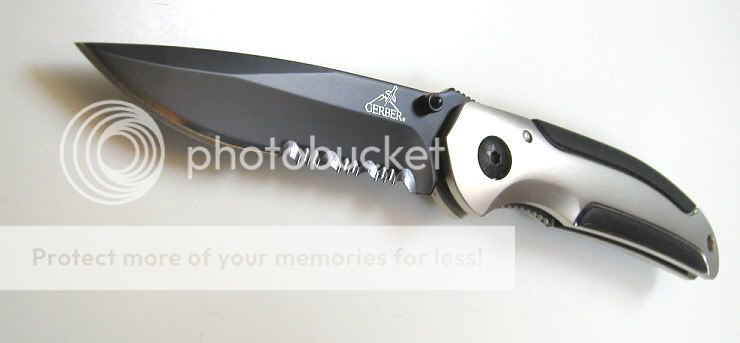
Serrations on this Gerber are horrible and serve no practical use in
the woods or outdoors. They just take up valuable real estate on the
blade in my opinion. These serrations are very similar to those found
on the Bradley Alias.

Smaller serrations like this cut through almost anything more quickly
and efficiently than a plain blade. They aren't good for debarking a tree
or whittling wood, however.
The two types of blade styles I avoid are the big bumpies and blades that are chisel ground (ground on one side), both of which are found on a lot of CRKT knives. I'd skip the serrations on the Bradley and search around until I found one without them. If I were going to spend much time outdoors, I'd have a plain edged knife and another knife with fine serrations all up and down. If you're going to be cleaning game or cutting wood chips, serrations only get in the way.
I'd take a good hard look at Cabela's Alaskan Guide knives by Buck. They're exceptionally strong and made from fine S30V blade steel. They're a steal for about $67 and come with a leather pouch.
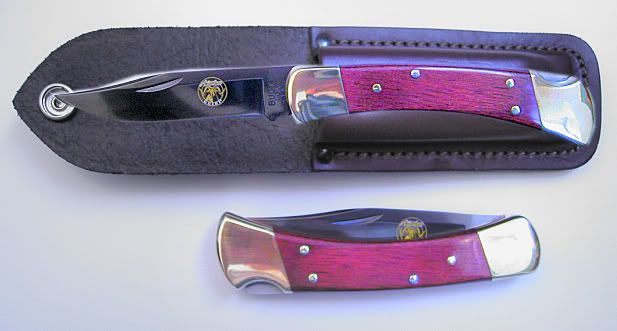
The Alaskan Guide comes with an exceptional plain edged blade and
a fine leather pouch. It's legendary among hunters and outdoorsmen
worldwide.
Serrations on this Gerber are horrible and serve no practical use in
the woods or outdoors. They just take up valuable real estate on the
blade in my opinion. These serrations are very similar to those found
on the Bradley Alias.
Smaller serrations like this cut through almost anything more quickly
and efficiently than a plain blade. They aren't good for debarking a tree
or whittling wood, however.
The two types of blade styles I avoid are the big bumpies and blades that are chisel ground (ground on one side), both of which are found on a lot of CRKT knives. I'd skip the serrations on the Bradley and search around until I found one without them. If I were going to spend much time outdoors, I'd have a plain edged knife and another knife with fine serrations all up and down. If you're going to be cleaning game or cutting wood chips, serrations only get in the way.
I'd take a good hard look at Cabela's Alaskan Guide knives by Buck. They're exceptionally strong and made from fine S30V blade steel. They're a steal for about $67 and come with a leather pouch.
The Alaskan Guide comes with an exceptional plain edged blade and
a fine leather pouch. It's legendary among hunters and outdoorsmen
worldwide.

- Joined
- Nov 29, 2001
- Messages
- 3,286
I think combo blades get a bad rap. I use to also think 'only plain' or 'only serrated' but unless you're talking a 3" blade, combo blades often do give you the best of both worlds. A big Voyager (or Gunsite like above) gives you enough plain edge to do what you need, and enough serrations to cut that seat belt. Don't be afraid of combo edged blades.

- Joined
- May 1, 2007
- Messages
- 534
my really hard user knife is a part serrated. I prefer a plain edge when I am working cause I don't cut fiberous stuff. But when I go fishing\hunting I use a half serrated.
- Joined
- May 11, 2009
- Messages
- 414
Serrations serve a purpose, no doubt about it, but I would never spend over 30 bucks on a knife that had serrations. You dont need a magical steel if you have serrations, any old steel will do.
I like serrations sometimes, mostly for yardwork, but it isnt worth paying a lot for. Any knife over 30 bucks probably shouldnt have serrations, to each his own. Since I only use serrations for yardwork I only own one knife with serrations.
PS not all serrations are equal either, kershaw has some really good ones.
I like serrations sometimes, mostly for yardwork, but it isnt worth paying a lot for. Any knife over 30 bucks probably shouldnt have serrations, to each his own. Since I only use serrations for yardwork I only own one knife with serrations.
PS not all serrations are equal either, kershaw has some really good ones.
Last edited:

- Joined
- Oct 26, 2008
- Messages
- 516
Pros:
Can't think of any.
Cons:
Not enough PE to do proper work
Not enough SE for fiber cutting
I have to agree... and disagree.
There was a time when I carried nothing but Partial Serrated.
Good on boxes, rope, small branches, skiving wire, and whatever else I needed.
Then I got a plain edge knife. I didn't know what I was missing until then.
The cutting was smoother. I didn't have to clean the paper and cardboard out of the handle any more.
Now I keep a combo in my truck and a plain in my pocket.

- Joined
- Oct 24, 2005
- Messages
- 1,836
I actually prefer partially serrated blades for medium sized (3.0-3.5 inch) EDC blades. It seems to do everything I ask it to as well or better than a plain edge. Now, for larger fixed blade hunting, camping and survival knives I generally perfer a plain blade and also for smaller folders.
I'd actually be curious if one of the "plain edge" crowd could give a specific example of a cutting chore that a partially serrated blade can't do, that a plain edge can? I honestly have never come across a situation where I had my partially serrated blade and thought "Darn! If I only had a plain edge knife right now!"
I'd actually be curious if one of the "plain edge" crowd could give a specific example of a cutting chore that a partially serrated blade can't do, that a plain edge can? I honestly have never come across a situation where I had my partially serrated blade and thought "Darn! If I only had a plain edge knife right now!"
Last edited:

- Joined
- Jul 16, 2005
- Messages
- 2,150
Pros:
Can't think of any.
Cons:
Not enough PE to do proper work
Not enough SE for fiber cutting
I agree with that. A sharp plain edge will cut fiber just well as a serrated edge. That said if you go with a combo edge you can sharpen the serrated part well with a Sharpmaker. You sharpen serrations the same way as a chisel ground knife.
I agree with that. A sharp plain edge will cut fiber just well as a serrated edge.QUOTE]
Not always. Polyester, nylon or hemp ropes and straps full of grease, dirt and grit will cut much easier with a SE. Heavy, tough plastic wraps are the same. I have had to cut welding cables in the field. Although they are heavy and thick they are composed of pretty fine copper strands. An SE cuts them fairly easy, a PE craps out halfway through. A good PE works fine for most tasks, but an SE will handle really tough materials better and faster with less damage to the blade.
- Joined
- May 22, 2009
- Messages
- 103
I agree with that. A sharp plain edge will cut fiber just well as a serrated edge.QUOTE]
Not always. Polyester, nylon or hemp ropes and straps full of grease, dirt and grit will cut much easier with a SE. Heavy, tough plastic wraps are the same. I have had to cut welding cables in the field. Although they are heavy and thick they are composed of pretty fine copper strands. An SE cuts them fairly easy, a PE craps out halfway through. A good PE works fine for most tasks, but an SE will handle really tough materials better and faster with less damage to the blade.
+1:thumbup: