sewing machine

Joined
Dec 29, 2006
Messages
103
If you can only have one machine to begin with, which do you get? the 3000- 4000 Artisan or the light weight such as Paul uses? Travis
 
Travis way back in the day I had the pump handle Tippmann Boss which is a stitcher, not a sewing machine. I started out with my Artisan 797ABLTHR flat bed because I could do the heavier stuff on the Tippmann. I worked that combination successfully for about a year and then I got my Artisan $4000. My thinking was that I could do the heavy stitching either on the Tippmann or by hand, but the finer stitching for inlays and lighter weight item such as chaps and chinks, spur leathers and other cowboy gear. Even today the little 797 gets used three or four times on each sheath and the 4000 for the final edge stitching only.

So if I could only have one machine right now, I'd still go with the motorized flat bed but I'd be very sure it could handle up to 3/8" thickness if it had to, and based on my absolute satisfaction with Artisan it would probably be the 2nd or 3rd generation 1797AB.

Paul

Edited to add: The Artisan 3000 wasn't born yet when I got my 4000. If I was buying today it would be the 3000 for sure and I'd put the rest of my $4000 that I paid back then in my pocket. Great machines, much lower prices, now.

 
Paul thanks for the reply.I thought maybe i could change to a heavier thread on the 797 for the final stitching, and get the 3000 later. thanks again. Travis
 
Trav, most of the flat bed machines can't handle the thickness of the edge stitching required on the sheaths. You might call Jerry Zonis or Dave at Artisan toll free and get some counseling and information on some of their later machines but generally speaking it's hard to do what I do without the two machines.

Paul
 
I have the Toro3000 and I try to do what Paul does and frankly it's hit or miss on the fine work. It can be a little frustrating doing the light stitching and trying to get the tension just right only then to have to adjust it to go to the heavier edge stitching.
You can do inlay work and linings though with a 138 thread then go up to the 207 for the edge but 138 with a 23 needle is probably as light as you can do with the 3000 with any success. I just did a panel overlay with tonight and it's not as clean as Paul's that's for sure but when it's finished it'll look alright. You just can't get the stitch/inch down to Paul's level for the clean look. I just have to tone down the tight corners and wild shapes for now.

So all in all... if just one machine then I'd still choose the Toro3000. I do a variety of sheaths and this machine will cover most of them.

Have to start saving for the flatbed machine.
 
Last edited:
Stuart.thanks for the explanation. You and Paul have made it easy to decide .Think i'll just go with the 3000 for now. It should do 90 per cent of my work anyway. Trav
 
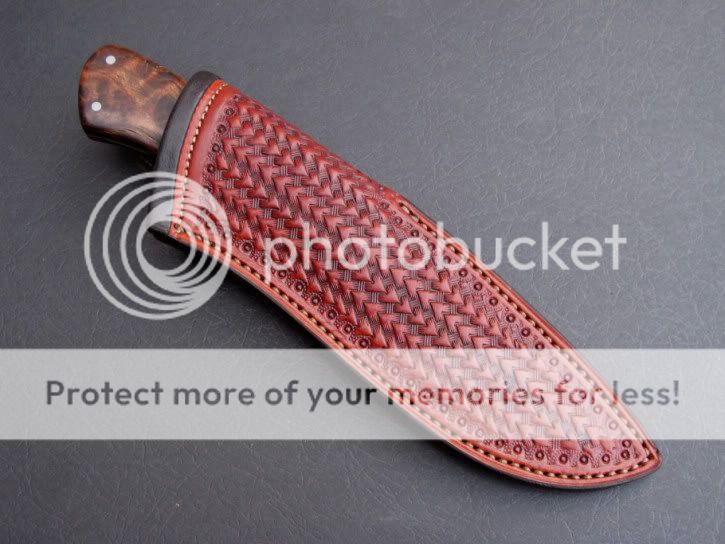
Here's a comparison of what the Toro 3000 can and cannot do.
If you look at my sheath where I've sewn down the liner, this is about as fine a stitch I can do with 138 thread and a 23 needle (though this is an LR needle I bought by mistake and will get "S" needles next order.) I use 207 thread and a 25 needle around the edge of the sheath.

newsheaths_7.jpg


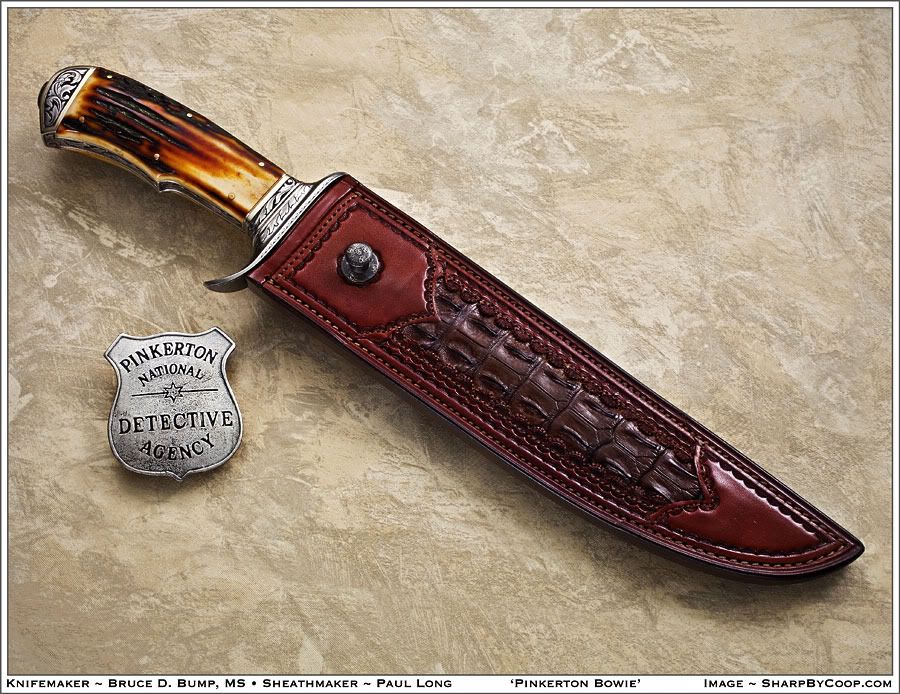
If you look at Paul's here, you can see how much finer it is. I could never get as clean a sewing job around those panels. Maybe if I modified a presser foot without the "stitch groover" (?) I could get a little cleaner results.

Bump_100904B-web.jpg
 
Last edited:
I have a Cobra 4 with EPS that I love. It is for stitching heavier stuff... I wish it did it all... but there just isn't such a beast. I would not trade this for a flatbed though, the edge stitching is the main part of my work.

The EPS is an awesome thing on the Cobra!
 
Comparing the Cobra 4 with the Artisan 3000 is just a little bit apples and oranges. The EPS and the $3695 price tag on the cobra being the main difference. I have no experience with EPS, but it does make a good TALKING point. I have enough experience on my own to do the things that EPS is supposed to do, and while I have one of the original old Artisan Toro 4000 machines I believe I could duplicate sewing results comparing the Cobra 4 with my machine or me on the newer Artisan 3000.

Jon is right, there is not, to my knowledge a single machine that will do the two extremes of stitching as I do on my sheaths. My flat bed Artisan 797AB is just as important as the T-4000. Having said that I believe Stuart Branson has come very close using 207 thread and a smaller needle on his Artisan 3000 as illustrated by him in post # 7 above. The key here is on my 797AB I drop down to 69 thread through an 18 needle and I really close the stitch length tight. Can't do that successfully on the Cobra OR the Artisan big stitchers.

Paul
 
Last edited:
Big mistake on my part... I just forgot but I use 138 thread with a 23 needle for liners and inlays and the 207 for the edge.

Sorry about the confusion... I think it was because I have 277 and 207 in another colour.
 
Paul, thanks for the explanation. I agree that Stuart has come close to what you do, and I believe his work is close to what I want to do. Stuart , thanks for telling about the sizes . I am new to this machine sewing but thanks to you and Paul, I am going with the 3000. Trav
 
Travis, my friend----You will be impressed with the Artisan 3000. If you could only have one machine, this would be the answer to your prayers.

Whenever you can find the time, drop by and shoot the breeze and maybe we could go over and see Chuck and Peggy Patrick----Sandy
 
Great thread, i've been looking at the artisan 3000 myself. What is the most popular arm lenght for sheath work? Would the 9" be enough? And is there a " guide" of some sort to keep the stiching a set distance from the edge of the sheath?
Shawn
 
The 9 inch throat is plenty for sheath making and most everything else unless you are doing saddle blankets, saddle skirts or some other very large items. All the old Randalls had narrow throats and they have been performing adequately for nearly one hundred years.

The swing out stitch guide is, in fact, an optional accessory, but I believe Jerry includes it as part of the 3000 package. It would be worth mentioning if you order, just in case, because it is definitely, and absolutely useful and for me a a must have.

Paul
 
Thanks Paul, you mentioned the tippman earlier as a stitcher and not a sewing machine, could i have youthoughts on this machine? Or is the 3000 just that much better and suck it up for the xtra 700 dollars.

Shawn
 
Well now, then there, that's an easy one for me to answer:

a. because it ain't my 700 bucks

b. because among other things, that 700 bucks buys you a machine powered by a servo motor along with other capabilities and goodies too numerous to mention that the Tippmann does not have.

c. IF you did save 700 bucks and buy the hand operated Tippmann, it would just be a matter of time until you have it up for sale to make room for your new Artisan 3000.

The final decision is, of course, yours, and I did start off with a Tippmann but armed with experience and memory I'd buy the powered machines first if i had it to do over.

Paul
 
How did I know you were gonna say something like that.?:D All good answers You'd think I should know better by now and just buy the "right" tool for the job once and for good. My wallet just forces me to ask anyway.:)

Thanks again
Shawn
 
Back
Top