Sharpening angle question

Joined
Dec 2, 2008
Messages
83
Sorry gang... This is a completely noob question. When folks talk about the "included angle" that they sharpen to/with, do they mean the angle between the stone and the blade, or is that the angle of the actual V-grind itself? Sorry again...stupid question, I'm sure.

I've been sharpening on a stone since I was a kid, and I've recently learned or started to learn to the art of convexing using sandpaper and a mousepad. I'm getting pretty good at it, and it's pretty forgiving. I've always just eyeballed an angle between the blade and the stone/sandpaper, and depending on the application (i.e. chopper versus precise slicer), I've changed the angle. I'm just curious to see what other folks use as their angles.

Thanks again for the help...

Nick
 
"Inclusive angle" is the angle of the V. The angle of a single side is half of the V, like this: /| or |\, as opposed to /\.
 
To put it another way, if you looked at the blade in cross-section (such as with the knife pointing directly at you), imagine a vertical line drawn straight down through the blade, from the center of the spine to the edge. The 'included angle' would be the measurement of the two individual bevel angles (left & right) from the centerline, added together.

Simply put, the 'included angle' is the angle that 'includes' both sides.
 
It's not a stupid question, and THG and OWE gave good answers.

As to your second question, I used to just eyeball the angle. When I got into comparing knife steel edge retentions, I realized I needed a set angle in order to make valid comparisons. So, these days I use a Sharpmaker. If I use DMT stones, then I brace them against the Sharpmaker to maintain the set angle. But mine is a special requirement. There isn't anything wrong with eyeballing the angle if the results you get are satisfactory.
 
Thanks for the replies, and that makes some sense. If you have a knife with an established angle, how would you measure what that angle is? Better yet, how would I approximate the angle that I'm freehanding? Any thoughts?
 
Thanks for the replies, and that makes some sense. If you have a knife with an established angle, how would you measure what that angle is? Better yet, how would I approximate the angle that I'm freehanding? Any thoughts?

I use the Sharpmaker to get an approximation of the original manufacturer's angle on a blade. The Sharpmaker comes with settings for 30° and 40° inclusive. I blacken the blade edge with a Sharpie, take a few swipes with the rod in the 40° hole, then examine under a magnifying lens.
- If the black is completely gone, the edge angle is ~40° inclusive or 20° per side.
- If the black is gone from the back, but not from the very edge, then the angle is greater than 20° per side.
- If the black is gone from the very edge, but not from the back, then the angle is less than 20° per side. In this case, I will repeat the process with the 30° stone setting.

I then know if the per side angle is
- greater than 20°
- equal to 20°
- between 15° and 20°
- equal to 15°
- less than 15°

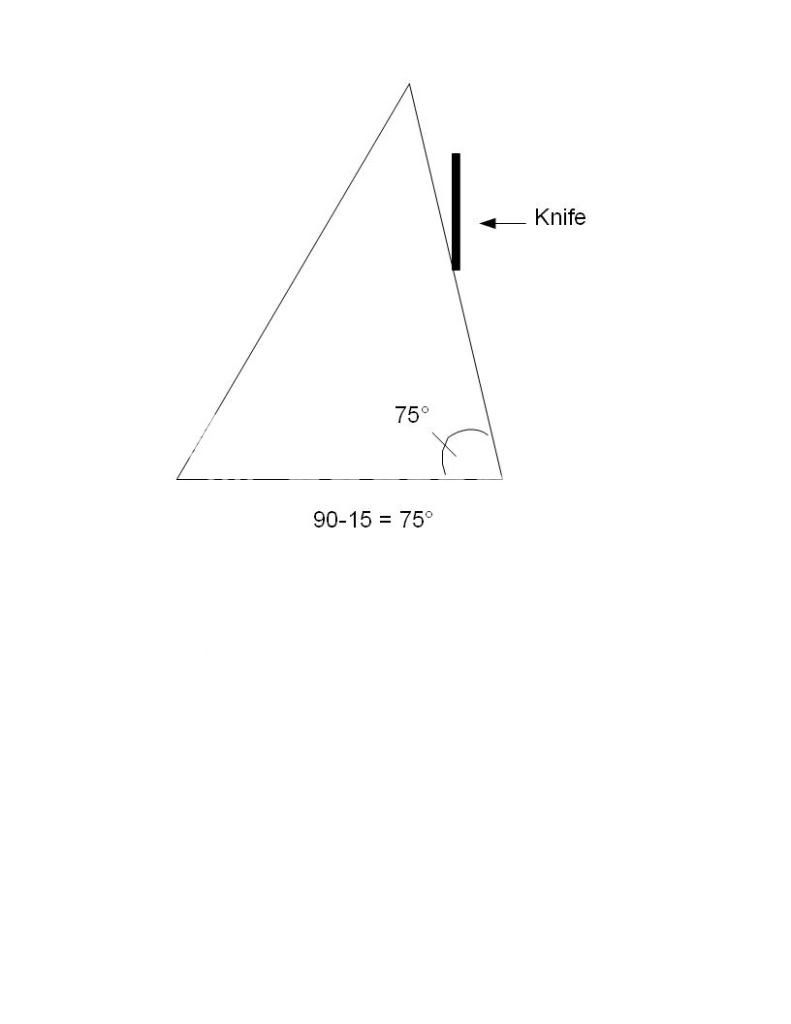
You could do the same sort of thing by using a protractor to construct some angles on cardboard at 15° and 20° (or whatever other angles you wish). Cut the cardboard so that you have free-standing triangles. Mark the blade with a Sharpie, then make backwards swipes along the angle you made and examine.

I fudged together an illustration to make it a bit clearer. If the interior angle is 75° and the base is flat, then that side will be 15° off vertical. You can hold the knife vertical and rub it against the side of the cardboard.

Hope that helps,
Frank

edgeangleapproximationmethod.jpg
 
Is it then correct to state that if a knife is sharpened at 25° on both sides would be 50° inclusive?
 
One final question guys. When using a guided sharpening system such as lansky, wicked edge, or edge pro at their deisignated degree of say 20°, is that 20° inclusive or are their angles acyually at 10°? Guess I could take a protractor and figure it myself.....lol.
 
One final question guys. When using a guided sharpening system such as lansky, wicked edge, or edge pro at their deisignated degree of say 20°, is that 20° inclusive or are their angles acyually at 10°? Guess I could take a protractor and figure it myself.....lol.

You'd be better off using the protractor anyways. Chances are, the true angle is going to be different from the marked setting, regardless.

The problem with the marked angles, on any clamped & guided sharpener, is that the marked angle will only be accurate if your blade exactly matches the profile & dimensions of the 'imaginary' blade used to designate those angles when the sharpener was designed. If your blade is narrower (spine to edge), the true sharpening angle will be steeper than the marked angle (because the edge is closer to the clamp). Conversely, if your blade is wider, the true angle will be lower (because the edge is further away from the clamp). Other factors, like blade length, positioning of the clamp on the blade (in the center, closer to the tang/tip, etc.) will make a difference too.

I assume the designers of the guided sharpeners probably intended the marked angles to represent one side only (1/2 the included angle). So the 20 degree mark would (hypothetically) imply a 40 degree inclusive.
 
You'd be better off using the protractor anyways. Chances are, the true angle is going to be different from the marked setting, regardless.

The problem with the marked angles, on any clamped & guided sharpener, is that the marked angle will only be accurate if your blade exactly matches the profile & dimensions of the 'imaginary' blade used to designate those angles when the sharpener was designed. If your blade is narrower (spine to edge), the true sharpening angle will be steeper than the marked angle (because the edge is closer to the clamp). Conversely, if your blade is wider, the true angle will be lower (because the edge is further away from the clamp). Other factors, like blade length, positioning of the clamp on the blade (in the center, closer to the tang/tip, etc.) will make a difference too.

I assume the designers of the guided sharpeners probably intended the marked angles to represent one side only (1/2 the included angle). So the 20 degree mark would (hypothetically) imply a 40 degree inclusive.

Good stuff Dave!

I've never really paid much attention to edge angle until recently. Depending on the knife, and my common use of it, I sharpen some at an acute, and some at a more obtuse angle.

I've always wondered though... what is the "common" angle that a given manufacture sharpens too, or more clearly, do manufacturers state somewhere what their current production knives come from the factory sharpened at?

For example, I just recently sharpened a Spyderco Persistence at 15% per side which created an new edge angle quite a bit more acute than the factory edge (that would be a 30% inclusive edge if I understand correctly???). Does Spyderco, or anyone else publish what they sharpen too?

Just as an aside, I used a Lansky to re-profile the Persistence. I used the 17% degree holes for the rods and it rook quite a bit of time to bring their factory edge down to get a burr. Once I had the burrs up, I finished with water stones.

What angle do most of the folks here use on most of their knives? (I realize this will vary greatly, but I'm just interested in the "averages").

Thanks all.
 
Unless you're taking triangle measurements and doing the math, the lansky type sharpeners are pretty inaccurate. The angles are pretty much suggestions, as they can be changed by how far the blade spine is in the clamp and the width of the blade.

I generally sharpen at 17 deg/side and touch up on the Sharpmakers 20 degree slots (40 inclusive). Spyderco says their edges are at 15/side, but that's not what I've seen on mine.
 
Unless you're taking triangle measurements and doing the math, the lansky type sharpeners are pretty inaccurate. The angles are pretty much suggestions, as they can be changed by how far the blade spine is in the clamp and the width of the blade.

I generally sharpen at 17 deg/side and touch up on the Sharpmakers 20 degree slots (40 inclusive). Spyderco says their edges are at 15/side, but that's not what I've seen on mine.

Thanks... I agree about the inaccuracy of the Lansky... In reality, I measured the finished edge (17 degree's by Lansky's hole) to be actually about 15. Since the Persistence is a full flat grind, the blade "tilts" about 2 or 3 degrees from side to side so the angle ends up being a bit more acute than their 17% (and as you say, the distance from spine to blade edge changes their 17% to a more acute angle as well).

Most of my Spyderco's also seem to be set from the factory at a more obtuse angle than 15% but I've never checked. I'll eyeball it next time before doing any re-profiling just for fun.

I pass any knife I'll be carrying "today" across a set of crock sticks every morning before I put them in my pocket just to keep 'em slicy.:)
 
I've always wondered though... what is the "common" angle that a given manufacture sharpens too, or more clearly, do manufacturers state somewhere what their current production knives come from the factory sharpened at?

As a whole (industry wide), I don't believe there is (or ever was) a "common" standard for edge angle. Some manufacturers have 'stated' guidelines that they try to follow, but keep in mind, most factories use belt-grinders to manually grind the edges on their blades. Consider that even one employee, in such a factory, would manually grind at least dozens, if not hundreds of blades in a single shift. There's bound to be some variation. Not to mention, each employee will affect the final grind in their own way, according to their own habits/skills.

For example, I just recently sharpened a Spyderco Persistence at 15% per side which created an new edge angle quite a bit more acute than the factory edge (that would be a 30% inclusive edge if I understand correctly???). Does Spyderco, or anyone else publish what they sharpen too?

Sal Glesser (Spyderco's founder) is a member here, and frequently contributes his thoughts regarding the knives his company produces. I'm sure, at one time or another, he's probably specified some details such as this. Wouldn't be surprised if it varies, at least by model and/or which plant a particular knife is produced in. Having said that, based on my own experience with Spyderco knives (I have a bunch of 'em), I'd assume they're a lot more consistent (knife-to-knife), for a given model. Don't know if they use CNC machines to grind the blades & bevels, but it wouldn't surprise me if they did. Seems to be a more precision in their blades, in my opinion. I'd generally (but not necessarily always) assume the same for other mid-to-high-end production makers of 'modern' folders (like Benchmade, Kershaw/ZT, Chris Reeve, etc.).

What angle do most of the folks here use on most of their knives? (I realize this will vary greatly, but I'm just interested in the "averages").

Again, I don't know if there is any such "common" preference, especially among knife nuts like most around here. Personally, I prefer acute edges, but even so, I still don't try to aim for a specific number. I've never calculated or measured the angles on mine. I've just developed something of a feel for what's 'too obtuse' or 'too thin' for my preference, and just try to keep the finished result somewhere in between. I've said it many times before here, I like acute edges for the very easy maintainability they afford. An acute edge inherently comes with a relatively wide bevel, and that wide bevel is very easy to 'feel' on a strop or stone. Makes it all the more easy to do accurate free-hand touch-ups, without rounding the edge. If an acute edge does actually require a little more maintenance, I'm fine with that (I actually enjoy it, and it keeps my sharpening 'muscles' in shape ;)).
 
I have my KME sharpener set to 24 degrees, I don't remember why I came to that, if it's inclusive degrees or what. I can get all my knives shaving sharp easily, but now that I'm thinking of angles, I'm slightly worried about it and feel like I shouldn't just remove whatever angle the knife originally had and put this 24 degree angle on. My knives don't get used real hard, so should I just worry about getting them sharp and not so much about what angles are best for what?
 
I have my KME sharpener set to 24 degrees, I don't remember why I came to that, if it's inclusive degrees or what. I can get all my knives shaving sharp easily, but now that I'm thinking of angles, I'm slightly worried about it and feel like I shouldn't just remove whatever angle the knife originally had and put this 24 degree angle on. My knives don't get used real hard, so should I just worry about getting them sharp and not so much about what angles are best for what?

You think like I do. ;)

I've never worried about what the spec'd angle is for a particular knife. I've used my Lansky/Gatco sharpeners to simply re-do the entire bevel anyways, and I've never been disappointed with the cutting performance of the finished edges. They've ALWAYS been much better than factory. The only knives I don't mess with too much, so far, are most of my Spydercos. Especially the ones with CPM steels (Military, Paramilitary, Manix2 in S30V/S90V/D2). I'm happy with the factory edges on those, so far.
 
Back
Top