Sharpening Hawkbills?

Joined
Dec 15, 2007
Messages
557
hullo guys,

I recently just picked up a spyderco tasman salt, and while I love it, I'm a bit unsure on how to sharpen it effectively. I have a Fallkniven Ceramic/diamond DC4 stone, as well as a sharpmaker. I assume the sharpmaker would be the way to go, but I seem to stuff even that up. :rolleyes: I also understand that H1 is a PITA to sharpen in any situation.

any hints?
 
Use only the corners of the sharpmaker stones. Another method that others have used and apparently works great is the spyderco 701 profile stone which I've been meaning to get as I have a love of hawkbills. The 701 is basically a fine stone with different radius curves on it.
 
As Knab said, just use the corners to sharpen it. If you still have the DVD your sharpmaker came with, there is a segment where Sal talks about sharpening Hawkbills. But basically, the only thing that's different is that you have to use the corners, and unlike a normal blades, where you bend your wrist downward with the curve, on a hawkbill you bend your wrist slightly upward with each stroke. That's basically to follow the curve of the blade.
 
DMT makes a stone for sharpening curved blades as well. Thats what I got for my aligner kit after I got my Tasman Salt.
 
The big question is, plain or serrated? Plain edge is easily sharpened on the SharpMaker or 701. The Byrd Duckfoot diamond sharpener is inexpensive and works very well for faster stock removal. The only caveat, as mentioned, is the wrist motion needed is backward from what most people are used to. I have to fight muscle memory every inch of the way., which makes keeping the blade vertical a problem. try propping a mirror up behind the SharpMaker where you can see the tip of the blade in the reflection.It makes it easier to see if you are keeping the blade straight.

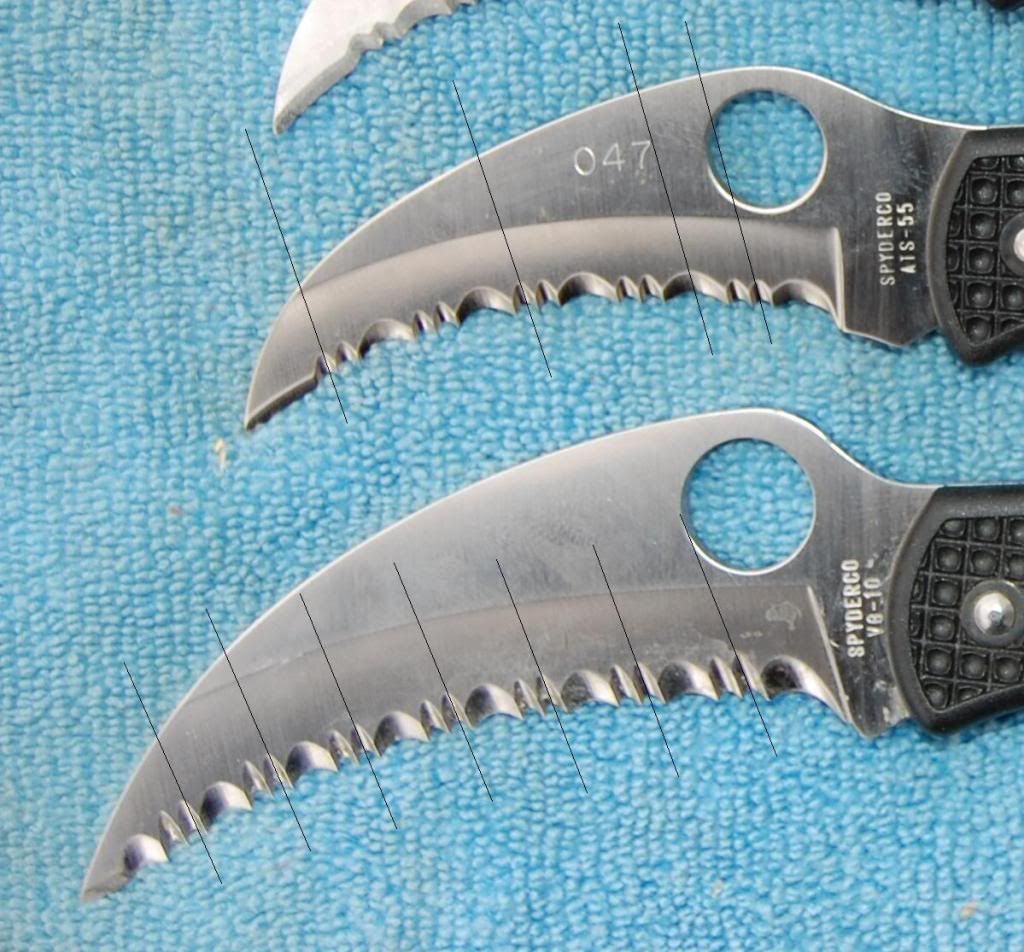
For serrations, it gets a bit trickier. Serrations are ground all at once on a shaped wheel. They do not follow the curve of the blade. You need to find the correct angle for the handle to match the serrations to the rods, then hold that angle throughout each stroke. If you try to follow the curve of the blade, you will round offff the points of the serrations.

Here is a picture I made a while back to show what I'm talking about.

Serrationangles.jpg


Notice the lines down the centers of the scallops are parallel to each other rather than perpendicular to the edge.
 
Thanks everyone for your input. I followed your tips and it got sharp enough to cut a clean hole in my pants when i got a wee bit too enthusiastic.:eek:

thanks Yablanowitz, while mine is plain, i might have to pick up a serrated one some time in the future... :)

cheers all,

Sam
 
Back
Top