Sharpening Question

geoffy

Platinum Member
Joined
Sep 7, 2010
Messages
259
Hey guys,

So this is my first post, but I have been reading on these forums for a couple weeks now. I'm trying to learn as much as I can about sharpening to take care of my own knives and was wondering if there was some epic thread here or other resources you all could point me to. I don't really know much about the topic and would like to learn more - especially about using bench stones and that whole process from start to finish (the sharper the better!).

Thanks a bunch!
 
Welcome to BF :)

Sharpening is a learned skill that no matter what takes time and much practice to "perfect".

Google Verhoeven sharpening, its a scientific view of sharpening and has some great SEM pictures. There a few others that I'm sure others will link to help you out.

Also have a look at my threads below, they may be of some help.

What are you using to sharpen?
 
Here is a web site that will get you to Verhoeven's information as well as complete comparisons and evaluations of virtually every sharpening device, every sharpening technique, and all sharpening products, all in one web site.
http://sharpeningmadeeasy.com/index.htm
His book, 'Sharpening Made Easy' is a wonderful investment for the newcomer to knife sharpening, but Steve B gives away freely almost all of the information in his book right there on the web site!! It's a great resource for sharpening information.

Stitchawl
 
Thanks for the information guys! I will check those out. Currently, I'm not using anything to sharpen since I don't really know what to get to start out, learn the basics on, and not break the bank in the process. I have some expensive knives and I would hate to ruin the blades with my inexperience. I've heard some encourage things about the Spyderco sharpmaker but is this something worth using on my sebenza, etc?

Oh and thanks for the welcome knifenut!
 
Last edited:
Greetings Geoffy: If your primarily interested in making and keeping your knife sharp with the least amount of complications, get a Sharpmaker. The Sharpmaker is also quite useful for maintaining your kitchen cutlery. It provides the SHORTEST learning curve and LEAST opportunity to screw up an edge. It is probably the EASIEST to use without prior sharpening experience. Another plus is a Small foot print, no oil, no water, no stone dishing no break in period no dislodged grit or dust. Even many who use other sharpening methods still find the Sharpmaker excellent for maintaining a sharp edge. It can also be used to reprofile but it will take quite a while.. The Sharpmaker is however limited to two preset sharpening angles of either 30 or 40 degrees but you can adjust for more. Used as per the included video and printed instructions it will get the job done and produce a consistently even and sharp edge. It is also recommended by CRK to maintain his Sebenzas. OldDude1
 
That's interesting. I'm thinking about going with the sharpmaker for a beginning option and using some of the resources listed above to increase my knowledge about the more intesive sharpening techniques. I'd like to eventually be able to take my knives the next level (using stones I suppose?). So I should probably get started practicing.
 
Greetings Geoffy: If your primarily interested in making and keeping your knife sharp with the least amount of complications, get a Sharpmaker. The Sharpmaker is also quite useful for maintaining your kitchen cutlery. It provides the SHORTEST learning curve and LEAST opportunity to screw up an edge. It is probably the EASIEST to use without prior sharpening experience. Another plus is a Small foot print, no oil, no water, no stone dishing no break in period no dislodged grit or dust. Even many who use other sharpening methods still find the Sharpmaker excellent for maintaining a sharp edge.

I'm one of those!! Although I'm a devout EdgePro fan, I also use the DMT Aligner clamp and the Sharpmaker. In fact, I keep the Sharpmaker set up at all times on a kitchen shelf and use it once a week to touch up my kitchen tools.

It can also be used to reprofile but it will take quite a while..

You can vastly improve the re-profile times by wrapping a sheet of low grit wet/dry sandpaper around the Sharpmaker rods and fastening them on with a bulldog paper clamp. (The sort that have to two folding 'wings.')

The Sharpmaker is however limited to two preset sharpening angles of either 30 or 40 degrees but you can adjust for more. Used as per the included video and printed instructions it will get the job done and produce a consistently even and sharp edge. It is also recommended by CRK to maintain his Sebenzas. OldDude1

Yeah! Wut he said!! :thumbup:
Sharpmaker is an excellent intro (as well as keeper) in the sharpening tool family!


Stitchawl
 
The Sharpmaker also comes with a very good and very informative (general sharpening concepts) instructional DVD. Well worth the cost.
 
I'm going to go away from the Sharpmaker advice here. I generally recommend a Norton Coarse/Fine combination stone from somewhere like Grainger or your local woodworker supply store. They usually run about $20 to $25 and will get you a hair whittling edge with practice. They are also coarse enough to rebevel thick edged knives if you need to. They dish quite slowly. Mine saw daily use for almost 8 years before I decided I needed to flatten it.

The 8" long by 2" wide model that is gray on one side and orange on the other is the one I'm talking about. 6" is ok, but is a little small for longer kitchen knives. If you have access to any woodworking equipment to cut accurate angles, you can make all sorts of stone holders and such. If not, just raise one end of the stone about 3 inches off the table, then hold the knife horizontal and stroke the knife away from you, keeping the blade level. I alternate 20 strokes per side or so, until I raise can get a burr on each side. The burr will raise on the side opposite the one touching the stone. Once the burr is raised, increase the height of the end of the stone to about 3.5 inches. Now, using the fine side, make light strokes alternating 1 stroke per side until the burr is gone. This will get you a sharp knife. If you find you prefer a shallower edge angle, just lower the elevation of the stone end to 2.5" or even 2". Be aware that most knives when new will not fit these shallower angles. Some may not fit with the 3" elevation. You can increase the height of the stone end or you can make a new bevel, though rebeveling takes time, especially if you are new to it.

Here is a link to using a tilted stone. He has a base, but the Nortons are strong enough that you shouldn't break it by just raising one end and having the middle unsupported. Just don't push with too much pressure, like all your weight. Dont push so hard that you start to loose control of your angle either.

http://www.youtube.com/watch?v=EP9tII6Tp7s
 
So this may sound like a dumb question but how do you know what angle to begin sharpening your knife with? Say I have a spyderco military - how do I know what angle to go with?

P.S. And thank for the info Me2 - I'm just trying to figure out how to even begin sharpening without destroying the edge by using the wrong angle or "accidentally" re-profiling the edge.

Any and all advice appreciated!
 
Oh and if I'm looking to start out learning on something more sophisticated than the sharpmaker - would you guys recommend the Edge Pro or some stone system? (like DMT or Arkansas). I have some beater knives to practice with - I just want to start out with a system that will allow me to get higher end results over time.
 
Hi,

If you're using the Sharpmaker, the quickest way to find the correct angle is to color the entire edge with a Sharpie, let dry and take a few swipes at the Sharpmaker at 15 degrees.

| |
| |
| |
\ / <--- if the ink is worn here, then the angle is too acute. Go to 20 degrees.
\ /
\/ <--- if the ink is worn here, then you're hitting the tip. You're GTG.


EDIT - that looks like crap. :) It looked good in the editor. :p
 
First color the edge bevel with the Sharpie so when you start sharpening, you will see where you are hitting the bevel. Since it seems the original poster is more interested in an Edge Pro I would suggest to start at 15 degrees per side of the blade for 30 degrees inclusive. That is the angle the knifemakers at Spyderco aim for in their original factory sharpening, but some variation is within "tolerences". :)

By the way, I think the Spyderco Sharpmaker is very sophisticated in a simple way not to mention effective.
 
Last edited:
Cool, that makes sense - Thanks ChapmanPreferred. Ugh, with all these choices it's so hard to pick something and go with it. Guess I'll just think on it for awhile and do some more reading. :)
 
There really isn't a wrong angle. If you get it too high, you can lower it. If you get it to low, you can raise it back up, but you'll have a double bevel for a while, until the lower bevel is gone. If you're doing it by hand, you really can't go so fast that you won't catch any errors. Some scratching will be the worst you can run into, and if you're planning on using the knives, this will happen anyway.
 
Ok, so I can't really accidentally re-profile the edge as that would take a long time to occur and considerable neglect on my part? Also, am I only trying to sharpen the very edge of the cutting edge or the entire edge of the blade (wish I had the right terminology here). The post from dsmegst looks like it's just the "edge of the edge" so to speak.
 
Ok, so I can't really accidentally re-profile the edge as that would take a long time to occur and considerable neglect on my part? Also, am I only trying to sharpen the very edge of the cutting edge or the entire edge of the blade (wish I had the right terminology here). The post from dsmegst looks like it's just the "edge of the edge" so to speak.

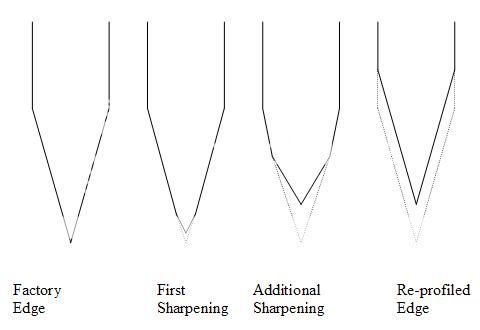
Yup, if a knife edge angle was perfect (30 degrees) then the 30 degree setting on the Sharpmaker would grind the entire bevel. But in real life, no edge angle is perfect so you're most likely sharpening just the tip.

That's good though. As long as the angle is pretty close to your target angle. What you end up doing is creating a micro-bevel. That's a tiny bevel on top of the one that's already on the knife.

Later when the micro-bevel grows too big to cut well, you reprofile the blade to cut down on the shoulder.

Sharpen-edge.jpg


The micro-bevel in the diagram is quite big, I had to make it big or it wouldn't be visible. Ideally, you want a TINY micro-bevel. Just a few swipes on the fine rod is all you need. Every time you touch up the edge, remove as little metal as necessary.

http://www.youtube.com/watch?v=vabd6vE5DdU

http://www.youtube.com/watch?v=BhDNI66J5qo

Since you asked, the two vids above are the best videos I've found to date that explains sharpening.
 
Last edited:
Back
Top