Sharpmaker: Is my idea good or bad?

Joined
Sep 21, 2010
Messages
2,957
I am ready to go to work on my folders. Most of them are fairly dull, yet new or nearly new.
I have the coarse diamond rods, the regular, and the fine.
This is a new Sharpmaker -- first time out.

1) Planning to do 40 strokes with each set. Sound good, not enough, or too much?? Don't want to ruin my blades. I have an old crap blade I will try first.
2] Is it worth the bucks for the super fine rods for an even finer touch?
 
It depends on the current bevel angle on your knives.

I suggest using a sharpie to mark the edges, and give it a few strokes.
If the stones aren't hitting the edge, you could potentially need to do hundreds of strokes
to bring that angle down until you are hitting the edge.

Found that out the hard way, but now I am getting hair splitting edges with ease.
It's really a foolproof system, but that doesn't mean practice isn't necessary.
 
I sharpened my Swisstool Spirit X's blade yesterday. Did 70 strokes on the edge of the coarse, 70 on the flat of the coarse, 90 on the edge of the regular, 90 on the flat of the regular and 120 on the edge of the ultra-fine and 120 on the flat of the ultrafine. my arms are now hairless. You can get a knife sharp in fewer strokes by far but you will get a better polish with more strokes.
 
1) Don't worry about counting strokes, each knife is different and will need to be profiled to match the SM angles.

2) Work with the coarse diamond rods until each bevel has a even scratch pattern and the edge is sharp.

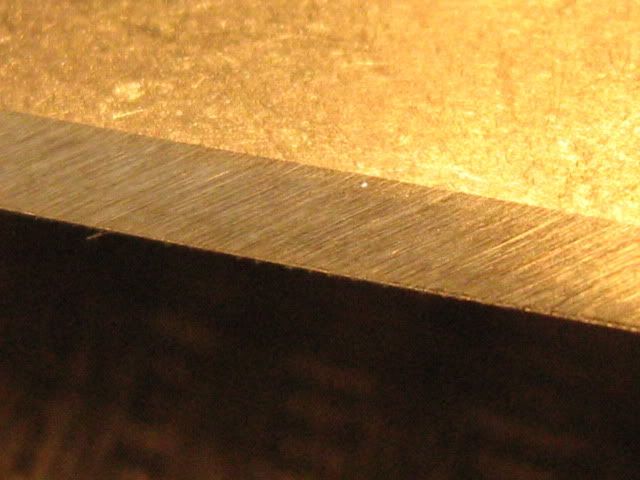
Like this.
Picture1252.jpg


Once the bevel has a evenly profiled edge that is sharp you can then move to the brown ceramics. Starting with a medium pressure work each bevel until the scratch pattern from the diamond rods has been removed and replaced by that of the brown ceramics.

The progression should look something like this. (this is a 1200 diamond stone, similar to the brown rods)
Picture1261.jpg


At the ending strokes you want to lighten up pressure and work to remove the burr at the edge. Each grit will produce a burr and it will help you greatly to try and remove it as much as possible at the finishing of each stone before moving to the next.

You will probably be fine with a single setting of 15/30 from start (diamond) to finish (fine ceramic). When using the blades you find that the edge is becoming too damaged a microbevel with the fine rods in the 20/40 setting will increase edge retention and resistance to deformation.

Go slow, take breaks, and just walk away if you become frustrated.
 
You won't need the UF right away. You can get really sharp with the F rods.

Use the sharpie, particularly for the diamond. No point in removing too much material.
 
Don't be surprised if the diamond rods don't work as quickly as you think they should. I found them very frustrating and finally ordered an extra-coarse/coarse DMT 6" stone that I use with the SM for profiling.

I recently reprofiled a friend's very dull chef's knife, and it took more than a couple of hours on the extra-coarse and then coarse DMT stone to get the bevel to 30°. The chef's knife was a lot thicker than most folders, of course. Not exactly an object of beauty when I finished, but at least it would slice hanging newsprint.
 
I had no idea that even the Diamond rods could take so long. Good to know. I have a 6 inch Smith Diamond course I got for Christmas which I was thinking would just be for the machete and some really big blades but may consider it for some folders too if the rods take a really long time.
 
I personally do not get hung up on counting strokes for knowing when to move to the next step, but it does help ensure that you are removing the same amount from each bevel. Yes, color the edge you are working on with a Sharpie marker so you can see where you are removing metal and that will inform you on how many strokes you are going to use. If you are hitting right at the edge, you should have a much shorter sharpening session than if it is just hitting the very back of the bevel where it transitions to the major blade grind.
 
Back
Top