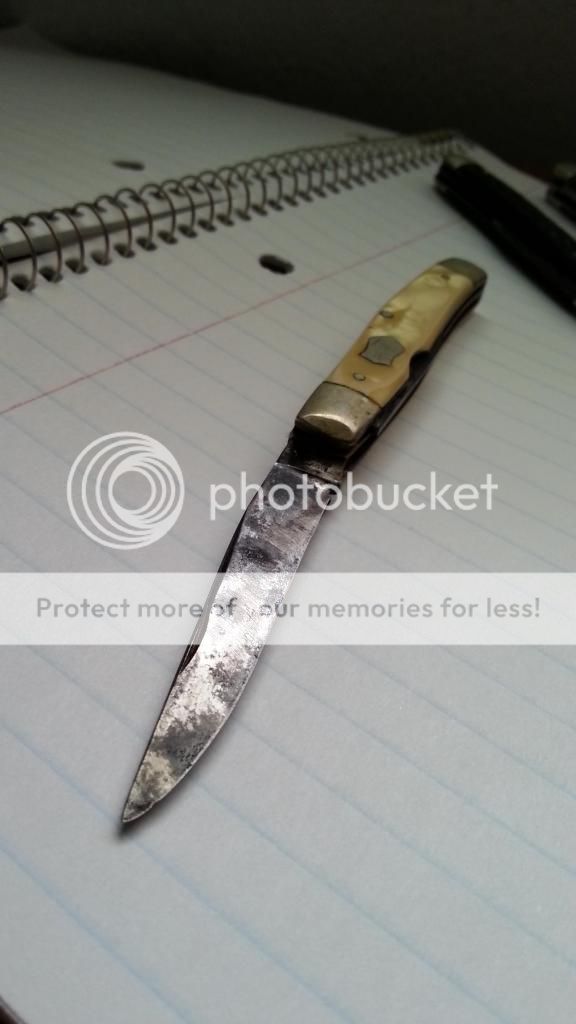
On rescuing my new old Remington R1572 it has to be the sharpest I've ever found. After a few licks on the sticks it is hands down sharp! I've rescued many a knife these last couple of years and haven't had this happen before. I do my own little sharpness testing first I shave arm hair then slice paper then go for my wood. I use three types of wood to see how the edge performs. One is maple the second is hickory and the third is dogwood. If I can whittle some good shavings from each I consider it sharp. What's the sharpest rescued tradional you've ever had. And is rescued a good proper term, I figure buying and cleaning them up and using them again is rescuing them from loss or destruction. I think I like rescue.

-
The BladeForums.com 2024 Traditional Knife is available! Price is $250 ea (shipped within CONUS).
Order here: https://www.bladeforums.com/help/2024-traditional/
You are using an out of date browser. It may not display this or other websites correctly.
You should upgrade or use an alternative browser.
You should upgrade or use an alternative browser.
Sharpness test of old knives rescued
- Thread starter PCL
- Start date

- Joined
- Jan 13, 2003
- Messages
- 6,577
Not any one in particular, but older knives, let's say pre 1950, have some of the sharpest carbon steel IMO. It's silly sometimes how the newer stuff doesn't seem to come close.
It's always enjoyable to take a rescue knife or some old knife, all peppered out and a rust bucket, clean it up and put a great edge on it.
I guess there is one I always enjoyed, it was a Schrade Cut co with B&M cell covers. It was a 2 blade, but the small pen was useless, so I made it into a single with an EO. The main blade was ate up, so I cleaned it some. One of my first mods, not hard to tell that. However, it's still one of my favorites, and boy, does it get sharp!
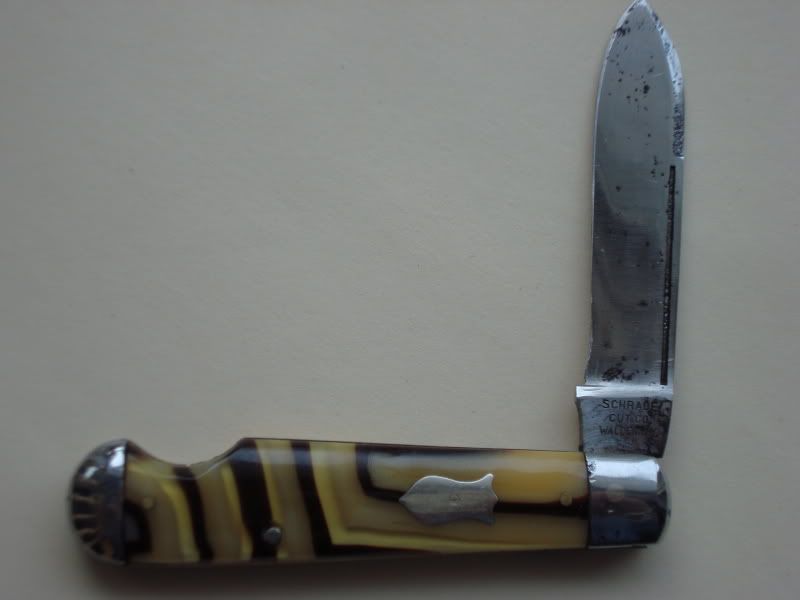
It's always enjoyable to take a rescue knife or some old knife, all peppered out and a rust bucket, clean it up and put a great edge on it.
I guess there is one I always enjoyed, it was a Schrade Cut co with B&M cell covers. It was a 2 blade, but the small pen was useless, so I made it into a single with an EO. The main blade was ate up, so I cleaned it some. One of my first mods, not hard to tell that. However, it's still one of my favorites, and boy, does it get sharp!


- Joined
- Mar 31, 2014
- Messages
- 8,640
Not any one in particular, but older knives, let's say pre 1950, have some of the sharpest carbon steel IMO.
Yes - I have some older carbon steel Camillus knives that are just "wicked sharp" with little sharpening effort - I just love the older knives anyway.


- Joined
- Dec 2, 2005
- Messages
- 72,319
I agree gents, don't know what they put in that old steel, but the way it sharpens is incredible :thumbup:

- Joined
- Feb 7, 2014
- Messages
- 1,590
I agree gents, don't know what they put in that old steel, but the way it sharpens is incredible :thumbup:
Blood, sweat & a good work ethic.
- Joined
- Jan 14, 2014
- Messages
- 19
could anyone point me in the right direction on a way to acquire one of these older knives? I hear all the time about how Schrade's old steel was the most amazing stuff, being able to sharpen up easily and yet keep a razors edge.
I want to experience the way it sharpens and its virtues, but i have no luck finding anything like that around here. The oldest knife i could find is only about 20 years old (fairly new).
Thanks
I want to experience the way it sharpens and its virtues, but i have no luck finding anything like that around here. The oldest knife i could find is only about 20 years old (fairly new).
Thanks
- Joined
- Jan 13, 2003
- Messages
- 6,577
could anyone point me in the right direction on a way to acquire one of these older knives? I hear all the time about how Schrade's old steel was the most amazing stuff, being able to sharpen up easily and yet keep a razors edge.
I want to experience the way it sharpens and its virtues, but i have no luck finding anything like that around here. The oldest knife i could find is only about 20 years old (fairly new).
Thanks
Send me a pm or email, I'll send something your way.
Glenn


- Joined
- Mar 8, 2014
- Messages
- 4,146
Send me a pm or email, I'll send something your way.
Glenn
That is very nice of you Glenn. :thumbup:
- Joined
- Jan 14, 2014
- Messages
- 19
Send me a pm or email, I'll send something your way.
Glenn
Thank you Glenn, it means a lot. I cant seem to get my hands on any of that magical steel. GECs blade geometry suits my needs fairly well, but like many, including yourself had said, there is no comparison to the old time steel.
- Joined
- Jul 1, 2013
- Messages
- 32,479
they also ground them a lot thinner back then, makes for a nice edge
What George said is right on the money! The prybar knife idea seems to have invaded all levels!
These older blades may be a few points softer which makes for easy sharpening and we really don't ask that much of out 2-3" pen blades.
- Joined
- Jan 14, 2014
- Messages
- 19
What George said is right on the money! The prybar knife idea seems to have invaded all levels!
These older blades may be a few points softer which makes for easy sharpening and we really don't ask that much of out 2-3" pen blades.
so is it the softer rockwell, or the steel composition that plays the larger part in how these steels performed?

- Joined
- Aug 13, 2013
- Messages
- 2,072
I think the geometry/thinner blades have much to do with it.
A couple knives I recently rescued from my Dads garage are absolute razors after a cleaning and sharpening.
Both had very thin carbon blades and make my GEC Crown Lifter look like it was made by ZT.
I think it would be nice if more new knives were offered with very thin blades cause it is nice to have such a specialized tool if needed.
A couple knives I recently rescued from my Dads garage are absolute razors after a cleaning and sharpening.
Both had very thin carbon blades and make my GEC Crown Lifter look like it was made by ZT.
I think it would be nice if more new knives were offered with very thin blades cause it is nice to have such a specialized tool if needed.
- Joined
- Mar 31, 2014
- Messages
- 8,640
I think it would be nice if more new knives were offered with very thin blades cause it is nice to have such a specialized tool if needed.
I agree with you, however, I doubt they will because they know that many people abuse these knives and here is an example of some people's mentality:
I have a brother/or friend that once told me that he was not going to buy any more American made knives - "the steel was too crappy." He said he had an American made BUC_ knife and the tip broke off of it. I asked him how that happened and he said he was very gently prying something and it just snapped off.
I politely suggested to him that a cutting blade was NOT DESIGNED TO PRY THINGS and he should use the proper tool for the job. He just kept ranting about it and swore to not buy American steel, that it was all JUNK and that he was only going to buy German made steel. He said that the "Germans know how to make good steel."
I recall thinking of a bull in a China shop and also "Poor Germans."
About a year or so later, I was over at his house and asked him if he had a kitchen knife I could use to cut up a salad. He pulled out a very nice and beefy stainless steel J.A. Hencke_ _ 8 inch chef's knife, made in Solingen, Germany.
As I cut up the veggies for a salad, I just could not help but ask him, "how did the tip get broken off of this nice ole German made kitchen knife?"
He looked strangely/sternly/embarrassed at me and told me that "his wife had broken it trying to pry on a window sill."
So - you see what they are up against with some of their customers.

Last edited:

- Joined
- Sep 28, 2005
- Messages
- 4,527
In my opinion a quality company would use a quality steel for the time, so geometry would be more important than composition. A few points softer will sharpen easier yet dull faster in more simple steels. However I do feel that it is less about the steel used- today smelting processes are much more exacting and pure than turn of the 1900's- we can even see CPM steels in traditionals! But to me it is the total package- the overall got and finish combined with thinly ground laser blades!
Here is the knife that immediately popped into my mind- I believe it is H Dorwal, I love the dark bolster pivot pins! (Ignore the WharnKris, I'll replace the pic later if needed, only one I have with this knife and wanted to make sure I posted). I love the look of what I call a scalpel blade- all belly and reminds me of a Scagel look! It is interesting to me to think of how and what this knife was used to cut to make the blade this shape. Plus the previous owner was like me- the pen blade was unused until I sharpened it!!
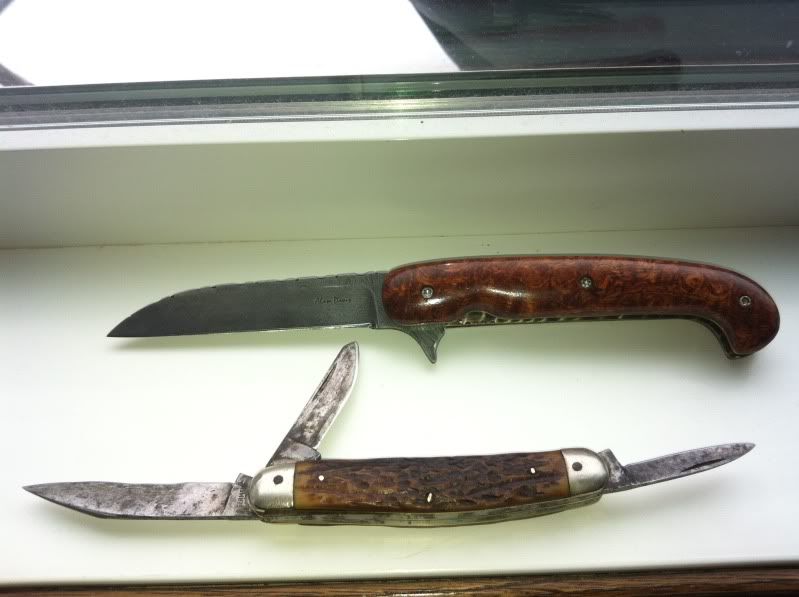
Here is the knife that immediately popped into my mind- I believe it is H Dorwal, I love the dark bolster pivot pins! (Ignore the WharnKris, I'll replace the pic later if needed, only one I have with this knife and wanted to make sure I posted). I love the look of what I call a scalpel blade- all belly and reminds me of a Scagel look! It is interesting to me to think of how and what this knife was used to cut to make the blade this shape. Plus the previous owner was like me- the pen blade was unused until I sharpened it!!

black mamba
Gold Member
- Joined
- Oct 21, 2009
- Messages
- 23,936
#85 teardrop jack in ebony.

- Joined
- Jan 14, 2014
- Messages
- 19
whatever it is, it was made right. I can see any of the above arguments being valid, and perhaps even working in conjunction with one another to provide such nostalgic steel.
Not being able to find any older knives due to no flea markets or garage sales, I wanted to openly thank Glenn for offering and sending me some fine samples. These knives have opened my eyes to manufacturing techniques and quality of a long gone era. Thanks Glenn:thumbup:
These showed up expertly packaged [by Glenn] on my doorstep.
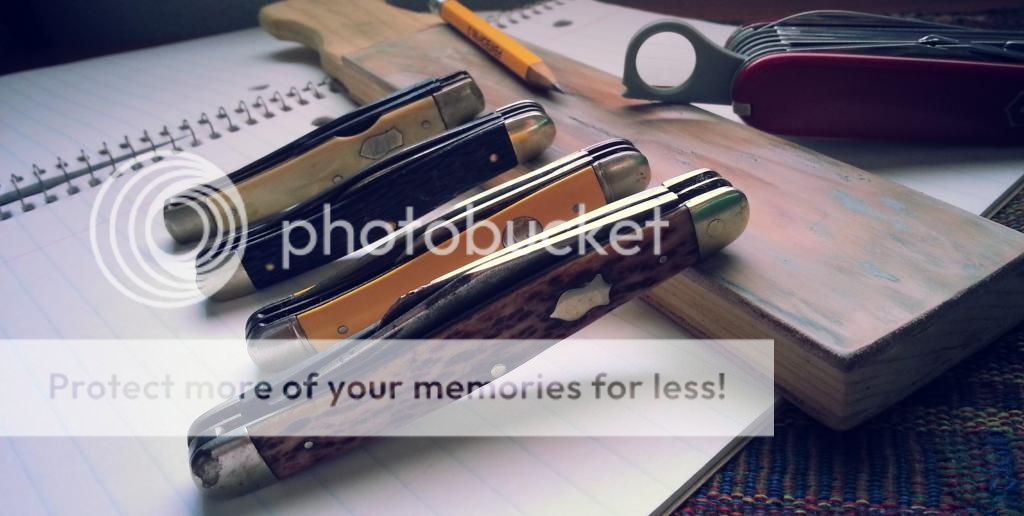
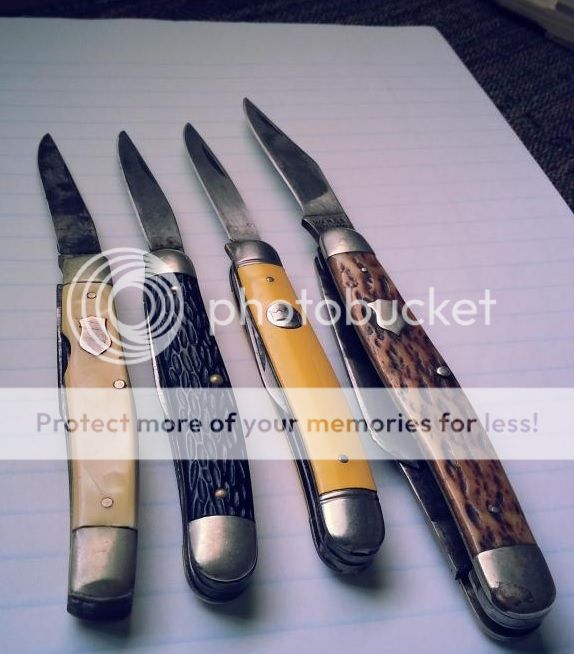
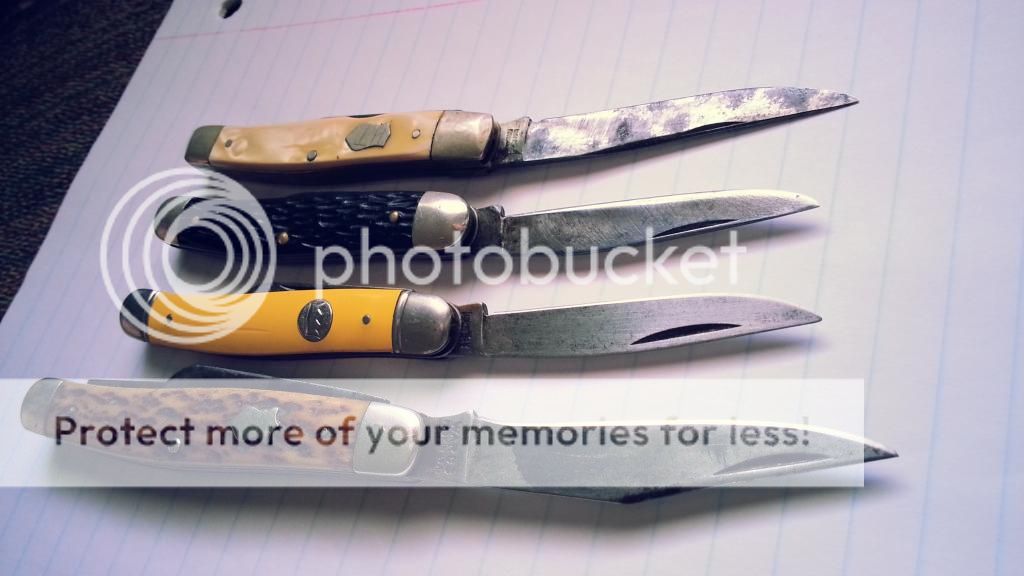
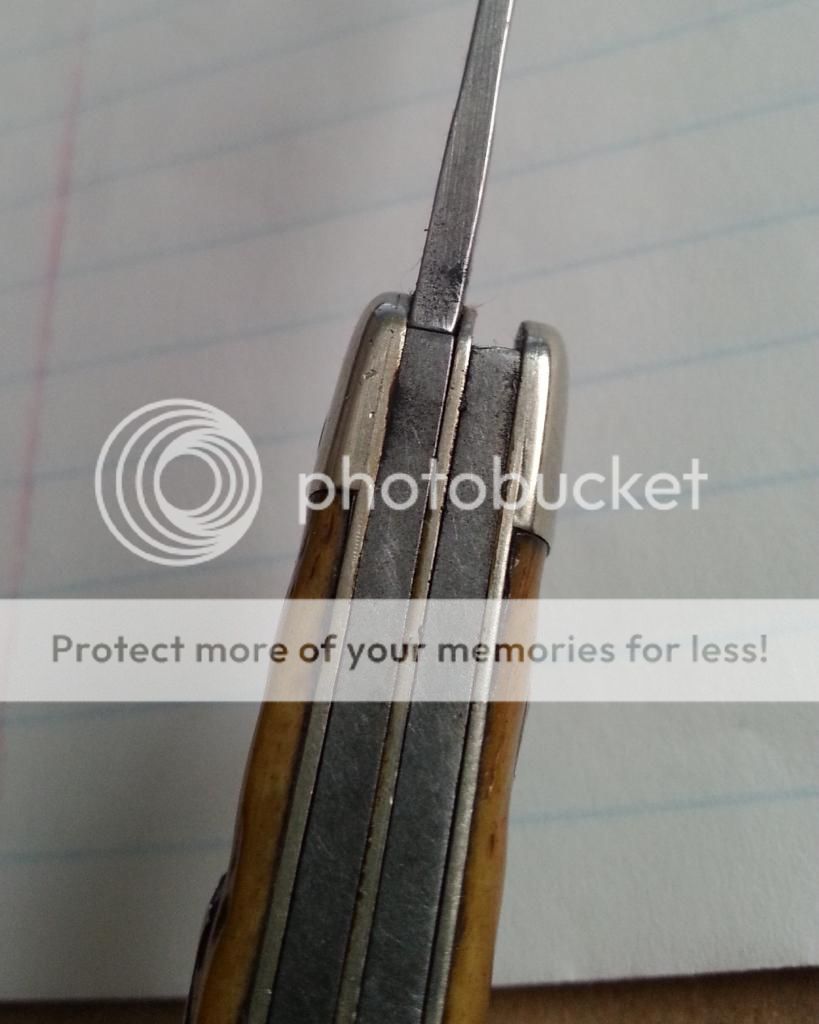
Two yellow Imperial serpentine jacks, black Hammer Brand serpentine, and a Wards stockman. Two have the stamped out shell covers, and two have nice pinned covers & pinned shields. The knives are a bit dirty/rusty, but have been cleaned since. Their construction, however amazing may seem to us now, was just standard practice back in the day. Smooth operating cam ends, well position nail nicks, not gluing shields in, wonderfully thin ground blades, square tangs at spring junction, and most importantly the great composition and heat treatment of the carbon steel.
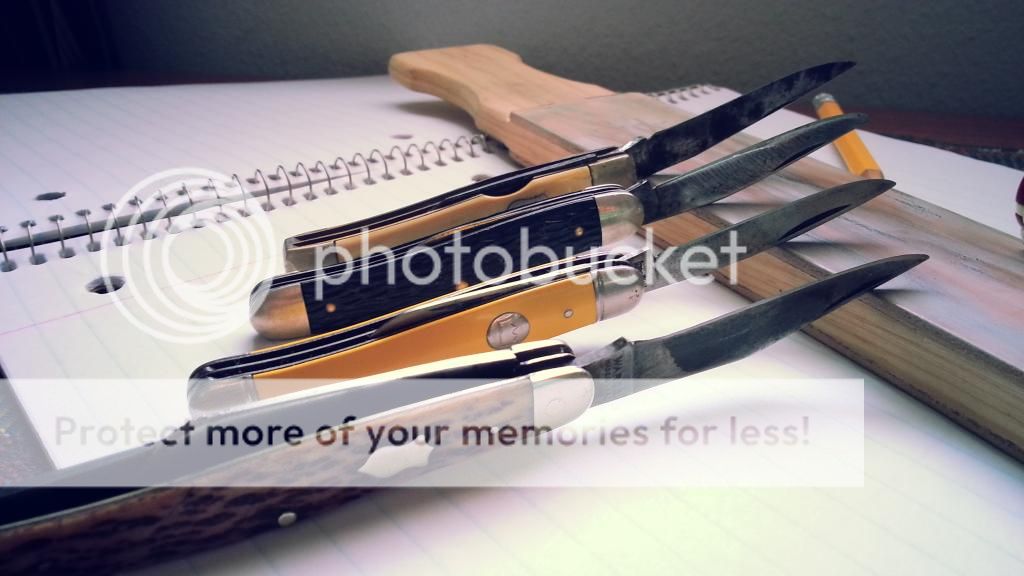

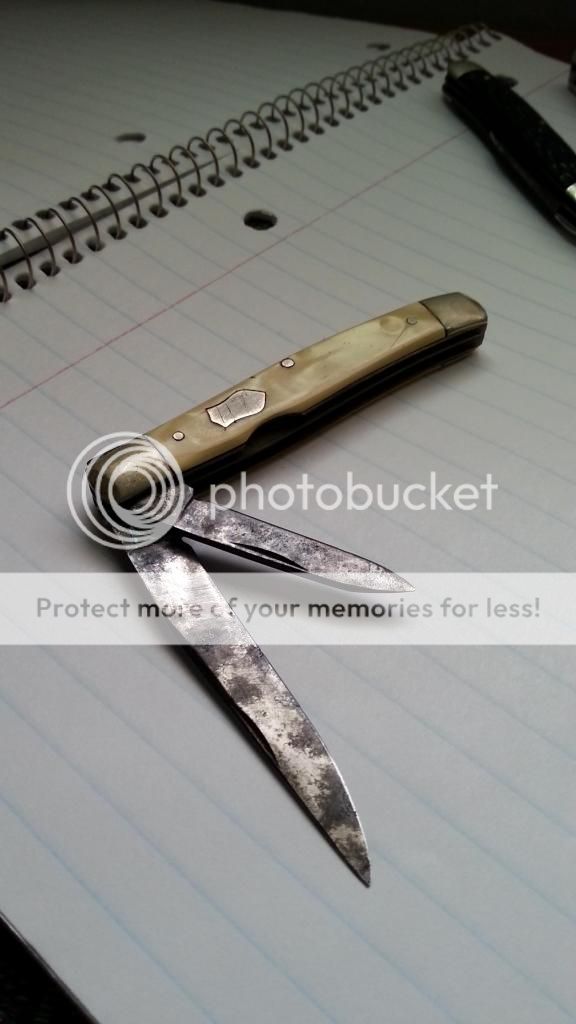
This one is my favorite, it looks to have been someones prized possession, and might have slipped out of their pocket without realizing it. I am really partial to the main-blade shape + nail nick placement, and it has an unusual little half spey / half pen secondary-blade that is appealing. The shield has "HT" scratched into it, and the blades look to have been only lightly sharpened.

Who says you need a 10 degree inclusive angle? These came screaming sharp, masterfully sharpened by Glenn. The geometry allows for a very shallow angle
Not being able to find any older knives due to no flea markets or garage sales, I wanted to openly thank Glenn for offering and sending me some fine samples. These knives have opened my eyes to manufacturing techniques and quality of a long gone era. Thanks Glenn:thumbup:
These showed up expertly packaged [by Glenn] on my doorstep.

Two yellow Imperial serpentine jacks, black Hammer Brand serpentine, and a Wards stockman. Two have the stamped out shell covers, and two have nice pinned covers & pinned shields. The knives are a bit dirty/rusty, but have been cleaned since. Their construction, however amazing may seem to us now, was just standard practice back in the day. Smooth operating cam ends, well position nail nicks, not gluing shields in, wonderfully thin ground blades, square tangs at spring junction, and most importantly the great composition and heat treatment of the carbon steel.


This one is my favorite, it looks to have been someones prized possession, and might have slipped out of their pocket without realizing it. I am really partial to the main-blade shape + nail nick placement, and it has an unusual little half spey / half pen secondary-blade that is appealing. The shield has "HT" scratched into it, and the blades look to have been only lightly sharpened.


Who says you need a 10 degree inclusive angle? These came screaming sharp, masterfully sharpened by Glenn. The geometry allows for a very shallow angle

- Joined
- Feb 3, 2001
- Messages
- 32,359
There's a name for when a metal improves its performance with age and for the life of me I can't remember the term but it has to do with aging.
Seems to me like the knives I have that are at least 50+ years old trend to take a keener, longer lasting edge. My 100+ year old Union Knifeworks Moose pattern takes a scary sharp edge and seems to outlast most of the modern comparable steels, even my late 1800s J. Szeraki Pearl Lobster is the same I've sharpened it maybe twice and it'll still filet paper.
Could it be that the way they made the steel back then compared to modern metallurgy today? I don't know but I do know older gets sharper easier and stays that way longer.
Seems to me like the knives I have that are at least 50+ years old trend to take a keener, longer lasting edge. My 100+ year old Union Knifeworks Moose pattern takes a scary sharp edge and seems to outlast most of the modern comparable steels, even my late 1800s J. Szeraki Pearl Lobster is the same I've sharpened it maybe twice and it'll still filet paper.
Could it be that the way they made the steel back then compared to modern metallurgy today? I don't know but I do know older gets sharper easier and stays that way longer.