Short term performance versus long term performance

Tai Goo

BANNED
Joined
Apr 7, 2006
Messages
3,806
Is there a difference?

If knives exhibit “high performance” in the short run does it also mean that they will exhibit high performance in the long run, or does high performance in the short run sometimes equal a shortened tool life?

What roles do steel selection, geometry and heat treating play, if any?
 
Last edited:
Yes.
Not necessarily, and yes, often.
Several.


If so,... how do we know whether the advice we are getting is geared more towards the short term or long term?

Does that mean knives often exhibit high performance in the short run,… but "often" catastrophically fail in the long run?

Please explain...?
 
Isn’t the factor of time, and/or the number of “stress cycles” (and to what degree) any given blade can withstand, at least equally as important as anything else?
 
Last edited:
Quote: Does that mean knives often exhibit high performance in the short run,… but "often" catastrophically fail in the long run?

It seems as if you're implying that knives "often" (??) catastrophically fail. I'm having visions of the handle scales coming off in my hand and the blade breaking into shards while cutting a marshmallow. If you're talking about the knives I make, then heck yea, but in general I don't feel this is accurate. If a person uses a knife beyond what it was intended for or just plain abused I could see it breaking or failing. Start batoning a little bird and trout knife or a fillet knife through hard wood and it will exhibit high performance... for a while, until it catastrophically fails.

Maybe I don't understand what you mean by "high performance" and "catastrophically fail".

- Paul Meske, Wisconsin
 
Last edited:
Tai,
Performance is a hard word to pin down when talking about knives. One person thinks performance is initial cutting ability, and another thinks it is edge retention.

All knives will wear with use. The degree of serviceability during wear is what you are getting at, if I read your question right.
Good blade and edge testing should include multiple cutting tasks, not just one or two cuts. The reason the ABS test has you cut a rope, chop through a 2X4, and then shave some hair is to prove the edge retention as well as the sharpness.

You are also correct in the fact that just because a knife has spectacular high performance tests in the shop doesn't mean it will not fail catastropically in the field.
Some folks use short term performance info as a selling point, and hide ( or never test) the long term specs.
A 1095 knife can be hardened to Rc 64. That could be used as a high performance atribute......but the long term survivability of the edge, and the entire blade, may well be greatly lessened if used beyond the most gentle slicing.
On the other side of that coin, a D2 blade may not get quite as sharp, or be a pretty, as the 1095 blade, but the edge will last many times longer....and breaking the D2 blade will not normally be an issue.

I personally feel that long term use is far more important than short term performance. This is especially true of professional cutlery. All sashimi knives can be sharpened to the same degree, but they quickly start to separate themselves in use. I still don't agree that a $1500 sashimi blade is automaticlly 10 times better than a $150 blade, but you can't tell the sheeple what they don't want to hear. The amount of time between re-sharpening is the key factor to most chefs......
NOT THE HANDLE WOOD
NOT THE BLADE FINISH
NOT THE STEEL TYPE
.................................IT IS THE EDGE RETENTION and CUTTING ABILITY after hours of use they care about.

I believe it was a very old Ford slogan that said, " Starts first time....every time". The implication was that all new cars look shiny and run good. It is how they do after years of use that makes for repeat customers. ( Just using the slogan - let's not sidetrack this into a car wars, Ford vs Chevy, thread)
 
Last edited:
"You are also correct in the fact that just because a knife has spectacular high performance tests in the shop doesn't mean it will not fail catastropically in the field."

"Some folks use short term performance info as a selling point, and hide ( or never test) the long term specs.
A 1095 knife can be hardened to Rc 64. That could be used as a high performance atribute......but the long term survivability of the edge, and the entire blade, may well be greatly lessened if used beyond the most gentle slicing."

"I personally feel that long term use is far more important than short term performance. This is especially true of professional cutlery."

Great points Stacy. I agree.

Unfortunately, I think the trend of the day is leaning more towards showy sort term performance,... over quenching/under tempering etc. Sure, we can push the steel to it's extreme limits and squeeze every last drop of performance out of it for showmanship, immediate gratification or to impress folks, but is that really such a good idea in the long run? I think not. Some of the extreme claims makers make about the short term performance of their knives or their in shop tests do seem somewhat misleading and may also contribute to unrealistic expectations and knife abuse in general.

Beyond a knife performing well for it's intended purpose and withstanding the test of time, it all gets a bit silly.
 
One thing that makes it difficult to answer these very important questions, in my opinion, is that the vast majority of the type of knives showcased here and in general, regardless of our fantasies, are rarely, heavy "working" knives. Kitchen cutlery may be the exception, but combat style, utilitarian and outdoors knives seem to be very casually used in general, at least to my perception.

Of course people will argue that their combat knives are tested in theater by whomever, wherever, etc. but in reality, how much actual "combat" use does any combat knife see? Just being carted around by a soldier, even a special forces type or whomever, doesn't see that blade being put to knife task often, if ever. Most people's "EDC"s might see 5 minutes of use per day cutting down boxes or slicing apples. The vast majority of top end knives are safe-queens regardless, maybe getting the occasional workout with kitchen duty, often being a knife that's not even designed for that work. The majority of the outdoors market is dominated by the spyderco folders for the casual crowd, and the inexpensive scandi's for the bushcrafting set.


As a professional maker of top end outdoor equipment for professional outdoorsmen, even in that arena, I see very little heavy use of high end cutlery, fortunately at least, the blades that are in play are getting used, and "work" tested, but often times, the percentage of actual use is marginal, and there's not a lot of user education in that market, even amongst the bushcrafting enthusiasts.

Kitchen cutlery seems to be the exception, and I'll include other food related work in that realm. Some of these knives are seeing every-day use, with many hours of work, but even still, like the rest of the cutlery market, the consumers seem to be highly un-educated, and the level of hype and myth seems astronomical. The more I learn about knifemaking myself, the more I realize, the amount of sheer misinformation being proliferated is *astronomical*, and it's very frustrating. However, considering the lack of general consensus even amongst the makers, I guess it's to be expected, so much about knifemaking has become dogma, regardless of objectivity.


Personally, and no offense intended to anyone, but I feel the ABS style testing, and the rest of the youtube type staged testing is largely irrelevant. Even amongst the ABS there seems to be a pretty strong opinion that the performance testing is largely formality that anybody with a basic understanding of knifemaking can pass. Anybody can make a knife that passes the bend test, and there's a simple reason why the vast majority of those knives are made in 5160, and why very few would be expected to pass if made in 1095, even if blue backed. It's a finite test with a very limited scope. The same with rope cutting and 2x4 chopping. It's the same thing when I see "built like a tank" combat knives chopping cinder block or whatever. I don't mean to disparage these test too heavily, I understand the need for an objective streamlined evaluation process, but in the greater scheme, I think they're essentially meaningless. I've never found occasion to need to chop rope, 2x4's or cinder block in real life, and I've never needed to have my knife bend 90degs. Frankly, I can chop 2x4s with any knife of adequate size even if it was dull as a stone to start with. Come on, it's soft pine. Rope is more appropriately cut, and the cinder block thing is entirely irrelevant IMHO.


So, I guess my longwinded point is, I think we know very little about long-term performance, and there's not much about the knife market that encourages any change in that.

Just my worthless opinion.
 
I agree that the buying public has slanted the sales market of nearly everything away from quality and toward salesmanship and showiness - AKA - hype. There is a good reason why cars,tools, and, even knives....are sold today with adds showing a shapely gal in a low cut ( or barely there) top. In days past it was the car the public wanted to see. The other problem with consumers is that we have become a throw-away society. Who cares about how long it will last...just buy another one when it won't cut anymore.

I sharpened a set of Henckels last month for a woman who was going to throw them out. She asked me to make a custom set to replace them with. I asked why she didn't like her Henckels, and she replied that she loved them, but they wouldn't cut anymore. She was blond to the brain, but one would think that even such a bubble head would know that good knives will get dull, too. So, I put super sharp edges on them, ....and she complained that they were too sharp,......because she cut herself the first time she used them.
But, I digress.......

As far as misleading claims to high performance and long term performance go, I submit the ultimate example:
The Ginsu Knife
There has never been a better/worse example of high performance hype in selling. Cutting cans and pipe , and then cutting a boiled tomato. This was immediately followed by the claim of a lifetime guarantee, seeming to imply that the blade would last forever.
The real marketing genius was the fact that the makers knew maybe ten people worldwide would actually ever return one for replacement.
 
Good points guys.

One problem is that long term field testing isn't something that can be shown in a short video clip or immediate performance test, so what we are left with is only seeing the short term stuff. Everyone likes to show off their blades a little, and it's an easy trap to fall into. Back in the late 90's I did some back yard heat treating on 5160 in a video and just wanted to demonstrate that the blade came out hard and tough. So I clamped the blade edge up in a vice and cold cut some mild steel rod with it using a blacksmith hammer. I didn't think it was any big deal at the time, but looking back I really kind of regret it because so many people who saw the video took it the wrong way.... knives aren’t made for cutting steel and even if a blade can pass that test, the test itself may weaken the blade for future use. In my recent Hammerjamin video I did a sharpening demo followed by some cutting demos, but those were just to show that the sharpening method I used could produce great results and said nothing about the long term performance of the blade I used. I think the sharpness demos were much less harmful than the steel rod cutting test.

As professional makers, obviously we can't keep every blade we make for long term testing, but I do think it's a good idea to make an occasional knife just for that purpose, especially if we are trying new steels and/or new methods and designs. The long term testing is generally up to the consumer and as already mentioned not many of them get used enough for a good test.

The main purpose for the in shop tests we do, is for our own education and they do often help give us some level of confidence in our blades.... but should those types of tests be made public and used for marketing?

I think to some degree we all want instant gratification, but until our knives have been in circulation and used for many years or even decades we really won’t know much about the long term performance, and even then I think the feedback will be limited.

It all leaves us in a bit of a pickle. Personally, I tend to be weary, skeptical and try to steer clear of the whole "high performance" niche or genre. I try to use common sense in my own work and sort of baby the steel along through the whole process,... take my time, try not to over stress it, make a few trade offs, a few small compromises and try to come up with a reasonable balance between short term and long term performance.

I want my blades to perform "good" in the short run, but "excellent" in the long run and tend to lean more in that direction.
 
Last edited:
I agree that the buying public has slanted the sales market of nearly everything away from quality and toward salesmanship and showiness - AKA - hype.

But my heat treat really is magic and my steel is superior to all other steels! I'm drunk!


There, hah! Beat that!
 
From scandi grinds and batons to straight razor hollow grinds and whittling hairs, theres a whole
world in between. Edge geometry?
Ken.
 
I always design for long term durability. I leave the edge a bit thicker on larger pieces and choose a hardness that is not overly ambitious given the steel and general intended use.
 
They’ll all last a lot longer if you don’t abuse them and treat them with respect.
 
In my opinion, the one style of knife that is put to the test over years and years of ownership is the hunting knife. Arount these parts, rural Virginia, hunting is practically a religion, and it is not uncommon to see guys carry and use the same knife for a lifetime, then pass it on to their kid. However, that knife, the one they carry and pass on, is more often a Buck hunting knife than a high end custom knife. I've sold quite a few hunters to local hunters, and so far everyone's a satisfied customer, so I guess my knives are long term performers. But...are my knives better than a plain old Buck hunter a guy can buy for a $100. or less and use and keep for a lifetime? Guess that remains to be seen since I've only been selling for six or seven years now.

Dave
 
Last edited:
I will try to keep this brief; there's an awful lot to think about on this topic, so I'll stick with my thoughts on edge retention and hunters for now.

The thing about hunting knives (whether dirt cheap or ungodly expensive) that attain near-mythical status by being passed on for generations is, they're mostly used once or twice a year, for maybe 20 minutes at time. A Buck knife made of 420HC (or even a dollar-store kitchen knife made of who-knows-what, honestly) can and will field-dress a buck or two without needing much sharpening, and there's nothing wrong with that. But I don't think that counts for much in terms of "long-term performance".

Two deer/year, times 50 years, equals what, 33 hours of actual cutting, maximum? A guy working for $10/hr in a meat-packing plant, turning near;y-frozen chunks of beef into the steaks I like so much does that every week.

Point is, most hunting knives suffer far more degradation from being used or stored improperly than they do from actually dressing/skinning deer... the issue is practically moot unless you're a professional guide or so rich that you can afford to hunt all year long all over the world.

Buck and others sell a whole lot of knives and enjoy great reputations because:
A) their designs cut well; they nearly all involve small-to-moderate sized blades that are handy to use, and ground thin. That works.
B) They employ efficient mass-production techniques, including easy-to-machine, easy-to-maintain materials to keep costs very low. Almost anyone can scrape together $30-50 for a Buck 110 or Vanguard, and they're both solidly-built knives that will cut soft material like deerskin and warm, raw meat quite well.

Edge-geometry has to come first; you can skrimp or splurge on every other aspect of a knife to your heart's content, if it's good and sharp out-of-the-box. The folks at Buck, Kershaw, CRKT, and many other manufacturers understand this.

There actually is an objective test to evaluate edge-retention, developed by the fine folks at CATRA. They take a knife and cut multiple layers of abrasive material with it under controlled circumstances, until it won't cut any more. This is not rocket science.

While I agree that marketing hype just plain sucks, I think it's clear that there is a growing number of knife buyers who've learned to see beyond the baloney and make fairly-well-informed decisions about what they really need and what they're willing to pay for.

 
Last edited:
I am dull boy, slow to understand some things. So I'm not sure I understand the question...

I am a knife user. This is what got me into making knives in the first place. It revolved around wanting more performance in the knives that I used because I used them a lot. I burn through pocket knives at a surprising rate because I use them in the shop. I want a high performance tool. I want it hard and thin so it will stay sharp and cut better. When deburring parts, stripping wire, cutting cardboard and glass reinforced tape, knives that I consider to be high performance stay sharp enough to keep doing the job all day. I like my high performance steak knife, it makes me happy to cut my food with it. I have kitchen knives so thin you can flex the edge with you finger and it makes me giddy to cut the corn off the cob with it.

My life is never going to hang in the balance of one of these high performance knives. If one should fail catastrophically, so be it. Which brings up an interesting point: The failure mode of most of my knives is wear. I wear them out. And the "high performance" knives need less sharpening and therefore wear less, and therefore "fail" less.

Ironically, a small Goo integral in W2 that I have beats every knife in my collection in a hardwood edge stability test. In my opinion, that is high performance.

Tai, if you're trying to be mediocre, you need to try harder...
 
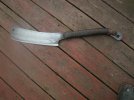
Well, here's a good example of a time tested working blade, it was used in slaughterhoues. This cleaver has a 15" blade, and is more than 100 years old. Still perfectly servicable, it could resume it's old duties with no problems.

Dave
 

Attachments

  • new knives 061.jpg
    new knives 061.jpg
    71 KB · Views: 30
Back
Top