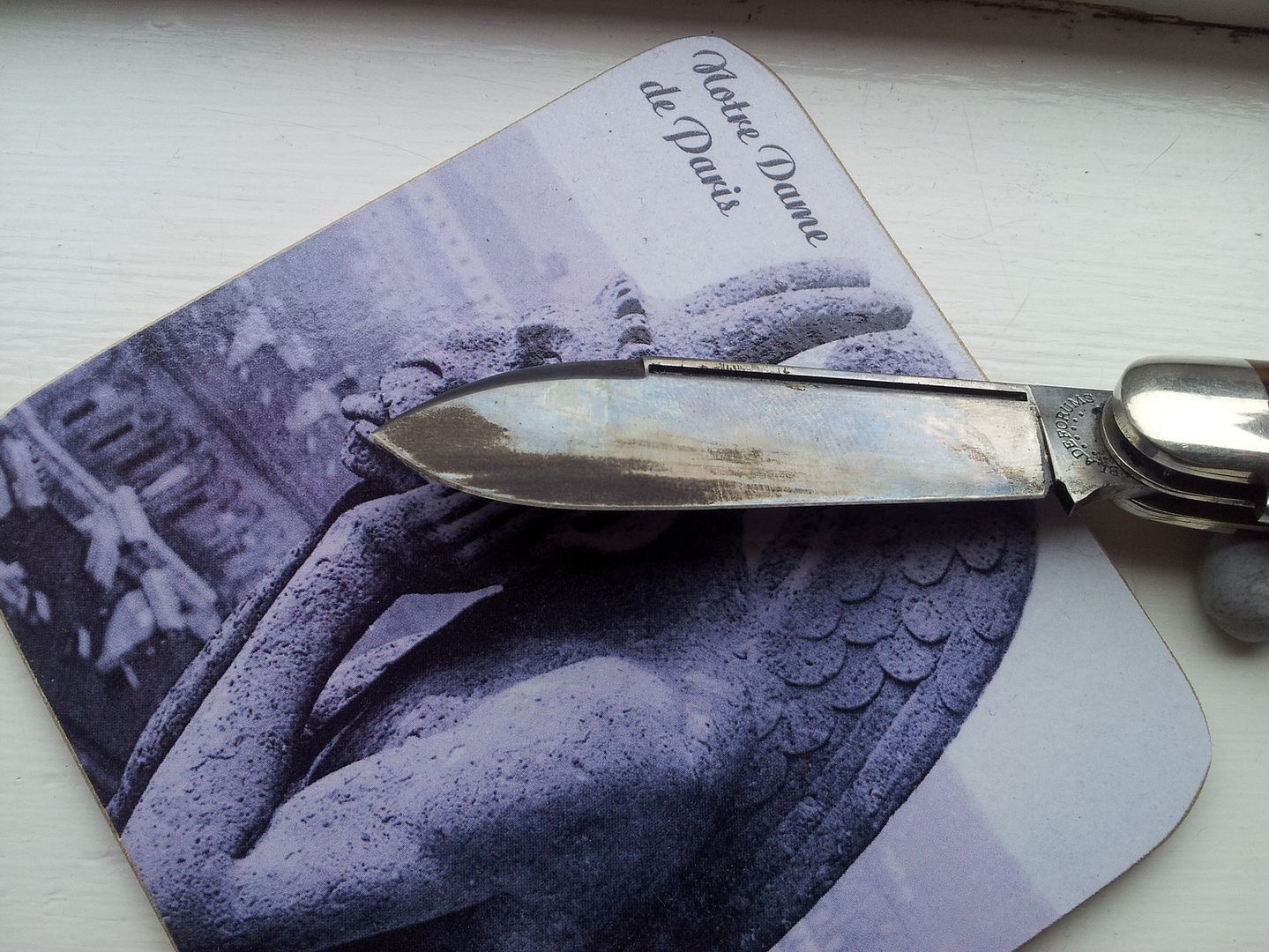
Should I be worried about this and if so what can be done?

meako

Gold Member
Joined
Sep 4, 2006
Messages
10,121
2012-11-22111817.jpg

This is my 2011 BF Trad knife.
I have sliced up fruit and meat with it.
Kept it clean and oiled.It dwells in its original brown paper nestled in a dedicated Plano tackle box with its brothers none of which have this discolouration.
What could be the cause of this harsh patina? It seems to have eaten in to the finish.
It is rough to the touch.And has occurred mainly on one side-there is a tiny patch on the other side.
I'm now carrying it in the hope that some more work will rub this crud off. I definitely don't like it.
Any comments /suggestions most welcome.
cheers.
 
try some rubbing alcohol..maybe some 0000 steel wool?
or a combination of both?

i've never quite seen anything like this before...
 
cheers -i'll try the rubbing alcohol(if it doesn't work at least I can drown my sorrow:))
No I haven't either and I haven't treated it any different to any other knife.
More than likely its fruit acidity.
It was sitting in the box for a couple of months awaiting rotation I think this may be a factor although I get them all out for a clean regularly.
 
Simichrome or Flitz might help. I've used WD-40 and a toothpick to good effect getting off some resistant crud on neglected blades.

The 0000 steel wool is a good choice as well.
 
Get it out of the paper when the dust clears. That paper will hold moisture should you put the knife away with say blood from meat, juice from fruit, etc.. Just store it sans paper and hopefully, it won't happen again AND wipe your knives down with an oily, flannel, rag or a silicone impregnated gun cloth - usually gray in color.

Here is how I store knives I want ready access to. Plano tackle box with toolbox drawer liner. Oh, the leather sheath was only there for a day or two. Leather draws and retains moisture too.

knifestorage2.jpg


Edit to say: It's ok to store knives in the paper wrappers they come in as long as you wipe em down and oil them before puttting them in the wrappers. This would apply to boxes, tubes, whatever storage medium you use.
 
Last edited:
Looks like there is a thumbprint on the blade too. I recommend handling your knives with an oiled rag and wiping them down before putting it away. I've had a few thumbprints show up from closing a knife barehanded a few times.
 
I'd 2nd the recommendation to scrub the blade with Flitz/Simichrome. Might take some scrubbing, but that should take the oxidation off (all patina). Looks as if something acidic, or maybe salts (cutting meat?), got into the blade originally. Whatever caused the oxide in the first place, there may still be something corrosive in/under that oxide. Hence, better to scrub all that off, down to clean, shiny steel. If the steel is pitted or etched, only way to remove that is by sanding. I'd also not store the knife with the paper; some papers can be acidic.

In the future, after cutting fruit, meat, etc with it, some Windex on a paper towel is very effective at cleaning the blade (handles oily fingerprints well, too). That's what I do with my carbon-bladed knives, each evening before putting them away. All the more important if they get put away for several days or longer; blade must be completely clean, whether it gets oiled or not.

Edit:
For what it's worth, I know vinegar (acidic) can turn a 1095 blade BLACK like that, more so if there was already a light, even patina before. On un-patina'd steel, vinegar will make it rust (red) in an hour or two. This is why I wouldn't be surprised if something acidic got to your blade, over some time.
 
Last edited:
Thanks for the advice.
I've just given a taste of WD40 and 0000 steel wool.It seems to be working.
With a little more persistance it should be back to normal soon.
Thats what I would do to clean up an old grungy knife but this one isn't old and I must say I was taken aback when I opened it up to find that corrosion.
The thumbprint is probably from today prior to the pic I was worrying it with my fingernail to see if the stuff would scratch off.
2012-11-22124436.jpg
 
For once the photo makes it look worse than to the eye.I'll give another go later. I used some P1200 wet n dry paper which was abit quicker than the wool.
 
cheers.it's gone under 24hr surveillance in my bumbag.
I hope no-one thought I was bagging the knife itself.
That(shudder) "patina" was the result of good honest work.
 
gargoyle.gif


What a difference a day makes...
 
I've noticed that compared to CASE cv and Böker's carbon, GEC steel can stain darkly and much more unevenly. This appears to be what has happened with your Forum 11 knife. I've found that building an even colour/patina on a GEC blade takes more 'supervision' I need to scrub it and use polish to allow an even colour. The other two brands can just be wiped down and a reasonably uniform patina emerges quite quickly.

Nearly every day I cut up two oranges for juicing breakfastime, and the GEc knives certainly stain in patches when put to kitchen tasks.
 
Blood has a habit of patinating carbon steel very quickly and the discolouration seems to penetrate much deeper than acids alone. It might have something to do with the oxygen enriched red corpuscules. If you let it dry it can be a real PITA to get the stain out.
 
Blood has a habit of patinating carbon steel very quickly and the discolouration seems to penetrate much deeper than acids alone. It might have something to do with the oxygen enriched red corpuscules. If you let it dry it can be a real PITA to get the stain out.

Blood also contains electrolytes (sodium, potassium, chloride, etc.), which regulate blood chemistry by allowing ions to move freely about. This is also how corrosion occurs, by exchange of ions. Considering blood contains water, oxygen and electrolytes, it's tailor-made for accelerating oxidation.
 
Willgoy's observation that GEC 1095 tarnishes more readily that the non stainless steels of other knife manufacturers is worthy of an explanation. I don't have one. Do you ?
I have many hunting knives with 1095 steel. Some have had blood left on the blade for up to 12 hours, but none ever developed the nasty blackness shown in the OP.
Might this indicate that the GEC 1095 blades are not polished to a high grit and therefore the surface is covered with "micro striations" ?
Surely there is a chemist among us who can explain what causes the GEC 1095 to react so excessively.
rolando
 
Insufficient data with too many variables in the experiences of various users.
 
Back
Top