Silly/Odd HT question

james terrio

Sharpest Knife in the Light Socket
Joined
Apr 15, 2010
Messages
22,618
We've all seen cool-looking forged knives where some of the forging marks and scale is left on. While I used to mock them as simply being unfinished, the idea is really growing on me.

I was just wondering if I did a similar project by stock-removal and left some of the mill scale showing, would that pose any problems during HT? Will it be an issue later in terms of corrosion resistance? Will the HT'ed mill scale be brittle or durable?

This isn't so much for aesthetics as for cost in my case... hand-sanding etc is one of the most labor-intensive parts of my work. It adds a good deal to what I need to charge to break even, much less turn a profit.

What I'm thinking is a simple-as-possible yet high-quality camp knife in CPM-D2 or CPM-3V with a very basic satin finish. The idea is to keep labor costs to a minimum yet still use high-performance steel. Peters' does all my HT at this time.
 
The answer to your question James, is: get a good quality, variable speed, reversing disc grinder. ;) :D

I am using mine more and more--- ESPECIALLY after my good buddy Mike Quesenberry was at my shop and I realized I was spending 85% of my grinding time at the 2X72 and 15% at the disc---and it's basically the exact opposite of that for Mike...

I finish ground a 9.5" fighter the other day, started hand sanding with 500grit, and hand sanded each side in 5 minutes. I timed it. ;) :)

The little extra time and couple extra sheets of paper I used working more with the disc is much cheaper than the 2-3 hours I would have spent before getting a similar blade to 500X the way I was doing it before.


To really answer your question, I've made knives the way you're asking about (both forged and stock removal) and never had any of the issues you're concerned about. :) I personally think it looks extra cool if you go over the scale area with a spiral sewn buff and 240grit Brownell's Polish-O-Ray compound, clean, apply Birchwood Casey super blue, and finally oil/steel wool the area.... It's quite fetching IMHO. :)
 
The answer to your question James, is: get a good quality, variable speed, reversing disc grinder. ;) :D

I'm just starting to learn to use my cheapo disk grinder, and it is making me want a nicer one. Lots of advantages to the disk, for sure. :thumbup:

To really answer your question, I've made knives the way you're asking about (both forged and stock removal) and never had any of the issues you're concerned about. :) I personally think it looks extra cool if you go over the scale area with a spiral sewn buff and 240grit Brownell's Polish-O-Ray compound, clean, apply Birchwood Casey super blue, and finally oil/steel wool the area.... It's quite fetching IMHO. :)

I knew I wasn't completely crazy, someone must have tried this before :D Thanks man, and that finishing idea sounds cool too.
 
AS Nick said above, 9" variable reversing disc - not a lot of hand sanding when you can start
clean @ 400 grit.
Ken.
 
Leaving scale and or hammer marks have always been the sign of poor workmanship by a smith. Many do it today because they believe that early knives were made that way. They were not, unless made by a total amatuer for utilitarian purposes only. That said, I guess it comes down to whatever sells for some, but if anyone thinks that is a traditional thing, they are wrong.
 
Help me out here. Due to my lack of experience I just cannot wrap my mind around using a disc grinder for knives. How does that work? All I have used is a 4x36 for handle shaping and slight grinding work with a 1x30.
 
Leaving scale and or hammer marks have always been the sign of poor workmanship by a smith. Many do it today because they believe that early knives were made that way. They were not, unless made by a total amatuer for utilitarian purposes only. That said, I guess it comes down to whatever sells for some, but if anyone thinks that is a traditional thing, they are wrong.

LRB, I agree that if it is done under the pretense of being "traditional" then they have never looked at some older knives and swords. I, however, love to leave the forge scale on the flats because I love how it looks. It is completely an aesthetic thing for me. I have been doing more and more of them lately. I really like how it looks.
 
Help me out here. Due to my lack of experience I just cannot wrap my mind around using a disc grinder for knives. How does that work? All I have used is a 4x36 for handle shaping and slight grinding work with a 1x30.

Because of the large surface area, it's easier to get flats nice and flat on a disk than it is on a belt. Also easier to get spines square (or chamfered evenly), at least on straight sections and outside curves.

Leaving scale and or hammer marks have always been the sign of poor workmanship by a smith.

That was my understanding, although I'm not a smith. As Bailey says, I think most guys doing it today just like the look, and they have customers who agree. Anyway, that's not where my current interest comes from, it really harkens back to the "ugly knife" thread a few weeks ago. I'm looking to make a knife that performs very well with a miminum of work :D I normally drive myself batty with every little scratch and thought maybe a change of pace would be refreshing. If there's any reason leaving a little mill scale on would interfere with proper HT, I won't do it.
 
The disc grinder is one of the most under appreciated tools in the shop. The ability to reverse, will make it twice as useful.Add VS and it will do amazing things. A good 9" disc grinder can be put together for less than the cost of a low grade belt grinder.
The reversing feature allows you to grind both sides evenly. On the belt grinder, you have to reverse the blade in your hands. On the disc, you just flip it over and hit the switch the other way. The smoothness of the surface makes it ready for final sanding much faster and better than the grind lines from a belt sander.

The cheap disc sanders used for wood working are not really all that suitable for metal grinding. The shafts are too light weight, the aluminum cast discs are wobbly, and other problems exist

Get/make one with the disc horizontal and no work rests. Use a motor with a short 5/8" or 3/4" shaft. Get a quality lathe turned steel disc,too.


Safety note - Know where the sparks are going when using a disc grinder of any sort....Just ask Raymond how important this is!
 
Leaving hammer marks, fire pitting and scale is nothing new. It’s been going on a long time and there are lots of examples of antiques from various cultures. Not all knives were like this, but there was a segment of them much like there is today. I suppose the hammer marks and scale were left for much the same reasons as you are describing. You need to look at some of the African work, Filipino, American frontier etc., and I’m sure you’ll find many examples. Today these types of knives are often referred to as "blacksmith knives", although there are lots of examples that go back to the copper age.

I don’t think it presents any problems in HT, but in terms of performance it’s probably best to clean up and smooth out the section of the blade at least 1/4 to 3/8ths inches back from the leading edge.
 
Last edited:
...in terms of performance it’s probably best to clean up and smooth out the section of the blade at least 1/4 to 3/8ths inches back from the leading edge.

Oh absolutely, the blade will be ground normally at least 2/3 up to the spine and finished to a minimum of 400 grit. The only scale or pitting from the mill will be left on th flats/ricasso/spine. Again, my aim is not to sacrifice performance in any way. I just want to make an ugly knife :)
 
Oh absolutely, the blade will be ground normally at least 2/3 up to the spine and finished to a minimum of 400 grit. The only scale or pitting from the mill will be left on th flats/ricasso/spine. Again, my aim is not to sacrifice performance in any way. I just want to make an ugly knife :)

Ugly knives get used. :)
 
I'm normally pretty OCD about hand sanding and fit and finish, but a while back I did a couple of blades like this for fun and for a change of pace. Not only did they sell quickly, but they generated interest and orders for more. I'm not a metallurgist, but I can't imagine the scale interfering with the HT in any way, and I would bet it is a pretty durable and corrosion resistant 'finish' to boot.

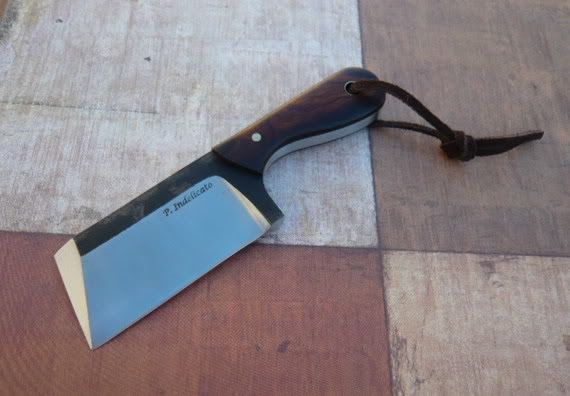
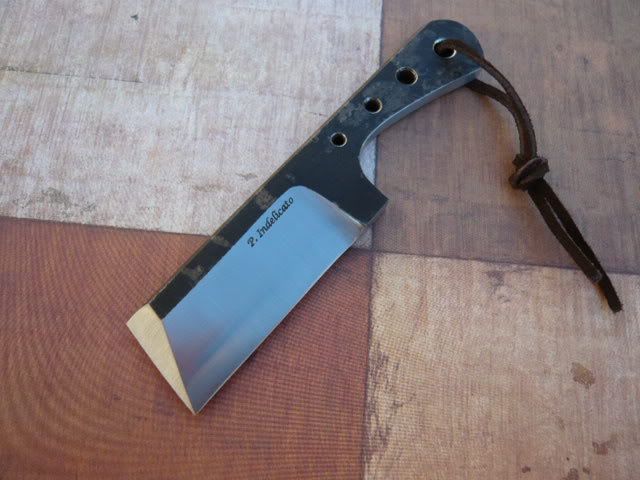
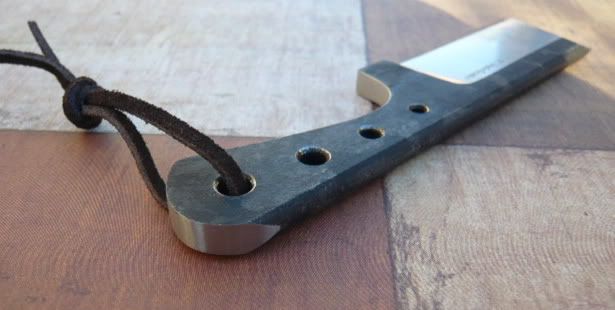
These have mill finish (and edge on the 2nd one), and heat treat scale and coloring left on the flats with machine finish on the bevels. Not my usual style, but I think it looks cool on the right knife. Also, it's not a completely free ride, as you have to take some steps to protect that mill finish during construction of the knife.

P1030429.jpg

P1030423.jpg

P1030427.jpg
 
Looks great PJ, that's exactly what I'm talking about. Very encouraging :thumbup:
 
Give it a try, James; folks seem to dig it (and it's grown on me since doing these.) Also, I think you mentioned using stainless in your first post, but I found on these (5160) that cold blue worked well to repair any spots on the mill finish that got thin or light for whatever reason during construction.
 
Well not quite stainless, either CPM-D2 or CPM-3V... it remains to be seen how the scale will react to any sort of bluing-type stuff. I presume it won't do much, only one way to find out for sure :)

I guess that brings me to a deeper question I should have asked in the first place... what exactly is mill scale anyhow? Is it just impurities on top of the steel, or similar to forging scale from the heat/oxygen involved in rolling it out, or what? I know it's a real bear to grind off and that a mild etch makes that part easier, but that's about it :o
 
Iron oxide??? :confused:

I don't think the cold blue affects the scale itself much...I use it if I get a shiny spot showing through the scale. I would guess the scale is a layer of oxidation, and the cold blue itself I think is an oxidizing agent.

Hopefully someone more smarterer will come along and fill in the gaps ;)
 
Mill scale is just black iron/steel oxide. The scale isn't so much of a problem, but there are other "mill flaws" and/or hot forming process flaws that could be a problem. These usually show up as lines running parallel to the blade... not such a big problem along the back as long as they are shallow. If they are down towards the edge on forged pieces, they really need to be ground off. Of course, with stock reduction, you'll be grinding that portion of the blade clean anyway.

Also keep in mind that directly beneath the scale, there's a thin layer of decarb.

If there are any lines, mill flaws, hot work flaws or otherwise, running perpendicular to the edge OR back, they should be ground off from the get go, or at any point that they show up..
 
Thanks guys! I'm off to catch some fish or at least a beer buzz for a couple days...
 
Back
Top