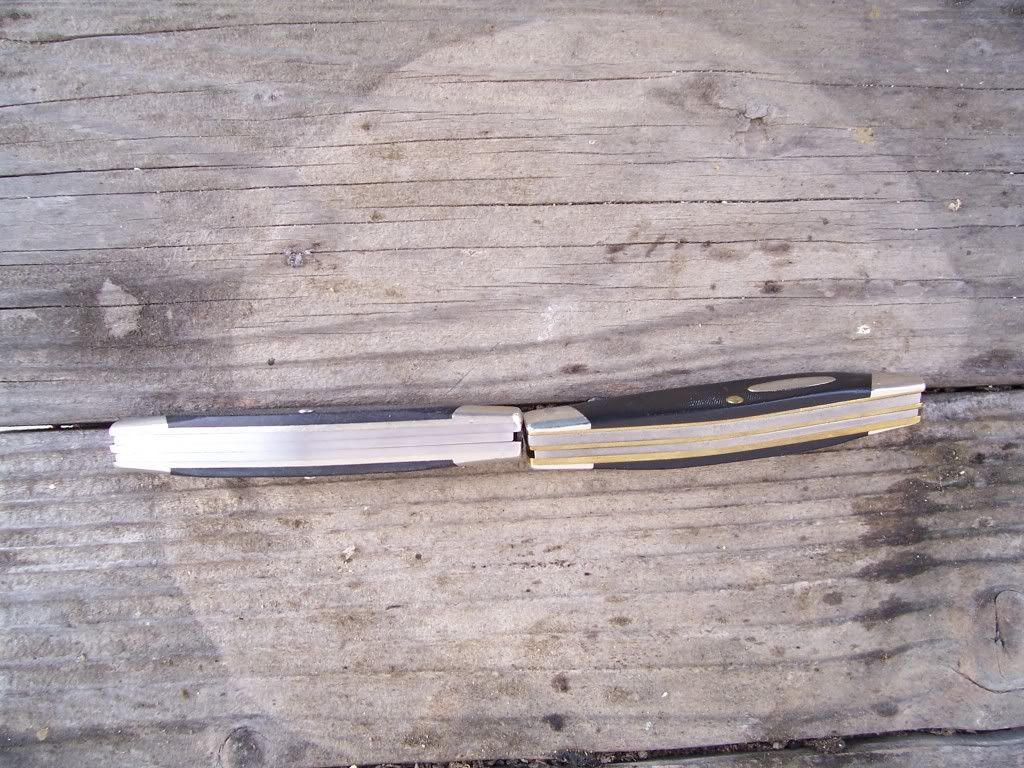
I read a lot of post regarding the GEC conductor and white owl. It seems that most folk really like them for their slimness and resulting pocketability. I have a very nice Case 1970s half whittler that looks exactly like the GEC conductor, and while I agree that you can barely notice it in the pocket, I actually rarely carry it because I find it too slim in the hand. I much prefer a peanut of small stockman due to the extra width in the handle. Just curios if anyone else prefers multiple backsprings.

-
The BladeForums.com 2024 Traditional Knife is available! Price is $250 ea (shipped within CONUS).
Order here: https://www.bladeforums.com/help/2024-traditional/
You are using an out of date browser. It may not display this or other websites correctly.
You should upgrade or use an alternative browser.
You should upgrade or use an alternative browser.
Single or Multiple Backsprings?
- Thread starter mdsmith
- Start date


Railsplitter
Gold Member
- Joined
- Oct 31, 2010
- Messages
- 8,202
I like all of them really. I usually carry two traditional knives. One medium size and one small. I like the small knife to have a single backspring and the larger one to have two backsprings. Heck, even three backsprings is fine with me on the larger knife. I too like the extra thickness of a multi backspring knife but I also appreciate the slim profile of a single spring.

- Joined
- Sep 2, 2004
- Messages
- 18,501
One or two backsprings are fine with me. Single spring knives tend to have shorter blades then their two spring cousins though.
I like the single spring knives because of the precision and detail that comes into play when fitting two blades in the same space. A prime example is the Case/Bose Norfolk. I think it's a symphony in knife engineering. I'll try and take a decent pic of what I mean and edit this post a little later.
All of the two bladed Congress knives I own have similar qualities.
Here's a Case/Bose Norfolk (bottom knife) and a Half Congress made by Rick Menefee to illustrate.
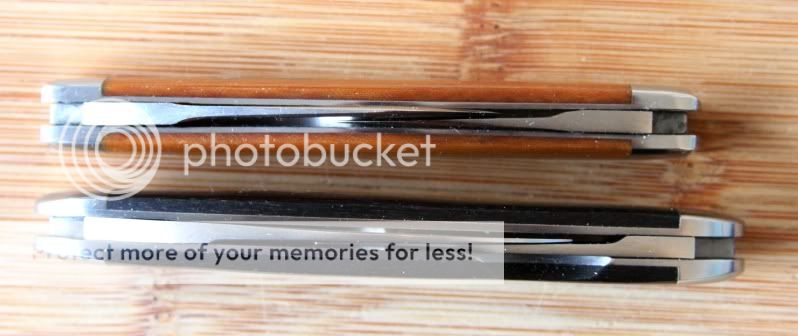
I like the single spring knives because of the precision and detail that comes into play when fitting two blades in the same space. A prime example is the Case/Bose Norfolk. I think it's a symphony in knife engineering. I'll try and take a decent pic of what I mean and edit this post a little later.
All of the two bladed Congress knives I own have similar qualities.
Here's a Case/Bose Norfolk (bottom knife) and a Half Congress made by Rick Menefee to illustrate.
Last edited:

- Joined
- Jun 30, 2003
- Messages
- 1,797
I like the multiple backsprings in my Case Peanut, becuase it is such a small knife, the extra width gives extra traction. It is already a three-fingered hold, so going down to one backspring on that size of a knife is not ideal to me.
But on any two-bladed knife whose handle is 3" or longer, I'd prefer a single backspring for slimnes.
Oh, one other neat thing about a slip joint with as many layers as blades is that the handle can be shaped for optimum comfort for every blade. I have a Old Timer US stockman, and it feels great while using the clip or sheepsfoot blade, but the grip while using the spey blade is just awkward.
But on any two-bladed knife whose handle is 3" or longer, I'd prefer a single backspring for slimnes.
Oh, one other neat thing about a slip joint with as many layers as blades is that the handle can be shaped for optimum comfort for every blade. I have a Old Timer US stockman, and it feels great while using the clip or sheepsfoot blade, but the grip while using the spey blade is just awkward.


- Joined
- Jul 25, 2010
- Messages
- 7,432
Well, I have a couple of 2-spring-knives. I like them more than my single-spring-knives. I like my SBG, but the single spring let the hand hurt during use at a longer time.
But I think, that´s a because of the size of the hands. Mine are medium-to-large. Maybe someone with smaller hands like a single spring better.
I haven´t had any Conductor in hand or any White Owl. They seem to be nice pattern. And GEC makes their knives a little bit thicker (than Case). So when I gonna try such a pattern, it could be enough size for my hand...
Kind regards
Andi
But I think, that´s a because of the size of the hands. Mine are medium-to-large. Maybe someone with smaller hands like a single spring better.
I haven´t had any Conductor in hand or any White Owl. They seem to be nice pattern. And GEC makes their knives a little bit thicker (than Case). So when I gonna try such a pattern, it could be enough size for my hand...
Kind regards
Andi

black mamba
Gold Member
- Joined
- Oct 21, 2009
- Messages
- 23,700
My hands are large so I prefer multiple spring knives-- the extra width feels good.

- Joined
- Sep 19, 2009
- Messages
- 1,679
I like all of them really. I usually carry two traditional knives. One medium size and one small. I like the small knife to have a single backspring and the larger one to have two backsprings. Heck, even three backsprings is fine with me on the larger knife. I too like the extra thickness of a multi backspring knife but I also appreciate the slim profile of a single spring.
+1 Rick. I couldn't have said it better ..... so I won't even try.

Yes, I prefer multiple back springs.
All things being equal, I like a knife that is a little thicker in the handle, especially if it's a small knife like a peanut or small stockman. If the handle is very small, sometimes a little extra thickness makes a real difference on how the knife feels. Even with my less than regular size hands, the peanut is a bit too small if it had a sing;e back spring. But the boxy feel the handle has to accommodate the two springs makes it a bit easier to hold onto when cutting something heavier than a piece of string, like breaking down a heavy cardboard box.
I'd rather have a thicker boxy handle than one too thin. I feel I have more control with a thicker handle.
Carl.
All things being equal, I like a knife that is a little thicker in the handle, especially if it's a small knife like a peanut or small stockman. If the handle is very small, sometimes a little extra thickness makes a real difference on how the knife feels. Even with my less than regular size hands, the peanut is a bit too small if it had a sing;e back spring. But the boxy feel the handle has to accommodate the two springs makes it a bit easier to hold onto when cutting something heavier than a piece of string, like breaking down a heavy cardboard box.
I'd rather have a thicker boxy handle than one too thin. I feel I have more control with a thicker handle.
Carl.

- Joined
- Apr 19, 2005
- Messages
- 5,533
Just for education purposes.
Buck folders have a spring for every blade in most all models. Below see the bottom of a 3 blade, a 2 blade and a single blade.
There are several reasons for such. Ease of assembly, ie no crinking. Ease of repair if necessary. I am sure you can think of a couple more. Likely negatives also. But that is just the way it is......300/ch
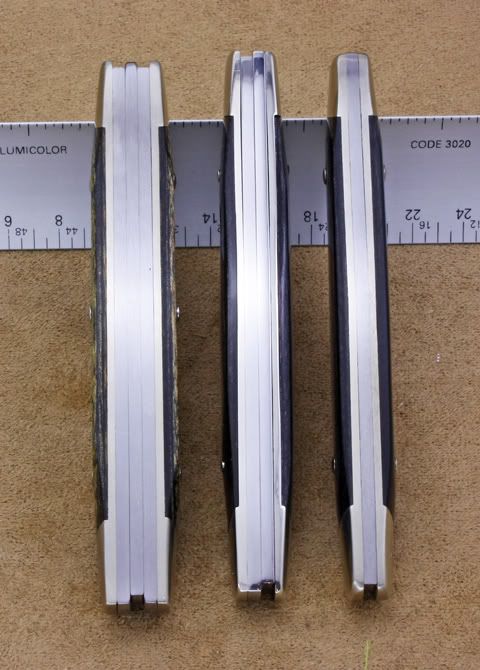
Buck folders have a spring for every blade in most all models. Below see the bottom of a 3 blade, a 2 blade and a single blade.
There are several reasons for such. Ease of assembly, ie no crinking. Ease of repair if necessary. I am sure you can think of a couple more. Likely negatives also. But that is just the way it is......300/ch

- Joined
- May 7, 2011
- Messages
- 3,426
300Bucks, thanks for the picture. Very informative.
Back to the OP...I guess I'm partial to the "one spring for each blade" philosophy.
The handle thickness factor is important but also depends on multiple factors (blade thickness, scales thickness and so on), and even though a very thin handle can be uncomfy, the ergonomics of handle grip involve many factors and not just thickness. I've had mostly single bladed knives in my life but nonetheless most of them were pretty comfy in my hand.
The main reason why I prefer the above mentioned philosophy is that I don't like crinked blades. I'm not sure that I can explain why...I guess I just don't dig them.
Fausto

Back to the OP...I guess I'm partial to the "one spring for each blade" philosophy.
The handle thickness factor is important but also depends on multiple factors (blade thickness, scales thickness and so on), and even though a very thin handle can be uncomfy, the ergonomics of handle grip involve many factors and not just thickness. I've had mostly single bladed knives in my life but nonetheless most of them were pretty comfy in my hand.
The main reason why I prefer the above mentioned philosophy is that I don't like crinked blades. I'm not sure that I can explain why...I guess I just don't dig them.
Fausto

- Joined
- Nov 27, 1998
- Messages
- 2,602
[...] I like the single spring knives because of the precision and detail that comes into play when fitting two blades in the same space. A prime example is the Case/Bose Norfolk. I think it's a symphony in knife engineering. I'll try and take a decent pic of what I mean and edit this post a little later.
All of the two bladed Congress knives I own have similar qualities.
Here's a Case/Bose Norfolk (bottom knife) and a Half Congress made by Rick Menefee to illustrate.
Well said! I prefer two blades riding on a single spring for the slimness and reduced weight of the handle, but particularly for the workmanship and design finesse required to pull off the blade seating, especially when it's accomplished without crinking or rubbing. The asymmetrical grinds and swedging used to shoehorn both blades into such a confined space give the knife a complex and almost jewel-like aesthetic that, to me, makes a simple side-by-side Jack arrangement seem comparatively ordinary and needlessly bulky. I suppose that's why the Norfolk and the GEC #62 (and *cough*Wharncliffe*cough* of course
 ) are two of my favorite production patterns.
- Joined
- Jul 30, 2006
- Messages
- 44,490
Just for education purposes.
Buck folders have a spring for every blade in most all models. Below see the bottom of a 3 blade, a 2 blade and a single blade.
There are several reasons for such. Ease of assembly, ie no crinking. Ease of repair if necessary. I am sure you can think of a couple more. Likely negatives also. But that is just the way it is......300/ch
I'd add a couple of things to that.
- I have both a Camillus-made Buck 303 and a Buck-made Buck 303. The Camillus has two springs. The Buck has 3. They are the same width.
- Because the Buck 3-spring blades are not crinked, it is easier to cut straight with them because they go straight out of the handle, instead of at an angle.
So I like one spring. One spring for each blade, that is.
Below is a picture of the two 303's. The Buck Buck is on the left.