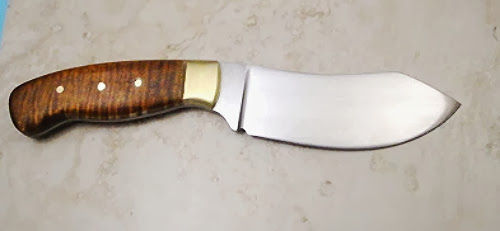
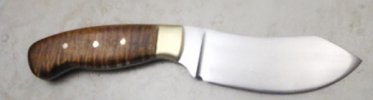
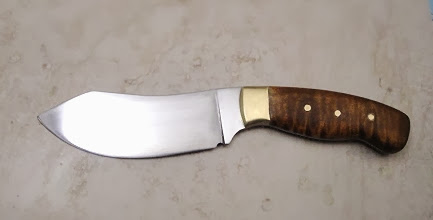
skinner for Dylan, 80crv2, brass, maple

Joined
Dec 18, 2008
Messages
760
Hello Everyone
This is a straightforward using knife. I wanted to play with 80crv2, and I know of someone who got a hamon with a clay heat treatment. So, I wanted to explore the possibilities.

Well, I clayed the blade with satanite, just like I would a blade of W2 or Low Manganese 1075. Guess what? the whole thing hardened! I guess this is a successful experiment but a fail as a hamon.

Let me know your thoughts on the knife and the heat treatment.
thanks,

Kevin
DSC03750.jpg


DSC03752.jpg


DSC03754.jpg
 

Attachments

  • DSC03750.jpg
    DSC03750.jpg
    10.9 KB · Views: 17
  • DSC03751.jpg
    DSC03751.jpg
    14.3 KB · Views: 10
  • DSC03752.jpg
    DSC03752.jpg
    14.3 KB · Views: 12
  • DSC03754.jpg
    DSC03754.jpg
    9.8 KB · Views: 9
Last edited:
That's a fine looking knife. What grit did you sand up to? The hamon may be visible right after heat treat to some degree then disappear as you start to sand then reappear at the higher grits. Here is an 80CrV2 blade I'm working on now. I did a simple edge quench. The hamon was evident after HT and followed the progress I mentioned. This picture was taken at 800 grit (I'm at 2000 now and still going). Of course I can't wait until I etch so I can watch the magic happen.

 
thanks for the advice. I didn't see much right after ht when I ground into it, either. I have had hamons be hard to detect during the middle grits, though. I kept hoping, but there wasn't any different feel to the steel, either. I think this is not as shallow hardening as w2...
kc
 
By right after HT I mean as soon as it comes out of the quench before you grind it. It would probably be visible at that point. Then you lose it as you start to grind. No this isn't a shallow hardening steel. I think the Chromium content allows it to through harden. As long as the knife hardened and makes a useable knife there isn't a sad ending to that story. The other thing I was thinking about was that my blade is 1/4" at the ricasso. If your knife is thinner, say 1/8" thick, there may not have been enough of a difference in thickness between the clayed and exposed parts to create a hamon. Another way to say that would be maybe you didn't have enough thickness in the spine to hold heat long enough to create a great enough difference in cooling rate between clayed and exposed areas, therefore not forming a hamon (whew! Now THAT'S a run on sentence! haha). It's just a thought.
 
Thats a nice looking skinner Kevin. I really like this steel what little Ive gotten to play with it. Forges nicely and seems like a great all around blade steel. I did a test blade that kept cutting and cutting and was very hard to brake (destructive testing :D). Got a couple little hunters for some friends that are in the works out of this stuff.

Hamon wise from what I have scene is usually the basic line like posted. Not any activity or anything but a visible line. I think all the factors like the blade thickness as mentioned or edge quenching are gonna be what it takes to get a visible hamon easily. I think its more on the lines of 1084 style hamons.
 
Wanted to add maybe as J Doyle about it. He has gotten some nice hamons out of 1080+ which is suppose to be the same thing.
 
thanks guys. Matt Parkinson got a good hamon with this steel, but he posted a pic of his clay and it was way thick. So, he had to really work with it to coax it.

imarc - if you heat treat something and get a hamon, it will be very visible if you take it straight to the grinder and grind a pass or two with a sharp, coarse belt. You can really see it well, but then it fades almost immediately due to oxidation (so heat, dipping it in water, oil, dirt, anything but the clean, just-ground blade).

Try it, it is a great trick! I use a 36 grit or 50 grit belt (whatever the grit was I used before ht, or a little larger). nice white, very visible hamon. But it goes away in a minute or two.

kc
 
I think I like it. It is definitely very abrasion resistant. It is very fine-grained. There are also both chromium and vanadium to form some very hard carbides even though the steel is eutectoid. So, it should hold a very fine edge (not too many big carbides), and wear well, with the fine grain and some carbides for hardness.

My fried, the owner of this knife once I ship it, is an avid hunter. It will get a lot of use. I will post his impressions.

kc
 
I noticed the same thing with the one I destructed. It had the same nice fine grain structure like I get out of aldos 52100. The 1080+ moves easier under the hammer though which is nice.
 
yep - does anyone have a link to the TTT diagram?

I am a little embarrassed. I made the ultimate dumb ____ mistake. I took someone's word for this steel rather than looking up the HT graphs for myself. Live and learn. I should (should) know better, but...

thanks,

kc
 
Back
Top