Slipjoints... why are they popular in USA but not Europe?

Joined
Jan 12, 2010
Messages
37
Please, I am not trolling this respectable sub-forum, just looking for education...
Why are good slipjoints not easily found in Europe, dare I say even snubbed, whereas in USA they are highly respected if well made?
What is the appeal and practicality of slipjoints compared to other "classic" knife types?
 
In Europe, they sell tons of slipjoint Swiss Army knives. I think folks over there prefer those to stockmen etc. because of the greater choice of tools. I think you can find plenty of good slipjoints in Europe, just as many as in the US, you just need to know where to look for them. I've been in knife stores in France and Switzerland that rival anything we have here in the United States.

You have to look to find good knives here in the US too, you can't just walk to the corner store and buy a nice Case or Buck anymore. Unfortunately.
 
Many of us have seen our father or grandfather carry a traditional slipjoint, and when we carry one now it sorta reminds of us the good old days. My dad is 81 years old and has always carried a slipjoint.
 
I'll take a stab: The U.S has really only been fully settled within the last 100 years. A great part of that settling, building, farming, ranching, exploration and exploitation were undertaken with good slipjoints in pocket. Slipjoints are woven into the fabric of hard work and expansionism, as are many other things that we find nostalgic.
I'm not sure if this makes sense or not...
 
Last edited:
I know what you mean, Pasha. It's something I have wondered myself.

I've been lucky enough to have traveled via being stationed overseas while in the army, and being a knife affictionado, I took notice of what knives were being used around me. My MOS was of the combat engineers, and we were on construction sites at many army and air force bases, and worked with local personal that did a lot of the grunt work.

While in West Germany, I never saw a German worker with anything but a low cost sodbuster type of knife. F. Herter seemed to be popular, as was the single blade slip joints by Linder. Plain and simple was the order of the order of the day. If a more upscale knife was used, a stag handle Hubertus or Puma was seen once in a great while. But all were simple single blade knives. The only multi blades I saw were sak's.

In Italy and France it was the same thing. Single blade knives of modest cost. Lot's and lots of Opinels, some Laguioles here and there, one Nontron, and a Douk-Douk or two. And sak's.

In England, doing some work at the Lakenheath air base in Suffolk, we worked with local cement contractors and suppliers of construction materials, and I don't ever recall seeing anything but medium size clunky single blade sheepsfoot blade knives. Plain iron bolsters or all stainless steel type of knives kind of rough finished. I know the British cutlery industry made tons of very pretty multiblade knives and dressy pearl handle knives of all types, but I never saw them. Maybe they were not sold to the blue collar guys who stood shin deep in mud laying a pipeline out to the local water and sewer systems. :confused::) I never made it to any gentlemens clubs in London when I was there. Pubs, yes. Drawing rooms, no.:D

I know that the European cutlery firms made them, but either they were made for export to the U.S., or they were sold to
people who didn't spend their workday on construction sites. In my own experience, almost all the pocket knives I saw in Europe were mostly low cost single blade folders. I can only conclude that some kind of cultural thing was at work. The last time I was in England and Germany as a tourist, I saw lots of sak's.

 
I really like or rather love slipjoints, Stockman, Sway Back Jack, Barlows... but from an economical point of view, a sak is really hard to beat if you consider the tools you have at hand and and even the "lowest" Case knives do cost more here in Germany, if available at all, then say a sak huntsman... it's a pitty really but what can you do?
 
I think slipjoints are just as popular here in Europe than in the US, and are alot older here. Culture, usage, needs, were (and basically are) just the same. There are respected and very appreciated brands and makers here too (for example, Laguiole, since u mentioned it).
But u have a very strong point here. The style of slipjoints here in Europe are way different than in the US. Especially on the 'single blade' matter: u will hardly find multibladed slipjoints in Europe, while they are the rule in the US.
There's a recent thread about this (I started it cause I asked myself the same question). So far, we collected lots of ideas, reflections and possible solutions, but I have to admit we came to no definite answer at all...
Fausto
:cool:
 
Our French brothers like slipjoints and other traditional knives. These guys know their knives and have some outstanding knife makers.

Check this thread out and you will see what I mean. (I would really like an ivory slipjoint from Raphaël Durand. But, he's not taking orders.)
http://forum.neoczen.org/viewtopic.php?f=11&t=3173

I was able to purchase a friction folder from David Lespect and it is bad a$$. The fit and finish is as good as it gets. Great ergonomics and the sharpest knife I own.
http://forum.neoczen.org/viewtopic.php?f=11&t=2486

Here's their main section for custom makers.
http://forum.neoczen.org/viewforum.php?f=11&sid=4db4e5352e8822615d5edf82467877d2

If you can't read French then you can use Google Translate to translate to English. Amazing technology. Just paste the web address in there and it translates for you.
http://translate.google.com/#


Enjoy,
Dave

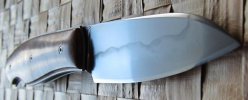
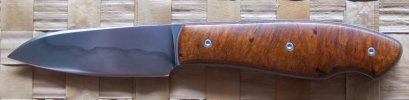
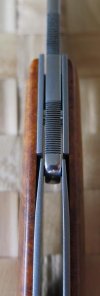
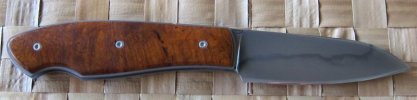
Here's some photos of my David Lespect friction folder.

Lespect1.JPG


Lespect2.JPG


Lespect3.JPG


Lespect4.JPG


Lespect5.JPG


Lespect6.JPG
 

Attachments

  • Lespect1.jpg
    Lespect1.jpg
    30 KB · Views: 15
  • Lespect2.jpg
    Lespect2.jpg
    22.1 KB · Views: 15
  • Lespect3.jpg
    Lespect3.jpg
    13.8 KB · Views: 20
  • Lespect4.jpg
    Lespect4.jpg
    21.7 KB · Views: 16
Last edited:
I was particularly struck by Jackknife's account, and one factor nobody has mentioned is class. Class differences used to be much more pronounced and rigid in England and in European countries than in the United States. It seems plausible that simple knives were used in abundance by the working class, that nicer, more complex knives were a hallmark of the middle class.
 
That is one beautiful friction folder, congrats, Big Dave could you tell me more about it.

How do you find the ergonomics.

It is exquisite

GREAT THREAD- Very intrigued to see where this goes
 
In Europe, they sell tons of slipjoint Swiss Army knives. I think folks over there prefer those to stockmen etc. because of the greater choice of tools.

Andy, you are right! I just realised a Victorinox Excelsior or similar is exactly like a classic American slipjoint, I just always thought of it as a SAK. Will keep by eye out for more.
 
Thanks for the clear eye opening posts. Looking at slipjoint as the locking mechanism it is, I now see them. For example a beautiful, mother of pearl vendetta knife, and another cork and copper handled carbon blade that is not a laguiole.

I was thinking of slipjoint as a knife style, like "bowie" instead of just the locking mechanism.

Still, it would be nice to see here more imports of some of the Case, Bucks, Barlows or Stockmans.
 
Big Dave, that is a gorgeous modern knife. I also agree, the French custom forging scene is heating up with loads of new young talent.

Unfortunately, the full service knife shop is increasungly hard to come by.

I have been considering a roadtrip to Thiers, France and Maniago, Italy, and the surrounding makers and knife ecosystems. It is hard to convince the family and aa bit worried about budget discipline.

Thanks for replying with the eye openers.
 
A lot of it has to do with the distribution of the product in various countries. While European knives were fairly well distributed in the US the same cannot be said of US brands in Europe. Case, Schrade, Queen would rely completely on a local distributer to push their products through gun stores, cutlery stores and other outlets. If they had poor penetration into the market the brands will not become popular and widely known.

Here in South Africa we have a perfect example of this. Victorinox and Puma have been widely distributed here for many years. The knives were available in all small town general stores and anyone who looked for a good quality pocket knife chose them. American brands were not widely sold here so many people simply don't know about them.

To use an analogy........Dr Pepper is an essentially American brand while Coca Cola is international..........
 
Like jackknife, I've written before about my experiences living in Europe (1993-98 and 2003-present) and seeing almost all single-blade folders, plus SAKs. Of course the ones I see these days are mostly of the Spyderco or Benchmade knockoff variety, not sodbusters.

At any rate, I was thinking about this post last night and something occurred to me. I wonder how much the economic and political history of the last century have to do with this phenomenon? Think about it: How many times have you read some American guy here posting about what his grandfather (or father) carried "back in the day." Meaning in most cases, back in the '30s, '40s and '50s.

Well, except for the elites, Europe was a really really poor place coming out of WWI. I know the Depression was a bitch in the U.S. but it also ravaged Europe, plus there was the struggle to recover from the physical damage of WWI (which was raging a number of years before the U.S. got in). Hell, Germany never really did recover until into the 1950s thanks to the Marshall Plan.

And while WWII forced some men (like my grandfather) to suit up and fight, and women and children (like my mom) to live on a tight budget and buy staples with ration coupons, it was nothing like the devastation in Europe that raged from the late 30s through 1945. In addition to lots of reading, I've heard stories from my mom (who was a kid in Chicago during the war), and stories from my wife's grandmother (who was living in Prague during the Nazi Occupation) ...... there's just no comparison. And when you talk about the wreckage of WWII, I visited Dresden in 1994 and there was a cathedral STILL in ruins from the war.

I guess I'm rambling, but this might have something to do with both the availability (meaning: the lack thereof) of multi-blade slipjoints, and the preference of your average European guy for simple, cheap single-blade folders. Guys couldn't afford to buy them, so why would stores bother stocking them?

Fast-forward to today, and you have an entire generation or two of European guys who grew up watching their grandfathers cut stuff, not with a barlow or stockman, but with a cheap, stout Herder or the clunky, single-blade sheepsfoot knives that jackknife mentioned.

-- Mark
 
A good analysis, Mark. Something to that. My mother was a child at the end of the war, growing up in a family of notaries and doctors who must have been the best well off. She recalls eating insects and acorns one year and used to cry even to her last days at the site of chickpeas. My uncle, her elder brother, remembers the war. Today he enjoys the fruit of the post war boom and his participation in that, but he is also an outdoorsman and works both wood and farmland in every spare minute, but I have never seen him with anything but the crappiest of lowest price blades. My grandfather was a POW for three years and abhorred weapons of any type. To them, anything sharper than a thumb, or of high quality steel was and is a weapon of war. Putting money into weapons of war is possibly too militaristic for civilians.
But in parallel, there is a very rich fine-knife making tradition. Perhaps this is trickle down frothe aristocracies which is becoming a hobby for the now wealthy european middle classes? As ASBOB mentioned, class structures are more pronounced in a europe with less social mobility and the collecting and carrying of blades must be associated with it.
 
Last edited:
In scandinavia you have puukko which does almost everything you need to do, so slipjoints never really rooted here or any folder culture. I still enjoy slipjoints myself very much.
 
Back
Top