
-
The BladeForums.com 2024 Traditional Knife is available! Price is $250 ea (shipped within CONUS).
Order here: https://www.bladeforums.com/help/2024-traditional/
You are using an out of date browser. It may not display this or other websites correctly.
You should upgrade or use an alternative browser.
You should upgrade or use an alternative browser.
Small utility/paring knife - heel or no heel.
- Thread starter Ryanol
- Start date
- Joined
- Sep 3, 2010
- Messages
- 2,460
First of all, I love the design. as far as the heel goes, I would do it depending on the size of her hand. If her hand fits inside, it will probably be pretty nice. If her hand is too large and ends up traveling onto the heel, then it is going to be uncomfortable. I have chef knife that I absolutely love but is uncomfortable becuase my hand is too big to fit between the blade and the heel easily. With a paring knife like that, though, you are almost always doing pushcuts, and so I wouldn't worry too much about needing a heel. That is just from my experiences.
- Joined
- Sep 3, 2010
- Messages
- 2,460
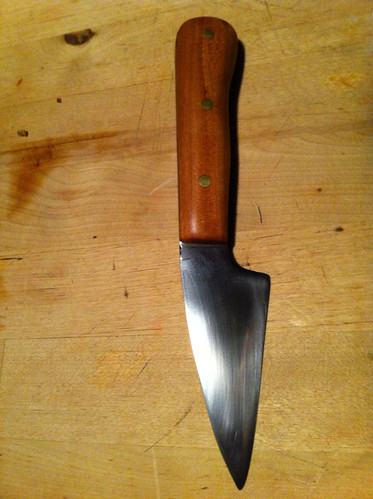
very nice. good job. what wood is it?
That's a good question not sure...cherry maybe? Its got a nice little pearlescent thing going on though. Both the handle are finished to 800. The handles finished with tru-oil the blade will get some sort of food safe wax rub after I take it to the 1x30 and bring itto the stones for the final edge.
The next one will be better- I nicked the blade spine with the grinder near the handle when I was contouring it post epoxy. Can't seem to get to full slab completion before epoxy. Even though I looks good at the time, when I glue em up I always seem to want to take more off.
Thanks for the compliments.
A shot with outdoor lighting:
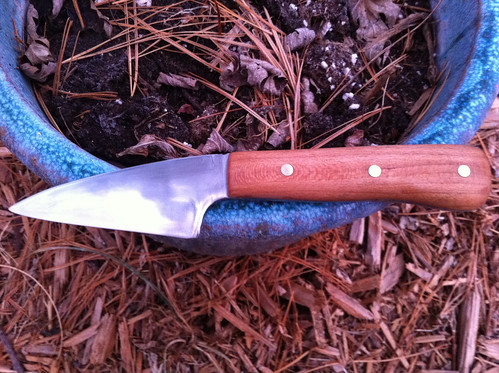
Untitled by rlibson, on Flickr
Any tips on suitable foodsafe waxes and sources? I thought i read somewhere about using beeswax.
The next one will be better- I nicked the blade spine with the grinder near the handle when I was contouring it post epoxy. Can't seem to get to full slab completion before epoxy. Even though I looks good at the time, when I glue em up I always seem to want to take more off.
Thanks for the compliments.
A shot with outdoor lighting:
Untitled by rlibson, on Flickr
Any tips on suitable foodsafe waxes and sources? I thought i read somewhere about using beeswax.
Last edited:

daizee
Knifemaker / Craftsman / Service Provider
- Joined
- Dec 30, 2009
- Messages
- 11,173
That's a sweet little knife, it will get a lot of use. The color on the wood is excellent. It looks like cherry to me too.
I do 85% of my handle shaping AFTER everything is glued up.
Only the rough cutting needs to be done before glue AND the front faces of the handles must be finished before glue (unless you're a masochist).
Shape the handles down to the spine, then sand them all together to get them mated.
I just use files to do most shaping. They remove material aggressively, but not fast, and don't cause overheating problems. Then sandpaper.
-Daizee
I do 85% of my handle shaping AFTER everything is glued up.
Only the rough cutting needs to be done before glue AND the front faces of the handles must be finished before glue (unless you're a masochist).
Shape the handles down to the spine, then sand them all together to get them mated.
I just use files to do most shaping. They remove material aggressively, but not fast, and don't cause overheating problems. Then sandpaper.
-Daizee
Only the rough cutting needs to be done before glue AND the front faces of the handles must be finished before glue (unless you're a masochist).
-Daizee
THANK YOU SIR MAY I HAVE ANOTHER!
Thanks for the compliment, I think a 8/10" disc sander for truing up my slabs is the next acquisition

- Joined
- May 11, 2007
- Messages
- 549
THANK YOU SIR MAY I HAVE ANOTHER!
Thanks for the compliment, I think a 8/10" disc sander for truing up my slabs is the next acquisition
I use a granite surface plate and some 60 grit sandpaper to make sure everything is dead flat, takes only a few minutes. You could also use glass. That said I do have a disc grinder but I find this method just as easy.
I tried that method and I am sure that it could work with enough patience but cutting my slabs with a miter saw leaves them pretty uneven.
To cheat on this one I just cut one slab off of both ends that had been trued up with a joiner/planer by my furniture making buddy, then I used the uneven cuts on the outside.
To cheat on this one I just cut one slab off of both ends that had been trued up with a joiner/planer by my furniture making buddy, then I used the uneven cuts on the outside.
- Joined
- Dec 15, 2009
- Messages
- 1,008
Do you have a grinder with a platen? you could roughly flatten it on the platen and then use a granite block to finish it out. Just an idea, but that's what I do.

- Joined
- Dec 6, 2010
- Messages
- 1,154
I like the way the handle "rings" emanate from the first pin.

- Joined
- Feb 4, 2011
- Messages
- 1,429
THANK YOU SIR MAY I HAVE ANOTHER!
Thanks for the compliment, I think a 8/10" disc sander for truing up my slabs is the next acquisition
I recommend a 9" disc. It can use standard size 9"x11" sheets of sandpaper. And yes, they really get stuff flat.

- Joined
- Nov 1, 2010
- Messages
- 893
I tried that method and I am sure that it could work with enough patience but cutting my slabs with a miter saw leaves them pretty uneven.
To cheat on this one I just cut one slab off of both ends that had been trued up with a joiner/planer by my furniture making buddy, then I used the uneven cuts on the outside.
Make sure you still flatten on a granite surface or something similar after that. The jointer makes little dips in the wood. A drum sander is really the answer for this job.
Last edited: