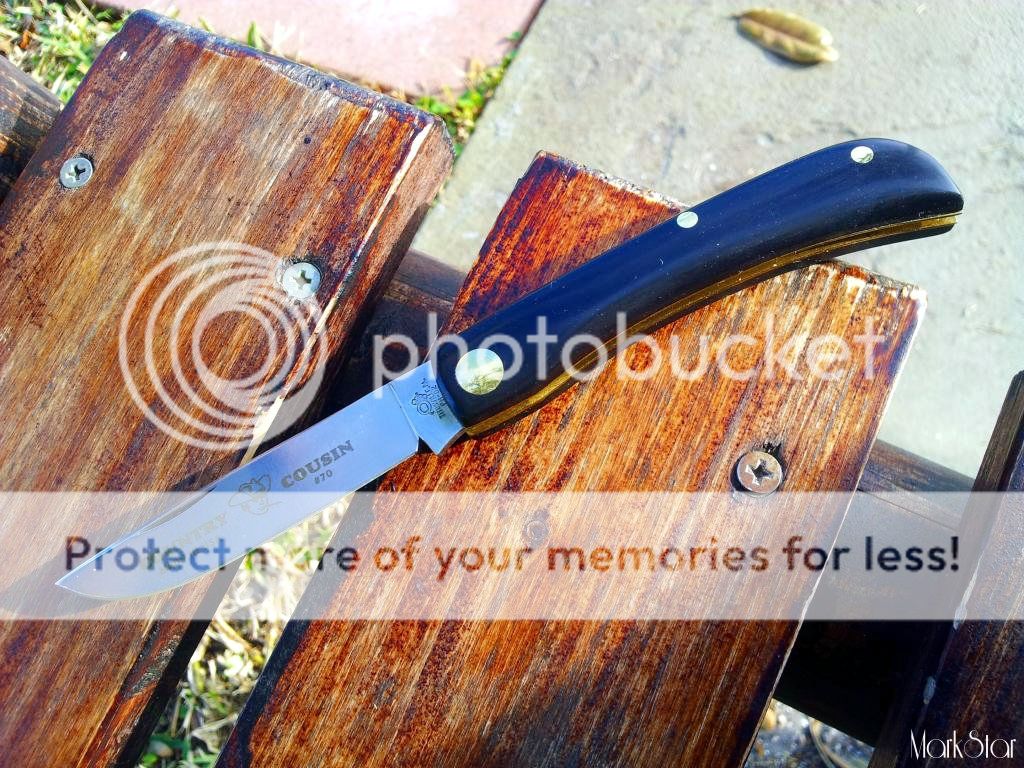
Thanks for the help guys. I am thinking of getting a Queen Country Cousin and having someone create a more usable edge if needed, as I do not have diamond stones to handle the D2. The D2 wil be nice because I won't have to sharpen it as often, and it won't rust easily. I am also thinking of getting a TL-29 to let him test drive; the flathead screwdriver will be handy for electrical plates and popping open paint cans.
Do not be afraid or reluctant to get a knife with D2 thinking you will need some special diamond equipment. I have two large Ontario sheath knives, several Kershaws, and a few Queens with D2. I sharpen all of them with
regular stones. Aluminum oxide, ceramics, and even a touch up now and then on an old Arkansas hard stone I have work just great. No special treatment needed, no precautions warranted, no extra sharpening skills to be learned... nothing. Sharpen as you normally would, then carry on. D2 is a great knife steel, but it certainly isn't anything extraordinary.
The TL 29 is a tested and true knife, but even on the nice ones (Klein with its limited lifetime warranty, and Greenlee for example) have such soft steel I haven't found them acceptable as a good working knife.
For its purpose, the TL 29 is hard to beat. Be aware though, that the knife isn't made for doing something like prying off a paint can lid.
I buy my knives for the knife blade, not for the other accessories on it. To each his own; if I were to go that route, I would buy some kind of multitool.
Do you still use a utility knife for certain tasks like cutting drywall? Personally, I avoid touching up my knife while working, so I use the utility knife for work that'll kill an edge fast.
Thanks again,
I absolutely do. For cutting drywall (nothing works better than a utility knife for that!), insulation, cutting hardened old sealants, stripping wires, etc., I use a utility bladed knife. That is what they are for. My Queen CC or whatever other work knife I have in my pocket sharpens my pencils, trims moldings as needed for fit, cuts wood plugs for screw hole fillers when hanging new doors, cleans up mortises for hinges, and on and on. Anything that requires cutting and slicing wood or other things you would use a regular pocket knife to do. It might also halve an orange, and notch my cigar on any given day. I use that knife as a pocket knife should be used, as a cutting instrument. The utility knife gets all the nasty work, along with the stuff it was actually designed to do.
I don't touch up my CC but once a week unless I accidentally do something like hit a hidden staple or cut something that was much harder than anticipated. I might change utility blades once a day.
Robert



 )
)