

- Joined
- May 21, 2011
- Messages
- 3,135
Yesterday I tried updating my thread on the Douk-Douk but I ran into some problems (some issues with vBulletin probably) and wasn't able to post. A new thread then! Here's what I wrote down yesterday, with some minor adjustments and additions:
See, you know the day is going to be awesome when the mail guy brings you two packages... Something that I like a lot about this hobby is that you often get packages from around the globe. The knife I started this thread about was French . Just now, I received a package from France, containing a USA made blade. The other package came from Japan. You guys see where I'm going. I'm just fond of that interconnectedness and the stories and history that go with it.
The package from Japan contained a nice yellow box with a blue rectangle and some Japanese markings. Most of you will already know what it is. The other blade, I recently won at auction. It had some rusting and patina, some pitting, some scratches and pits in the nice wooden handle but that was OK given the price I paid.
Without further ado, here they are:


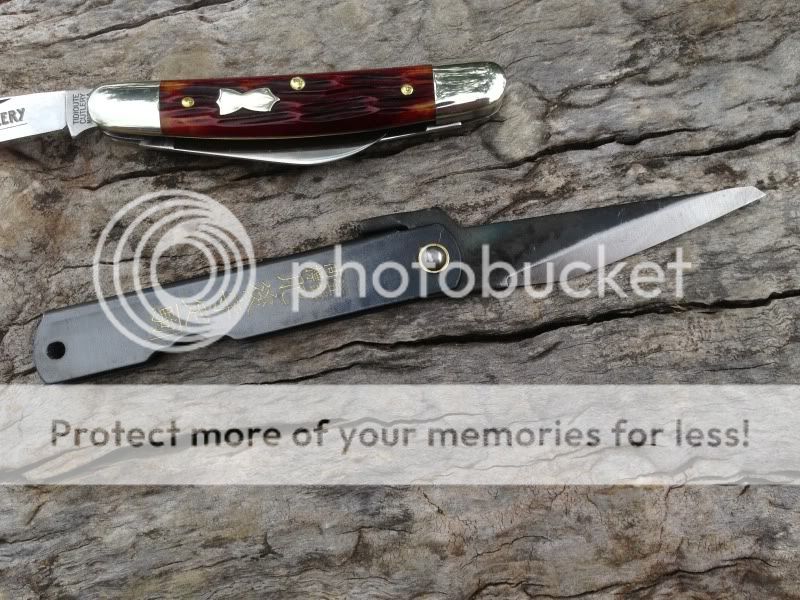
That's right, a Higonokami and a Camillus TL-29! I had been interested in that Higonokami for a bit and decided to get one. I've heard that one in a given amount is badly made but I didn't mind taking the risk and I'm glad I didn't. That knife just screams history! The blade with that specific shape, the engravings on the blade and the handle, the three different colorations in the blade... I dig it. A lot. I stumbled upon that Camillus rather on accident. Nobody seemed to have been watching it, which is often the case on non-us auction sites. I often try to get lucky there. As I said, it could have been in better shape but it's OK. Some slight wiggly here and there, but definitely good as a user and overall just a nice update for my collection. The bladeshape has been well proven in Swiss Army Knives and other Electricians knives so that was a no-brainer. I'm glad I got it.
Here's another picture of the stamp on the Camillus. If anyone has a timeframe for this guy, I'd appreciate it. I've seen an older thread here on the forums, but sometimes it's just not that clear for me from just looking at pictures. This pic shows the blade still rusty, but in the meantime I cleaned up the orange rust with rubbing some WD40 on it with a piece of cloth, and treating it with some polishing compoung afterwards. The engraving is rather difficult to clean from the orange rust. I'll need some time on that with a some toothpicks and a needle I guess.

Now for the Higonokami: it was a good purchase. I'm glad I opted for the smaller variant because that totally fits the (total and blade-)length I dig most in knives.
It's pretty much spot on in total length with the small Douk-Douk:

As I said already, I'm pretty fond of the blade shape. It's a nice reminder of a different culture, but yet something that would work evenly well as something similar made at the other side of the globe. The acute tip would come in handy as well, that's a very nice feature. I do want to highlight some of the more striking differences with the Douk-Douk.
First of all, let's look at the thickness of both blades.

The Douk-Douk at the bottom is way thinner than the Higonokami on top! I haven't been trying it out yet, but I'm curious to the difference in cutting performance. I often hear the saying "the right tool for the right job" or something similar, and I'm curious to experience where one of these blades would outperform the other in day-to-day light cutting tasks.
Next thing to talk about would be ergonomics. Both knives have folded metal as handle material. Both are closed at the spine and open at the bottom. Therefore, none of these would ever be known for their superb ergonomics, because they don't have it. The edges of the metal are rounded, but do dig into your palm quite deep. It doesn't hurt, but it might get annoying after a while. The feeling of the Higonokami annoys me more than that of the Douk-Douk. Probably because the bottom of the Higo handle is straight, whereas in the Douk it's shaped better to fit someone's hand.


Another thing I'd like to mention is that since the Douk-Douk is a slipjoint, it allows you to choke up on the blade and grip it close to the tip with your thumb. This allows for detailed cutting tasks. Since you put pressure against the spine, you shouldn't worry about it closing on you, even if your pressure on the object you're cutting into would lighten. The backspring is still there to correct your thumb pressure somewhat. That's not the case with the Higonokami. It's merely a friction folder. You have to exert energy on the extended tang for the blade to remain opened. If you put pressure near the tip or somewhere on top of the spine in general, it'll close on you. Since they're pretty sharp out of the box, that would not be a nice experience. Use it with caution and know what you're going to do with it and make sure that it's up for the task. And just... stay attentive while using it:thumbup:. One final remark: since there's no spring, the blade is held in place merely by friction. That causes the edge to hit the back of the handle sometimes. Luckily, it's made of Hitachi blue steel which is quite the steel for this low price. Hence, I won't be expecting dulling of the edge soon, but it's something to keep in mind.
In the end, I'm really happy with both purchases! I hope you guys liked my little write-up on my new arrivals.
I'll conclude with a group picture of the 3 blades I mentioned in this post:

See, you know the day is going to be awesome when the mail guy brings you two packages... Something that I like a lot about this hobby is that you often get packages from around the globe. The knife I started this thread about was French . Just now, I received a package from France, containing a USA made blade. The other package came from Japan. You guys see where I'm going. I'm just fond of that interconnectedness and the stories and history that go with it.
The package from Japan contained a nice yellow box with a blue rectangle and some Japanese markings. Most of you will already know what it is. The other blade, I recently won at auction. It had some rusting and patina, some pitting, some scratches and pits in the nice wooden handle but that was OK given the price I paid.
Without further ado, here they are:
That's right, a Higonokami and a Camillus TL-29! I had been interested in that Higonokami for a bit and decided to get one. I've heard that one in a given amount is badly made but I didn't mind taking the risk and I'm glad I didn't. That knife just screams history! The blade with that specific shape, the engravings on the blade and the handle, the three different colorations in the blade... I dig it. A lot. I stumbled upon that Camillus rather on accident. Nobody seemed to have been watching it, which is often the case on non-us auction sites. I often try to get lucky there. As I said, it could have been in better shape but it's OK. Some slight wiggly here and there, but definitely good as a user and overall just a nice update for my collection. The bladeshape has been well proven in Swiss Army Knives and other Electricians knives so that was a no-brainer. I'm glad I got it.
Here's another picture of the stamp on the Camillus. If anyone has a timeframe for this guy, I'd appreciate it. I've seen an older thread here on the forums, but sometimes it's just not that clear for me from just looking at pictures. This pic shows the blade still rusty, but in the meantime I cleaned up the orange rust with rubbing some WD40 on it with a piece of cloth, and treating it with some polishing compoung afterwards. The engraving is rather difficult to clean from the orange rust. I'll need some time on that with a some toothpicks and a needle I guess.
Now for the Higonokami: it was a good purchase. I'm glad I opted for the smaller variant because that totally fits the (total and blade-)length I dig most in knives.
It's pretty much spot on in total length with the small Douk-Douk:
As I said already, I'm pretty fond of the blade shape. It's a nice reminder of a different culture, but yet something that would work evenly well as something similar made at the other side of the globe. The acute tip would come in handy as well, that's a very nice feature. I do want to highlight some of the more striking differences with the Douk-Douk.
First of all, let's look at the thickness of both blades.
The Douk-Douk at the bottom is way thinner than the Higonokami on top! I haven't been trying it out yet, but I'm curious to the difference in cutting performance. I often hear the saying "the right tool for the right job" or something similar, and I'm curious to experience where one of these blades would outperform the other in day-to-day light cutting tasks.
Next thing to talk about would be ergonomics. Both knives have folded metal as handle material. Both are closed at the spine and open at the bottom. Therefore, none of these would ever be known for their superb ergonomics, because they don't have it. The edges of the metal are rounded, but do dig into your palm quite deep. It doesn't hurt, but it might get annoying after a while. The feeling of the Higonokami annoys me more than that of the Douk-Douk. Probably because the bottom of the Higo handle is straight, whereas in the Douk it's shaped better to fit someone's hand.
Another thing I'd like to mention is that since the Douk-Douk is a slipjoint, it allows you to choke up on the blade and grip it close to the tip with your thumb. This allows for detailed cutting tasks. Since you put pressure against the spine, you shouldn't worry about it closing on you, even if your pressure on the object you're cutting into would lighten. The backspring is still there to correct your thumb pressure somewhat. That's not the case with the Higonokami. It's merely a friction folder. You have to exert energy on the extended tang for the blade to remain opened. If you put pressure near the tip or somewhere on top of the spine in general, it'll close on you. Since they're pretty sharp out of the box, that would not be a nice experience. Use it with caution and know what you're going to do with it and make sure that it's up for the task. And just... stay attentive while using it:thumbup:. One final remark: since there's no spring, the blade is held in place merely by friction. That causes the edge to hit the back of the handle sometimes. Luckily, it's made of Hitachi blue steel which is quite the steel for this low price. Hence, I won't be expecting dulling of the edge soon, but it's something to keep in mind.
In the end, I'm really happy with both purchases! I hope you guys liked my little write-up on my new arrivals.
I'll conclude with a group picture of the 3 blades I mentioned in this post:




 )
)


