some work with a H1

Cliff Stamp

BANNED
Joined
Oct 5, 1998
Messages
17,562
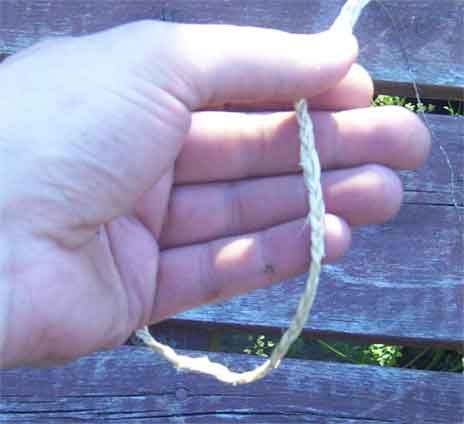
The H1 from Fallkniven is promoted as a hunting knife, but it makes a solid wood working knife. While the stock is very thick it has a high convex grind which tapers to pretty much a micro-bevel of a secondary edge. It cuts very well, close enough to the Mora 2000 that I would consider it in the same class for most woods. I am in the process of building a fairly large lean-to now and decided to make it more permanent so I am actually lashing some of it together. I usually use spruce roots, just split :
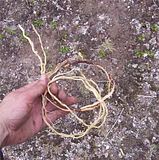


I have braided the splits, more for recreation though than strength :


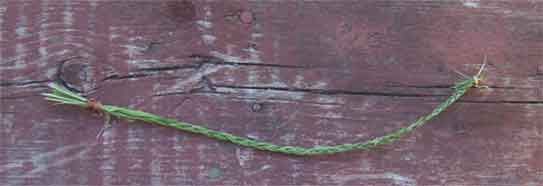
though it is useful on weaker materials like grasses :
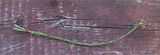


and on smaller roots. I lashed the knife to a stick after carving it to shape :
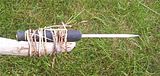


It works much better then for light vegetation just having much better reach and speed :


That wrap won't hold on woods though, even alders will break it readily. A heavier wrap done on very fresh roots will hold though. The H1 also works well as a splitter, and allows techniques like this :
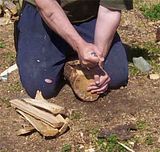


Which takes off a thick wedge much faster than something like the Mora 2000 which has to work up to the thick slabs. You can just pound the H1 in and just crack off the wood. You have to be careful though hitting it because the handle doesn't respond to impacts well on the rubber parts and if there is a knot in the baton you can rip the kraton readily and it gets abraded rapidly if it comes into forceful contact with the wood you are trying to split. Moving on past precut rounds, the same strength allows it to dig and pry in deadfall rapidly and basically shred the wood for tinder, food, or insulation :
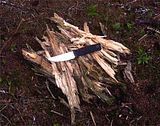


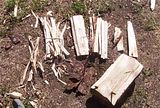
It isn't just a brute tool though, as noted the cutting ability is really high, it asily splits the wedges into fine shingles and pencil strips and then makes shavings as desired :


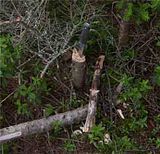
Felling and sectioning larger woods can be done but I would really prefer a longer blade. Even on small saplings you are essentially comparing seconds to minutes running it against the Wildlife hatchet for example :


This is an interesting type of blade grind because it has a lot of strength due to the thick stock but cuts well and sharpens easily as the grind is taken very close to the edge. Note Fallkniven recommends batoning the point into wood for felling rather than the blade which I have always found to be really inefficient.

Ref :

http://www.fallkniven.com/h1.htm

-Cliff
 
Seems that the history keeps repeting... Fallkniven, Busse, HI, Spyderco consistently are manufacturing high quality products, not only on this forums but on other forums as well.

"Note Fallkniven recommends batoning the point into wood for felling rather than the blade which I have always found to be really inefficient."

When I look at this model (on the website) I see the point is very acute, do you feel the point will be compromised if batoned hard into wood? The thickness is .2" which is almost 1/4", does the point retains this thickness as much as possible or is it tapered at a shallow angle?

I'm asking because I'm currently looking to add a few quality 3"-4" fixed blades to my collection. All my knives are basically 6" or above and reading posts like this have shown me the usefulness of a smaller blade for detailed work.
 
dante said:
When I look at this model (on the website) I see the point is very acute, do you feel the point will be compromised if batoned hard into wood? The thickness is .2" which is almost 1/4", does the point retains this thickness as much as possible or is it tapered at a shallow angle?

The point tapers at about 6 degrees per side through 0.75" from full stock to the point. It is just slightly thinner than the point on the Ratweiler. I actually broke the point off the first H1 I had digging in lumber. I discussed it with Peter Hjortberger of Fallkniven who was very surprised, as was I given the cross section. The replacement has not had similar problems, it is also laminated so it should just bend once overstressed, but I don't imagine it ever will be.

...the usefulness of a smaller blade for detailed work.

Yes, generally the gain in efficiency of larger blades for chopping/splitting tends to be reversed on precision work. Knives with versatile grips like the Ratweiler help a lot in a one-knife senario as you can shift the weight around, but still the H1 is much more efficient in general at shaping and carving and this is comparing a reprofiled Ratweiler to a stock H1. Then there is preparing foods and light utility cutting which is much easier with a smaller blade.

This is a lean-to shelter built with the H1 and a few other tools for comparisons. I lashed the basic frame together as we were having really high wind plus I wanted a more permanent structure and was experimenting with making cord anyway. I used forked branches for the upper supports for additional strength. For a general debris shelter I would have a more filled in frame, but I have a decent amount of large boughs to set the initial base :


This is the front after a decent layer of about a 6-12" deep :


This cuts down on wind and the overhead sun, and would also stop snow, but isn't enough to stop rain. It takes a lot more material to do that or use of large sheets of decent barks or really wide leafy vegetation, of which there is almost none locally. There is a marsh close by and I think I might do a bog/earth layer on top of the vegetation later on. I might also close in one or both of the sides. This is the inside :


It also needs a bedding layer and I might dig out a coal bed for a heat source.
This only takes about half an hour to make with the right tools. It took me about two but I was experimenting with different knives. It is much better if you have more than one person. One guy can be making it while the other is just gathering the material and you can complete it in 10-15 minutes.

-Cliff
 
Cliff,

Your blade knowledge and practical uses of them in the out-of-doors never ceases to amaze me. Thanks for all the info over the years. Your photos make me look forward to moving out of the desert back to the North country one of these days...

Dave
 
Yeah you have to get out there, you can learn a great deal about a knife from some general stock work but there are some details that you really need to experience. You also need to learn how to use a less than optimal knife because you can't just use the same methods as they will be ineffective and possibly destructive to the knife and or to you. I think I am going to try to add some work of this type as a sort of test/competition to some of the reviews such as a 4x4 water boil. It would be interesting to have a competition of sorts based on actual wood craft chores.

-Cliff
 
Yeah, but where's the real world testing???!!!??? :p :D

running, laughing, ducking for cover....
 
Cliff Stamp said:
You also need to learn how to use a less than optimal knife because you can't just use the same methods as they will be ineffective and possibly destructive to the knife and or to you.

-Cliff

That is a hell of a point. Part of your survival skills should include learning the best techniques to minimize injury to you and damage to your equipment.
Cliff if you find yourself in a survival situation (not testing) would you perform the same activities. We can focus fully on equipment but this is also the survival forum and a few pointers on general safety won't hurt. Do you feel that batoning, for example, is something that you would not do (or not do as intensely) in a survival situation even with a good knife? or using a full size ax (maybe minimize the use to a safe minimum) if available?
 
sodak said:
Yeah, but where's the real world testing?.

Yeah, I really need to spend some time "in the jungle".

dante said:
Part of your survival skills should include learning the best techniques to minimize injury to you and damage to your equipment.

Yes and just general wear.

...if you find yourself in a survival situation (not testing) would you perform the same activities.

I would not use a knife the same way generally. Primarily I would be a *lot* more cautious about cuts. I would also quickly start to make a bunch of tools to prevent wear on the knife and in general minimize strain because eventually you will fatigue fail anything and it is possible that you might have to rely on it for quite awhile. A lot of course depends on the type of knife and the steel, if I had a knife made out of M2 at 66 HRC and one out of S7 at 57 HRC then they would be treated very differently.

Do you feel that batoning, for example, is something that you would not do (or not do as intensely) in a survival situation even with a good knife? or using a full size ax (maybe minimize the use to a safe minimum) if available?

Generally if I had an axe I would not be batoning. On some small and problematic wood you can actually baton through it faster than you can chop split it with an axe, assuming you have an axe made to cut wood and not split it. However usually wedges are faster still and you can break wedges all day long and they just serve as tinder. In general batoning on a knife with a piece of wood isn't very stressful unless the knife is ground really thin and/or the steel is inherently very brittle. The big concerns are if you have to do something in a hurry and you are suffering from physical limitations which reduce your precision. If you start hitting the handle accidently for example or loading the very tip sideways then you can cause problems.

However you also have to consider that in actual survival situations we might not have to depend just on ourselves and do you really want to have a "survival" knife which is easily broken if used by the inexperienced or physically aggressive. Can you even be sure you will remain perfectly calm if your life is in direct danger? I have used for example a South Fork from Wilson for a lot of wood work including felling and splitting just to see how to do it with such a knife. But I would never recommend it for that work and nor would the maker because it would not respond well to less than optimal method or aggressive use. It is optomized for a different set of tasks.

Anyway in regards to techinique and batoning what you want to avoid is chisel cutting through a knot which means cutting it perpendicular to the run of the knot. This is *massively* harder than splitting the knot. You also want to position the knife optimally. When the knife encounters a knot during batoning the internal torque will be maximum at that point so you don't want this generally near the tip or near the choil as the knife is weakest at those points. Generally when evaluating a knife I will do it at those points specifically but I would avoid them in general otherwise. Similar for wood selection, I always pick the worst wood I can find as test media, but in general a few minutes scouting for better wood makes life a lot easier on you and your tools.

If you really know the local wood and area it helps because you are able to make decisions like how likely is it I can find birch bark or thick pitch woods or suitable lichen or should I start splitting some wet dead wood now and going that route. In general you always gather the less than optimal materials while looking for better ones of course. If there is more than one person then one of you can start immediately on the splitting while the other scouts for better material. Being observent never hurts either, even when out hiking or driving cross country so you know how far it is to a river or pond for water or a suitable tree type for fruit/wood, or where you heard a bunch of frogs croaking, or saw animal trails, etc. .

-Cliff
 
Back
Top