Stabilized axe handles?

Joined
Sep 28, 2005
Messages
4,527
What would be negatives to using stabilized bird's eye maple in a broad axe handle as opposed to non stabilized BE maple?

 
My guess is that it would make the handle heavy enough as to become detrimental to the performance of the axe. The amount of power available and the moment of impact is related to the weight of the handle as compared to the weight of the head.

it would look nifty though.
 
I just had some curly maple stabilized and weighed it before I sent it out.
One block, before treatment - 5.4 ounces.
After - 11.6 ounces!
It doubled.
 
Karl was that from hard maple [hardwood] or big leaf maple [soft wood ] ? I can't imagine hard maple doubling in weight when stabilized.
 
the other thing is that if you are making an axe to be used, then at some point it is realistic to expect that the handle will need replacing, the axes i use very often have the handles replaced about once a year.

buying a big chunk of stabilised maple every year aint gonna be cheap!
 
I use very little stabilized wood. I know it makes wood harder and denser but does it add any strength? Has anyone done any test on it?
 
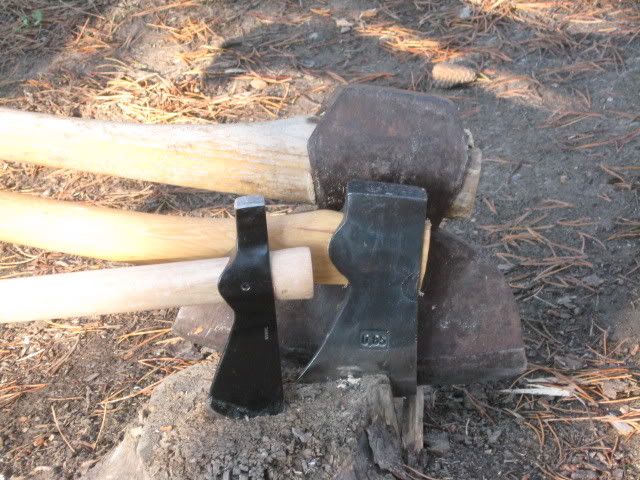
It is a 10.5" broadaxe that I have used forever, I already have the wood, unstabilized but, and I don't know how much the extra weight would offset such a heavy head. I was more wondering about strength- would it add any or would it take it away. If it adds some then it could be a touch thinner- I would judge it by feel as I made it and am wondering if the price is worth it.

IMG_2955.jpg


Here is my hand for reference (with a fuzz stick it just made)
IMG_2907.jpg
 
Last edited:
Karl was that from hard maple [hardwood] or big leaf maple [soft wood ] ? I can't imagine hard maple doubling in weight when stabilized.

They are both "hardwoods", though A. saccharum is indeed much harder and denser than A. Macrophylum. Softwoods are conifers, hardwoods are flowering trees, regardless of density. Notable dense softwoods would be yew (Taxus) and thuya burl (Tetraclinis). A popular "soft" hardwood is obeche (Triplochiton).

I would suppose that depending on the stabilization, you could reduce the neck diameter of the handle considerably while retaining strength (similar to steel axe handles). It would be interesting to see some strength/weight analyses of stablilized and un-stabilized wood.

Phillip
 
These are my thoughts:

I think the issue here is the wood type and grain. Axe handles take a lot of shock, and need a grain that can flex enough to not separate (split) when the head strikes the target. With birdseye maple, there are lots of little changes in the grain (the eyes), which may make hundreds of places for a break to start. For a decorative axe handle, it would be lovely, for a user it probably would break more easily.

Second, is the fact that stabilization is to make the wood less flexible and more water resistant. The things that make an ash or hickory handle able to take the shock would become the downfall of the handle if stabilized.

The weight issue has already been addressed.

Stacy
 
These are my thoughts:

I think the issue here is the wood type and grain. Axe handles take a lot of shock, and need a grain that can flex enough to not separate (split) when the head strikes the target. With birdseye maple, there are lots of little changes in the grain (the eyes), which may make hundreds of places for a break to start. For a decorative axe handle, it would be lovely, for a user it probably would break more easily.

Second, is the fact that stabilization is to make the wood less flexible and more water resistant. The things that make an ash or hickory handle able to take the shock would become the downfall of the handle if stabilized.

The weight issue has already been addressed.

Stacy

Stacy, I never knew you had the powers to read minds. :D Exactly what I was thinking.
 
Back
Top