-
The BladeForums.com 2024 Traditional Knife is available! Price is $250 ea (shipped within CONUS).
Order here: https://www.bladeforums.com/help/2024-traditional/
You are using an out of date browser. It may not display this or other websites correctly.
You should upgrade or use an alternative browser.
You should upgrade or use an alternative browser.
Stacked leather
- Thread starter Ondalake3
- Start date

- Joined
- Aug 5, 2001
- Messages
- 4,306
Not sure what your definition of "seamless" is? Most quality leather stack handles are seamless, in my opinion.
And suede is simply leather that is the "other" side of the outer skin leather. Suede is usually pretty soft depending on how it was treated/cured - I'm not sure how durable it would be for use as handle material.
And suede is simply leather that is the "other" side of the outer skin leather. Suede is usually pretty soft depending on how it was treated/cured - I'm not sure how durable it would be for use as handle material.

AntDog
Basic Member
- Joined
- Apr 3, 2001
- Messages
- 27,712
Suede would make a terrible knife handle. You could NOT get it wet whatsoever, and it would gather all the smells and dirt and crud in the world. Only way it might work would be if you sealed it in epoxy. At that point might as well use something else.

- Joined
- Aug 29, 2010
- Messages
- 13,996
(Disclaimer: I nerded out a bit here, forgive the clarifications, just wanted to make sure we're on the same page)
Leather has two sides, Flesh and Grain. A simple way to look at it is the Flesh side is what was connected to the meat of the animal and the grain side grew the hair.
Looking at a cross section of leather, the grain side looks like a dense thinner layer, and the flesh side will look fibrous and makes up the vast majority of the thickness.
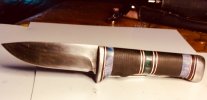
The visible lines/seams in a stacked leather handle are the junction of the grain side meeting the flesh side. Those density differences create the "stripes" that it sounds like you're trying to avoid.
Suede is basically leather that has had the flesh side "roughed" up to create a texture. It may or may not have a grain side to it.
If it doesn't have a grain side, it's considered split leather. That has the grain side removed and leaves you with the fibrous flesh side only.
How leather is tanned is important in stacked leather handles. Vegetable tanned leather allows the leather to be formed and compressed and it will take a "set". It won't spring back to it's original shape after it dries, it will stay condensed, which is what you want. Chrome tanned leather will not wet form or take a set.
To answer the OP's question, using split leather is entirely possible though you guve up the strongest portion of the leather, the grain.
In theory it makes sense, take out the grain and you will remove the lines and suede might help the pieces "intertwine" better. You will however still be able to notice the seam between the layers, it just may not be as pronounced as it would be if the grain side was there.
You'll be able to reduce the seams but by how much is questionable. I have used both and will say that I prefer top grain.
Edit go add: I noticed that you mentioned durability as well. Having the grain side present will without question give you more durability. In my experience, the most important aspect of a stacked leather handle is the amount of compression, the more the better.
Leather has two sides, Flesh and Grain. A simple way to look at it is the Flesh side is what was connected to the meat of the animal and the grain side grew the hair.
Looking at a cross section of leather, the grain side looks like a dense thinner layer, and the flesh side will look fibrous and makes up the vast majority of the thickness.
The visible lines/seams in a stacked leather handle are the junction of the grain side meeting the flesh side. Those density differences create the "stripes" that it sounds like you're trying to avoid.
Suede is basically leather that has had the flesh side "roughed" up to create a texture. It may or may not have a grain side to it.
If it doesn't have a grain side, it's considered split leather. That has the grain side removed and leaves you with the fibrous flesh side only.
How leather is tanned is important in stacked leather handles. Vegetable tanned leather allows the leather to be formed and compressed and it will take a "set". It won't spring back to it's original shape after it dries, it will stay condensed, which is what you want. Chrome tanned leather will not wet form or take a set.
To answer the OP's question, using split leather is entirely possible though you guve up the strongest portion of the leather, the grain.
In theory it makes sense, take out the grain and you will remove the lines and suede might help the pieces "intertwine" better. You will however still be able to notice the seam between the layers, it just may not be as pronounced as it would be if the grain side was there.
You'll be able to reduce the seams but by how much is questionable. I have used both and will say that I prefer top grain.
Edit go add: I noticed that you mentioned durability as well. Having the grain side present will without question give you more durability. In my experience, the most important aspect of a stacked leather handle is the amount of compression, the more the better.
Last edited:

- Joined
- Sep 13, 2017
- Messages
- 9,115
Great post.(Disclaimer: I nerded out a bit here, forgive the clarifications, just wanted to make sure we're on the same page)
Leather has two sides, Flesh and Grain. A simple way to look at it is the Flesh side is what was connected to the meat of the animal and the grain side grew the hair.
Looking at a cross section of leather, the grain side looks like a dense thinner layer, and the flesh side will look fibrous and makes up the vast majority of the thickness.
The visible lines/seams in a stacked leather handle are the junction of the grain side meeting the flesh side. Those density differences create the "stripes" that it sounds like you're trying to avoid.
Suede is basically leather that has had the flesh side "roughed" up to create a texture. It may or may not have a grain side to it.
If it doesn't have a grain side, it's considered split leather. That has the grain side removed and leaves you with the fibrous flesh side only.
How leather is tanned is important in stacked leather handles. Vegetable tanned leather allows the leather to be formed and compressed and it will take a "set". It won't spring back to it's original shape after it dries, it will stay condensed, which is what you want. Chrome tanned leather will not wet form or take a set.
To answer the OP's question, using split leather is entirely possible though you guve up the strongest portion of the leather, the grain.
In theory it makes sense, take out the grain and you will remove the lines and suede might help the pieces "intertwine" better. You will however still be able to notice the seam between the layers, it just may not be as pronounced as it would be if the grain side was there.
You'll be able to reduce the seams but by how much is questionable. I have used both and will say that I prefer top grain.
Edit go add: I noticed that you mentioned durability as well. Having the grain side present will without question give you more durability. In my experience, the most important aspect of a stacked leather handle is the amount of compression, the more the better.


jfk1110
Gold Member
- Joined
- Mar 9, 2013
- Messages
- 26,940
My thoughts exactly!!Great post.
jfk1110
Gold Member
- Joined
- Mar 9, 2013
- Messages
- 26,940
Very informative!! Thanks! I never really put much thought beyond my miniscule knowledge of brain tanning a hide for my own purposes and just because its fascinating the every animal has enough brain to tan its hide,.enough intestine to stuff its.meat into and enough tendon to stitch it up. If necessary of course!!!(Disclaimer: I nerded out a bit here, forgive the clarifications, just wanted to make sure we're on the same page)
Leather has two sides, Flesh and Grain. A simple way to look at it is the Flesh side is what was connected to the meat of the animal and the grain side grew the hair.
Looking at a cross section of leather, the grain side looks like a dense thinner layer, and the flesh side will look fibrous and makes up the vast majority of the thickness.
The visible lines/seams in a stacked leather handle are the junction of the grain side meeting the flesh side. Those density differences create the "stripes" that it sounds like you're trying to avoid.
Suede is basically leather that has had the flesh side "roughed" up to create a texture. It may or may not have a grain side to it.
If it doesn't have a grain side, it's considered split leather. That has the grain side removed and leaves you with the fibrous flesh side only.
How leather is tanned is important in stacked leather handles. Vegetable tanned leather allows the leather to be formed and compressed and it will take a "set". It won't spring back to it's original shape after it dries, it will stay condensed, which is what you want. Chrome tanned leather will not wet form or take a set.
To answer the OP's question, using split leather is entirely possible though you guve up the strongest portion of the leather, the grain.
In theory it makes sense, take out the grain and you will remove the lines and suede might help the pieces "intertwine" better. You will however still be able to notice the seam between the layers, it just may not be as pronounced as it would be if the grain side was there.
You'll be able to reduce the seams but by how much is questionable. I have used both and will say that I prefer top grain.
Edit go add: I noticed that you mentioned durability as well. Having the grain side present will without question give you more durability. In my experience, the most important aspect of a stacked leather handle is the amount of compression, the more the better.
Great post John. Thanx!!!
James
- Joined
- Dec 5, 2018
- Messages
- 1,437
I don't think you'd be able to completely eliminate the seams between the layers and have the handle be solid. You need to have at least a thin layer of glue between the leather washers, and even if you use leather that's napped on both sides, you'll be able to see the seams where the glue is. I guess you might be able to get glue that's color matched to the leather, but that'd be tough. The last stacked-leather handle I did had leather with nap on both sides, you could see seams in the final product. Good sanding and wax minimized it, but you can still see the distinct layers.

Richard338
Gold Member
- Joined
- May 3, 2005
- Messages
- 7,489
I did this FS dagger not long ago with some help from John Conner.
The leather was dyed with vinegaroon and I added a bit of black dye to the marine epoxy I put between layers.
I assume I could do a better job with more practice, but already you can see the lines between layers aren't too prominent.

The leather was dyed with vinegaroon and I added a bit of black dye to the marine epoxy I put between layers.
I assume I could do a better job with more practice, but already you can see the lines between layers aren't too prominent.
- Joined
- Aug 29, 2010
- Messages
- 13,996
Nice work Richard, that's gotta go great with the smatchet. Great idea using dye with the epoxy.I did this FS dagger not long ago with some help from John Conner.
The leather was dyed with vinegaroon and I added a bit of black dye to the marine epoxy I put between layers.
I assume I could do a better job with more practice, but already you can see the lines between layers aren't too prominent.
Let's hope our OP comes back to continue the discussion.