 im having some problems with my full tang handle making. #1 ive been using a standard 30 min epoxy i got from home depot. i had to remove a handle to do it over, when i took it off there was no epoxy between. it had all pushed out when i clamped it. is the epoxy im using ok? how hard should i clamp it so it will be tight enough but still have epoxy between? im also using 1/4" pins in the handle. #2 any ideas on glueing & clamping without getting it everywhere? thanks,willy
-
The BladeForums.com 2024 Traditional Knife is available! Price is $250 ea (shipped within CONUS).
Order here: https://www.bladeforums.com/help/2024-traditional/
You are using an out of date browser. It may not display this or other websites correctly.
You should upgrade or use an alternative browser.
You should upgrade or use an alternative browser.
sticky problems with epoxy!
- Thread starter willy m
- Start date

- Joined
- Apr 27, 1999
- Messages
- 6,117
You want to use a "filled" epoxy. In industry they add some sort of precise grit (often microscopic glass beads) to the resin to insure that you won't squeeze it all out. You also want to limit how much clamping force you apply. You could take a paper hole punch and create some aluminum foil circles. You could stick a few of these in your joint to give yourself some minimal space.

- Joined
- Oct 9, 2007
- Messages
- 115
I use carbide burrs in my Dremel to nick the tang everywhere that will be covered by the scales. Once you have squared the surface of the scale material to be glued, use another burr to cut and nick the scale. This gives the glue a place to migrate to as the clamps squeeze out the excess. I use spring clamps and not c-clamps. Wipe everything to be glued down with acetone.
Once I have the scale and tang glued and ready to be clamped, I use a wrap of waxed paper to keep the glue off of the clamps and gluing area. Waxed paper lets you see through to your work to check alignment and such, it doesn't stick, and it's cheap. I'm using the same epoxy and it works well for the application.
I use this epoxy:
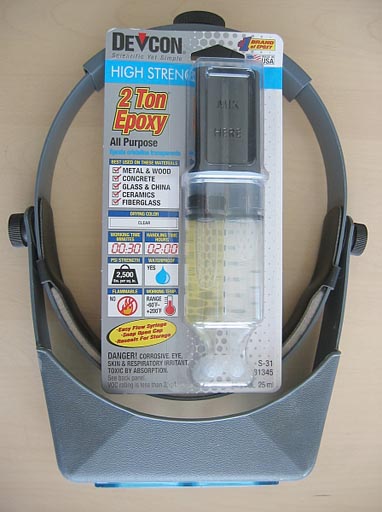
Once I have the scale and tang glued and ready to be clamped, I use a wrap of waxed paper to keep the glue off of the clamps and gluing area. Waxed paper lets you see through to your work to check alignment and such, it doesn't stick, and it's cheap. I'm using the same epoxy and it works well for the application.
I use this epoxy:

- Joined
- Oct 2, 2006
- Messages
- 3,238
First of all use the "2 ton" variety of epoxy, fast setting stuff stays gooey (in my experience)I will drill a couple of very shallow impressions in the tang and on the insideof the scale to form "epoxy rivets" I also rough the sides of my rivits so the epoxy will grab between the rivets and the wood. as for the mess, i just put down lots of scrap paper, and cut/sand the hardened epoxy off when final shaping/finishing. I clamp it in a vise lined with several layers of paper to keep the epoxy from attaching the knife to the wood blocks of the vise. As for hardness, I crank the snot out of the vise, If I can see a gapbetween scale and steel before glueup it's not fitted well enough, if I can see a gap once glued up it's not tight enough.
-Page
-Page
I am with Sunshadow. I want no visible gap, and I use Devcon 2 ton. I honeycomb some tangs, drilling "bridge" holes for the epoxy to fill. I once had to replace a set of buffalo slabs on a tang done this way, the owner wanted ivory, and I had to burn the grips off. I could not break the bond with a hammer.
- Joined
- Jun 23, 2006
- Messages
- 2,413
Well, I don't subscribe to the epoxy rivet belief, but I do like to put holes in the tang of many of my knives to just let the weight out. A trick I was told by Alan Folts is to use a thin strip of colored fiberglass between your scale and tang. He was told this by an epoxy rep. who said that the fiberglass will keep an even layer of epoxy between the two surfaces, you also get a colored spacer out of the deal.
Steve Johnson uses CA on his handles and you can get water resistant cyanoacrylate if you're worried about it breaking down. I've used Gorilla glue a bit and found that it works well. Polyurethane glues bond better in tight, thin applications, so you can clamp the heck out of them. You don't get a glue line with these. The package says it's waterproof and it held up well in the glue wars, but bear in mind that some folks here and on other forums say that it will break down in water. Do your own testing if you're not sure what to think.
Most makers view glue as a water barrier more than a fastener, I am mostly in agreement with this line of thought. Use a good mechanical fastener and apply your glue as a water barrier with benefits.
Steve Johnson uses CA on his handles and you can get water resistant cyanoacrylate if you're worried about it breaking down. I've used Gorilla glue a bit and found that it works well. Polyurethane glues bond better in tight, thin applications, so you can clamp the heck out of them. You don't get a glue line with these. The package says it's waterproof and it held up well in the glue wars, but bear in mind that some folks here and on other forums say that it will break down in water. Do your own testing if you're not sure what to think.
Most makers view glue as a water barrier more than a fastener, I am mostly in agreement with this line of thought. Use a good mechanical fastener and apply your glue as a water barrier with benefits.
- Joined
- Apr 27, 1999
- Messages
- 6,117
You could pulverize or chop a little bit of glass fiber (the type for making fiberglass) and add it to your epoxy.
- Joined
- Sep 12, 2007
- Messages
- 709
I use carbide burrs in my Dremel to nick the tang everywhere that will be covered by the scales. Once you have squared the surface of the scale material to be glued, use another burr to cut and nick the scale. This gives the glue a place to migrate to as the clamps squeeze out the excess. I use spring clamps and not c-clamps. Wipe everything to be glued down with acetone.
Once I have the scale and tang glued and ready to be clamped, I use a wrap of waxed paper to keep the glue off of the clamps and gluing area. Waxed paper lets you see through to your work to check alignment and such, it doesn't stick, and it's cheap. I'm using the same epoxy and it works well for the application.
I use this epoxy:
This is basically what I do and use the devcon epoxy. I use the dremel with the metal cutting disk to cut shallow slots in the tang and handle material. I also dye the epoxy the color of the spacer material I use between the knife and handle material.
Willy,
Unlike wood glues, epoxy doesnt require hard clamping to ensure strength. The glue can be built up to some extent and does not have to be a thin film to be effective. I would suggest along the same lines of other suggestions: rough out some little indents in both the tang and the scales, and ensure the whole surfaces are rough while your at it. Clamp the pieces, but just enough to squeeze out a small amount of epoxy, and get the scales in the right position. No need to clamp more than this. Pins to reinforce the bond are a good option and the pins and the glue compliment each other - The total is stronger than the sum of the parts, as such.
Now I am wondering how 2 ton epoxy is characterised? is it 2 tons weight pulling apart two glued together plates which are 2m x 2m or two plates 2cm x 2cm?
Lang
Unlike wood glues, epoxy doesnt require hard clamping to ensure strength. The glue can be built up to some extent and does not have to be a thin film to be effective. I would suggest along the same lines of other suggestions: rough out some little indents in both the tang and the scales, and ensure the whole surfaces are rough while your at it. Clamp the pieces, but just enough to squeeze out a small amount of epoxy, and get the scales in the right position. No need to clamp more than this. Pins to reinforce the bond are a good option and the pins and the glue compliment each other - The total is stronger than the sum of the parts, as such.
Now I am wondering how 2 ton epoxy is characterised? is it 2 tons weight pulling apart two glued together plates which are 2m x 2m or two plates 2cm x 2cm?
Lang
- Joined
- Jun 23, 2006
- Messages
- 2,413
The two ton strength is measured in one square inch of surface to the best of my knowledge.
I use the regular 'overnight' epoxy. First run a 60 grit belt to scuff the tang of the knife and the scales of the handles where the epoxy will be applied.
Have your rivets and pins ready to go. Mix and apply epoxy, insert your pins and rivets. Then squeeze the scales and the handles down with firm pressure in the vise until epoxy is oozing from every part of the handle. At the same time squeeze in your rivets so that they are set into the handle. At this point your pins should be in their final position.
Let the epoxy set up. Then grind the pins flush to the wood, look the handle over and then profile it to shape and then finish it up.
Have your rivets and pins ready to go. Mix and apply epoxy, insert your pins and rivets. Then squeeze the scales and the handles down with firm pressure in the vise until epoxy is oozing from every part of the handle. At the same time squeeze in your rivets so that they are set into the handle. At this point your pins should be in their final position.
Let the epoxy set up. Then grind the pins flush to the wood, look the handle over and then profile it to shape and then finish it up.
- Joined
- Oct 9, 2007
- Messages
- 115
After roughing the tang and scales, here's what I do:Having not put together a knife before. Would you put the pins in at the time of putting the knife togerher with epoxy?aquamanlr
1. Finish the front of the scales, because you can't do that easily after they're glued to the tang
2. Glue one scale to the tang, clamp and let set up
3. Drill at least pilot holes in the places you will insert a pin or lanyard tube through tang and scale material
4. Glue other scale to tang and let set up
5. Drill holes for pins/lanyard tubes through pilots holes, slightly oversized
6. Cut pins/tubes to length and rough up where each passes through the tang
7. Grind tapers on pins so they are easier to insert
8. Glue and insert pins, peen if necessary.
9. Shape handles to taste
This method may take a little longer than others but it helps ensure that your pins are in straight and the scales are aligned

Fillers are used for high strength ratios to create a matrix when used. Divots thin grooves etc wil all enhance bonding surface and depth.
Try
www.westsystem.com
Fillers can be from micro balloons, cotton fiber, graphite dust,etc. they all will give the epoxy 2-5 times the strength of an unfilled product.
West Systems created the pump system and many large boats , small planes etc. are built with the wood epoxy saturation tecnique. You can use aluminum dust to make repairs on aluminum. There is a lot of good knowledge on the site, and their book is great.
Try
www.westsystem.com
Fillers can be from micro balloons, cotton fiber, graphite dust,etc. they all will give the epoxy 2-5 times the strength of an unfilled product.
West Systems created the pump system and many large boats , small planes etc. are built with the wood epoxy saturation tecnique. You can use aluminum dust to make repairs on aluminum. There is a lot of good knowledge on the site, and their book is great.