Still more forge questions

Joined
Aug 28, 2009
Messages
7,951
So I am getting close to having all my parts to start my forge build, but there are a few things I ma not sure about.

First off, is a question about the door. I am only going to have a front door with a pass through hole in the back. The door is going to be a side opening one, but I am wondering about the need for a seal/gasket on it, and what to use if one is needed. Secondly, the holder tube for the burner. Should it penetrate all the way into the forge and be even with the insulation, or just be flush mounted to the side of the forge with just a hole cut through the insulation to allow the burner to pass through. And lastly, just how far in should the burner be in relationship to the insulation. I will be running 3" of coated ceramic wool, so would the end of the burner stick out past that, be flush, or come up short?

I guess now would be a good time to confirm my understanding of TC placement too. From what I understand it should be placed roughly center of the chamber (front to back) and at about the same level at your work piece. Am I correct on that?

I am in no real rush on this, because I don't plan on having it fired till mid December, but I am tinkering with the layout and placement of everything while I am waiting for things to come back from HT. Oh what the heck one more question, burner placement, front bias, rear bias, or dead center? I am still not sure if I should be going with a dual burner or not yet either. I will be running this burner that Brian Ayres is sending me, or from what I understand that is roughly what it will look like when I put it together:o if that makes a difference and the volume of the forge should be around 425 cubic inches give or take 50 cubic inches.

Thanks for putting up with me, but I learned with my grinder build, that it is good to ask the questions and get it right the first time, instead of assuming and trying to go it on my own:o BTW I am so glad I listened to all the advice I got on my grinder, I couldn't be happier with it.
 
I was in a hardware store that sold wood burning stoves and supplies for them. On the rack near by, they had a package of "rope" seal for the door of the stove. If you are going to use a seal on it, this might work. While you are putting on the hinges, maybe also put on a latch to keep it closed? Not speaking from experience, just a thought that came to me.
 
Hey George!

I struggle with the whole door issue too, but haven't used any gasket type stuff. So far my first approach was stacked soft firebricks. That worked well, except I'm such a klutz (not to mention my high school students) that they're frequently getting knocked around. I never got around to making a frame to hold them in place. My latest efforts have used the 1" high temp insulating board permeated with rigidizer and coated with satanite and ITC100. That has worked well for me, but I'm anxious my next HS classes will be rough on them. I'm just starting to put together another new forge I'm going to put doors lined with castable refractory hinged on both ends. The ends of the tube shell will also be cast. I'm hoping everything will be smooth and flat enough to seal well.

The burner collar usually just welds on flush with the metal shell wall at whatever tangent to the inner chamber you want. To help setup it up for the weld I stack four 3/4"x3/4" lengths of wood through the collar (it's what I have at hand that fits snugly in the 2" schedule 40 I use for the collar) such that they protrude into the shell at the angle I want the flame.

If you sharpen the edge of a pipe that just fits inside the welded on collar you can cut out the refractory wool you line the shell with by spinning the pipe back and forth while pressing with your hand against the fiber on the inside. Dave at Chile Forge told me that trick. Michael Porter describes using the burner tube in a similar way in his book, Gas Burners for forges, Furnaces & Kilns. Another trick Dave told me was to use a cone shaped form pushed up from the inside of the fiber lined shell into the inner opening of the tunnel cut through the fiber to flare out the opening. I use a top cut from a plastic drink bottle. While the cone is held in place, poor a quarter cup or so of rigidizer into the burner collar/tunnel from the outside opening and let it dry in place. Coat the flare and tunnel along with the rest of the liner with Satanite and ITC.

The burner will last a good while if it doesn't protrude in the forge chamber. It should come up short. The flared out opening helps with that and the performance of the flame.

I've seen different ideas regarding to the angle for the burner and flame. Many folks say to have it come in at a tangent to the chamber such that the flame can vortex around the chamber. Keven Cashen is such an advocate. Others say that it is irrelevant, including Kevin, if there is a flat floor at the bottom of the chamber such that the chamber walls don't circle all the way round anyway. Michael Porter and Dave at Chile Forge go with just shy of top dead center with the flame aimed at the center of the floor. It looks like NC Tool Co forges' burners aim straight down. I built my first forge of the Porter/Chile Forge style this last summer with the burner centered on the long axis and just to the right of top dead center. It works nicely. I just built another one like that and a third one with the burner lowered a couple more inches. It works well too. The one I'm building now will be lined with a 1" cast shell inside the fiber blanket and be completely circular in cross section (without a flat floor, thus I will have the burner come in at a tangent to it for the vortex effect.

I'm not sure about how many burners you want. I'm using one 1" high-tech aspirated burner in each of my small forges satisfactorily.

All the best, Phil
 
Last edited:
I was in a hardware store that sold wood burning stoves and supplies for them. On the rack near by, they had a package of "rope" seal for the door of the stove. If you are going to use a seal on it, this might work. While you are putting on the hinges, maybe also put on a latch to keep it closed? Not speaking from experience, just a thought that came to me.
Way ahead of you on that;), as soon as I decided that the door would open to the side I knew I needed a way to keep it closed.


The rope seal your talking about works, I use an old pot bellied stove for my forge and have the same sealant.

I can pick up the rope fireplace seals locally, but I was concerned that it wouldn't take the heat of the forge being that it is only rated for 1000F. It looks like that isn't a problem though.

Hey George!

I struggle with the whole door issue too, but haven't used any gasket type stuff. So far my first approach was stacked soft firebricks. That worked well, except I'm such a klutz (not to mention my high school students) that they're frequently getting knocked around. I never got around to making a frame to hold them in place. My latest efforts have used the 1" high temp insulating board permeated with rigidizer and coated with satanite and ITC100. That has worked well for me, but I'm anxious my next HS classes will be rough on them. I'm just starting to put together another new forge I'm going to put doors lined with castable refractory hinged on both ends. The ends of the tube shell will also be cast. I'm hoping everything will be smooth and flat enough to seal well.

The burner collar usually just welds on flush with the metal shell wall at whatever tangent to the inner chamber you want. To help setup it up for the weld I stack four 3/4"x3/4" lengths of wood through the collar (it's what I have at hand that fits snugly in the 2" schedule 40 I use for the collar) such that they protrude into the shell at the angle I want the flame.

If you sharpen the edge of a pipe that just fits inside the welded on collar you can cut out the refractory wool you line the shell with by spinning the pipe back and forth while pressing with your hand against the fiber on the inside. Dave at Chile Forge told me that trick. Michael Porter describes using the burner tube in a similar way in his book, Gas Burners for forges, Furnaces & Kilns. Another trick Dave told me was to use a cone shaped form pushed up from the inside of the fiber lined shell into the inner opening of the tunnel cut through the fiber to flare out the opening. I use a top cut from a plastic drink bottle. While the cone is held in place, poor a quarter cup or so of rigidizer into the burner collar/tunnel from the outside opening and let it dry in place. Coat the flare and tunnel along with the rest of the liner with Satanite and ITC.

The burner will last a good while if it doesn't protrude in the forge chamber. It should come up short. The flared out opening helps with that and the performance of the flame.

I've seen different ideas regarding to the angle for the burner and flame. Many folks say to have it come in at a tangent to the chamber such that the flame can vortex around the chamber. Keven Cashen is such an advocate. Others say that it is irrelevant, including Kevin, if there is a flat floor at the bottom of the chamber such that the chamber walls don't circle all the way round anyway. Michael Porter and Dave at Chile Forge go with just shy of top dead center with the flame aimed at the center of the floor. It looks like NC Tool Co forges' burners aim straight down. I built my first forge of the Porter/Chile Forge style this last summer with the burner centered on the long axis and just to the right of top dead center. It works nicely. I just built another one like that and a third one with the burner lowered a couple more inches. It works well too. The one I'm building now will be lined with a 1" cast shell inside the fiber blanket and be completely circular in cross section (without a flat floor, thus I will have the burner come in at a tangent to it for the vortex effect.

I'm not sure about how many burners you want. I'm using one 1" high-tech aspirated burner in each of my small forges satisfactorily.

All the best, Phil

Thanks for the info Phil. Like you I am a bit of a klutz at times and I am thinking about a replaceable floor so that kind of took care of the stacked brick idea:o The door and hinges were very easy to design. With the full front of the forge having the ability to be completely removed at any time (preferably when cold) it will make it easy to reline the forge and change out the floor if needed. I have it planned for the burner to be pointed slightly down to try and get some circular motion inside the forge. I have also offset the opening of the forge more towards the bottom. My thinking on this is that I will be able to trap more heat inside if there is a bit of space above the front opening.
 
I just built my first forge so I am by no means an expert but here is how I did mine:

The door is made from a piece of the same 8" pipe as the forge cut 2" long with a piece of plate welded on and the 4" square opening cut out of the plate. the door itself is lined with koawool, satanite, and itc100. I just left about 3/16 inch of koawool hanging out the front of the of the forge all the way around. With the hinge pin in place and the latch secured the extra koawool is compressed down to about nothing giving me a tight seal.

The burner holder is flush with the outside of the forge, The burner does not stick in past the lining, I made a small dished area similar to what Phil described. The burner goes into the forge about 2/3 of the way back.

It is a single blown burner and the forge volume of just under 500 cubic inches. It seems to put out plenty of heat.

I am still considering TC placement but I will more than likely weld a 3/4 threaded coupling over the TC hole...I may make more than one to try different placements, and when not in use fill the coupling with koawool and a threaded plug.

Hope some of this helped.
 
I'd love to see some pix of your door, hinges and latch(es)!

I still haven't actually made my hinges, but they are fairly simple. I am also working with a 33# tank and not a 20# tank so I have a bit of flat space to work with. The thing for me to remember when I am welding all the parts together is to keep everything level as humanly possible. If I let one piece come out of line a little bit the whole works will bind and be a bugger to open and close.

I have everything drawn up in my cad program, I will render a couple of pictures of the hinges and latch.
 
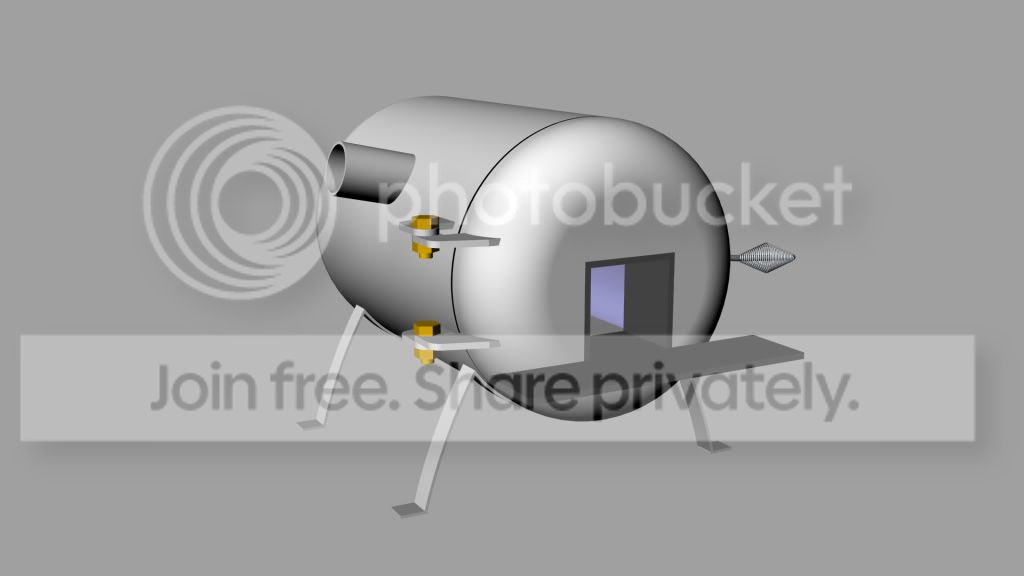
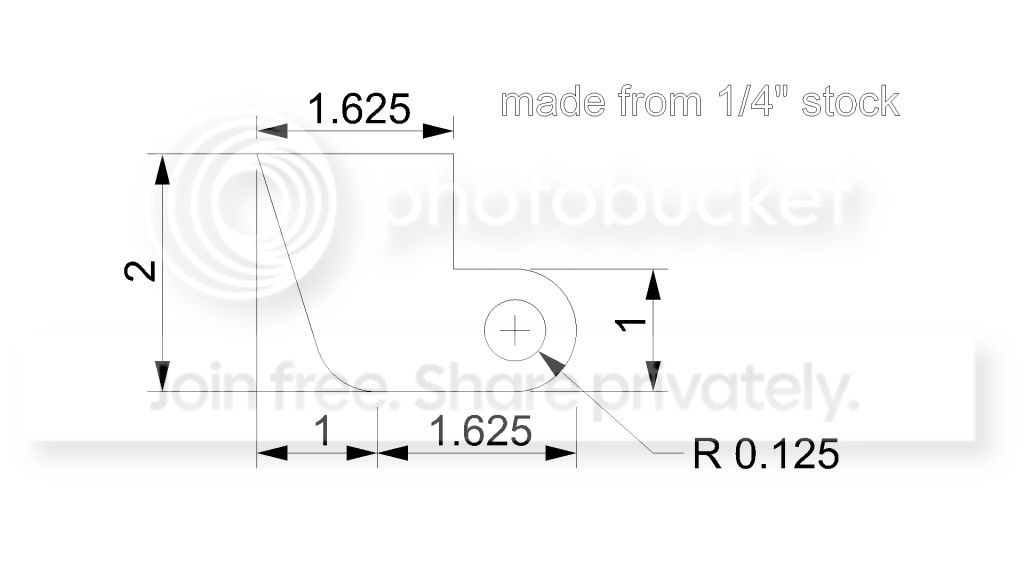
OK so here is what I am thinking for hinges and a latch. Two things to keep in mind is that my drawing isn't exact, where the door side of the hinges attach is actually flat not a radius like in the drawings, and I know there is no handle on the door. What I am thinking of doing there is to just drill a hole through the shelf so I can stick something into it to open the door. I am also considering adding a stop to the hinge to keep it from swinging all the way to the side. In a perfect world the door will never be opened while the forge is hot, so the handle isn't really needed, but we all know that the world isn't perfect.

hinge_01.jpg


hinge_02.jpg


hinge_03.jpg


latch_01.jpg


latch_02.jpg


hinge_dims.jpg


The latch catch I am just going to make out of three pieces and bolt them together, if I had a mill I would machine it
 
Last edited:
Don't have any pics railrider don't know how to post on here but the stove is one my grandpa used to keep his barn warm. When he died I got it and found a mark jor1903DTx which I've been told is a makers mark from the jordan steel company from Dallas 1903. Really heavy and can take any heats I put to it. My anvil has a similar mark but from 1909.
 
Back
Top