Stockman guys , I need your help :D

Joined
Jul 24, 2010
Messages
192
Tonight I search whatever I can to find a stockman which does not have any blade has its tip outside when chosed.

And yes , I found some in RR , GEC ,and Case , but all of them are either SS or a little costy.

So here's a new question from a freshman in stockman , as I find many stockman from many brands have this same "shortage" :

Does the outside tip(when closed) matter or not ?
 
Hey mate,
If you don't mind the aesthetics, there's no problem funtionwise because you never use two blades at a time and the point of the sheepsfoot is always cover by another one, the Spey or the main clip.
Mateo
 
Tonight I search whatever I can to find a stockman which does not have any blade has its tip outside when chosed.

And yes , I found some in RR , GEC ,and Case , but all of them are either SS or a little costy.

So here's a new question from a freshman in stockman , as I find many stockman from many brands have this same "shortage" :

Does the outside tip(when closed) matter or not ?
i have one whose spey blade is exposed when closed. i noticed it only when i watched a yootoob review; comparing it (US-made) with the chinese counterpart. the short of it is it doesn't hurt me any. i've run my fingertip laterally along the length where the spey tip is exposed. nothing. the blade is thick and the sharpening bevel does a good job of hiding the edge away from the side. and judging from the height of the thumb notch above the handle, the makers deliberately exposed the tip. grinding down the kick to lower the tip is not advisable (though one guy here did it.) you might sink the thumb notch below the handle!

and no, i don't think other makes do this (even accidentally.)
 
Doesn't matter, it's next to impossible to cut yourself in that tip, be it the spey (ex. buck301) or the sheepsfoot (ex. case). It doesn't affect function in any way.
 
you could always file down the kick a little and the blad will go further into the handle.
 
Sometimes, filing the kick helps. BUT, you need to check beforehand, to see if altering the blade position will cause other problems. Look at the nail nicks, and see if lowering one blade will cause it's nail nick to be blocked or obscured by an adjacent blade. On a stockman pattern, oftentimes it's the sheepsfoot that rides high, and lowering it will sometimes put it's nail nick behind the spey blade (or the pen blade on smaller models).

Also be sure to check in the blade well, to make sure there's enough free room below the lowered blade's edge. With the sheepsfoot, and often the spey, there's usually enough room below the edge. The main (clip) blade might not have as much. If lowered too far, an edge might end up contacting the inside face of the backspring when closed.

Assuming that's not an issue, and filing the kick looks like a solution, do a little at a time and watch the backspring for that blade. On some less well-designed/constructed knives, the backspring might sink further below the spine of the handle, as the kick gets filed down. On a better knife, that shouldn't happen.
 
Last edited:
you could always file down the kick a little and the blad will go further into the handle.

That has the potential to ruin a knife right quick. Find a knife where the sheepsfoot blade rides in the frame. Examples:

Case 18 pattern - Sheepsfoot blade rides above the frame

Case 47 pattern - Sheepsfoot blade rides in the frame

As the OP said; he'll need to do some research to find a Stockman where the sheepsfoot blade doesn't ride proud of the frame.
 
maybe a Maverick #62 from GEC would be right for you? Stockman blade configuration with congress frame. A bit unusual, with a shorter than usual clip.
I have never handled one, so I don't know if it has the potential problems you mention, but intuition tells me that the curved congress frame would cover the blades more. I know they are at the more expensive end of the production spectrum though.
 
That has the potential to ruin a knife right quick. Find a knife where the sheepsfoot blade rides in the frame. Examples:

Case 18 pattern - Sheepsfoot blade rides above the frame

Case 47 pattern - Sheepsfoot blade rides in the frame

As the OP said; he'll need to do some research to find a Stockman where the sheepsfoot blade doesn't ride proud of the frame.

I thought he was saying that the tip of the blade rode high out of the handle, whick would be a defect in my mind. But yes, dont just file it could mess things up if its not messed up in the first place.
 
My buck 303 has all blades inside the handle, and the backspring of the spey is not flush with the scales, but actually a bit higher, and filing the spey kick would make it right, and make the blade rest even deeper, but lower the nail nick...
 
In addition to the ones Ed and jacktrades mentioned the Queen Cattleking stocman; I have the Marbles version and my Case 39TB Sowbelly, my S&M Sowbelly sits flush with the frame and the GEC #53 though I consider it more of a cattleman.
 
By all means, get a Great Eastern, whether it be Great Eastern, Tidioute, or Northfield.

The #53 stockman pattern was made to address this very issue. It has a Turkish clip, which sits low, and additionally has the sheepsfoot face the mark side. The tip of the sheepsfoot sits at least an 8th of an inch below the top of the frame at all times. Arguably the best damned stockman pattern ever made, and I've carried a few. If you would like, I will include a few photos, just let me know.
 
Last edited:
akadave2
Gold Member
Join Date
Jun 2008
Location
Alaska
Posts
887


" you could always file down the kick a little and the blad will go further into the handle."

Good idea, and the approach I would take if one buys a knife that doesn't already have the sheepsfoot low enough.
 
Last edited:
Just be careful when filing down the kick. As others have said, be careful not to cover nail nicks and not hitting anything with the edge.
But there's another thing: When you file down the kick, the backspring will inevitably go down a bit as well and won't be perfectly flush in the closed position. It may be less of an issue on smaller knives, but on my #53 with crisp edges it is very noticeable.
 
The buck 301 spey blade never catches on my finger, in my pocket or anywhere else. I never even notice it was exposed for quite awhile.
 
I am not sure I even need to comment here , you guys have it covered. I will defend myself (not really needed). A post or two back I talked where I "honed" on the kicks to slightly lower them. This after determining there was space to do so and I did it slowly and carefully. This was a repeat of what I said in the post and still think is important. That was also in reference to a knife I modified and had to file a depression on the liner top for best access to the lower spey nic.

I think the shape of the Buck spey tip keeps it from being a problem as much or more than the closing depth.

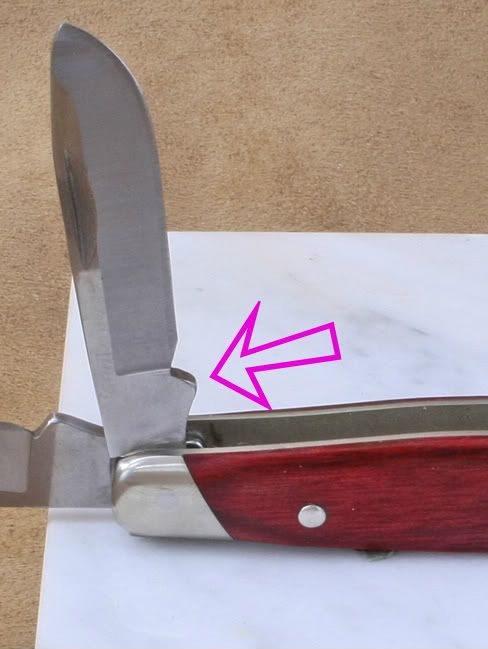
Also remember we have readers that might not know a knife kick from a football punt. So I will do the photo thing again.

The arrow points to the kick. That point rests on the top of the spring when closed and determines how the blade 'nestles' in the blade well. You don't want the blade edge to hit bottom.....this is adjusted by the factory and is set to a average standard before leaving the facility. Custom makers use a slightly more precise standard.
SpeyB.jpg

300
 
Last edited:
I always file the kick on the sheepsfoot blade. Just be careful to leave enough of the nail nick exposed that you can open the blade!
 
Back
Top