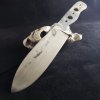
Strange activity, deep decarb or something else?

Joined
Mar 28, 2016
Messages
811
This is a first for me. What I thought was decarb seems to run too deep for me to grind through.
This is .1875 1084 from Aldo. I thermal cycled the profiled, un ground steel. 1600, 1500, 1400. I did not grind the steel clean. Ground the bevels about 2/3 of the way.
Aus @ 1500 for about 5 minutes, quench in parks 50. Temper 425 twice for 1 hour.
Pretty basic.
While finishing, I could see a cloudy layer of decarb on the steel. So I ground and ground and ground until if i made one more pass, i would have ground out my stamp. Still cloudy splotches.
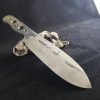
So I said screw it, guess I'm going to play with forced patina. Tossed it in some vinegar and the splotches turned black. You can see where the black parts are on the top of the bevels, those were flats during heat treatment.
So what's going on here?
20190219_080332-1512x1512.jpg 20190219_080316-1512x1512.jpg
 
You click "Edit Thread" in the drop down from Thread Tools. Then change the title and click Save Changes. I took care of it for you.
 
It’s an auto hamon. The spots that etched dark are pearlite, rather than martensite,
 
It’s an auto hamon. The spots that etched dark are pearlite, rather than martensite,
I guess I shouldn't have tried so hard to grind it away! Is this fairly common with 1084? Do you think it occured because I left the thermal cycle decarb on the flats and it acted as the clay would?
 
I guess I shouldn't have tried so hard to grind it away! Is this fairly common with 1084? Do you think it occured because I left the thermal cycle decarb on the flats and it acted as the clay would?

Probably not because of the decarb. Accidental hamon is more common as steel gets thicker. I get it almost every time on simple steels when 1/4” thick. When soaks are shorter, the thicker parts of the steel might not get fully up to temp. This occurs either because the quench is too slow, or all the steel hasn’t come up to full temp yet.
 
I sometimes etch as part of my sanding process and have noticed that I'm getting spots on 1084 that aren't fully hard. Its pretty surprising sometimes. I usually get do full flats and see it on the spine.
 
I sometimes etch as part of my sanding process and have noticed that I'm getting spots on 1084 that aren't fully hard. Its pretty surprising sometimes. I usually get do full flats and see it on the spine.
What do you do at that point? Any luck grinding them out? Do you reheat?
This knife is a keeper for myself, but I would hate to have is happen unexpected. I guess increasing soak times will help.
 

Notice how the basic shape and position are the same on both sides.
What you are seeing is unhardened steel, grinding deeper will just make them bigger.

1084 needs a fast quench to fully harden. In thicker blades, the spine and upper bevel may not make the pearlite nose. That is why such steels can auto-hamon.
 
1084 needs a fast quench to fully harden
Faster than Parks 50? Don't get me wrong, I'm kind of glad this happened, now I'm playing with etching and bringing it out more. I just want to be sure to avoid it when it's not desired. This was the last piece of 1084 that had in that thickness, normally I use 80CRV2 for this design and I'm thinking about trying a few in 52100, at the lower temps. I just want to be sure to avoid this happening when It's not desired.
 
Sorry, I missed that you used Park's #50. That should have done the job. Check you temperatures and soak time to assure the spine area is fully austenitized.
 
Last edited:
Back
Top