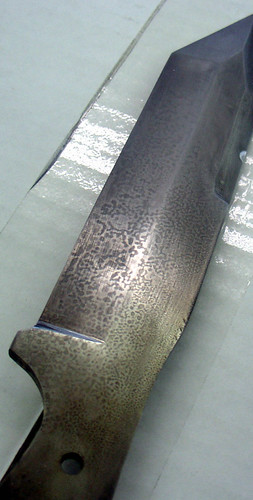
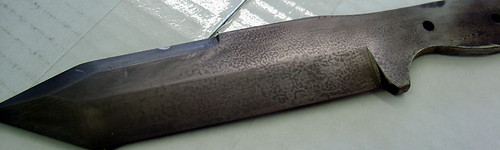
How much of the rind did you grind off after HT.It looks like you may have taken the blade to too final of a finish before HT.Take off about .01-.02" and see what it looks like.It may not have that pattern any more.Too high a heat before quench is most likely the culprit.
A little metallurgy for those who want to know:
Heating high carbon steel above the optimal temperature creates large grain particles(they can be 3/4" round).The steel can even fall apart in a zig-zag or gravelly pattern upon quench.Done to excess,it creates a pattern that looks like cable damascus (but is very weak).Another reason to bring the steel slowly to pre-heat,and then gradually to the austentizing temp is to avoid compressing the center of the blade when the austentite shrinks upon conversion,and thus creating stress in the core - which creates warpage.To avoid this don't stick the blade in a roaring forge at full throttle.Pre-heat in an oven to about 200 below the critical temp first and put into the HT oven or forge which is running at the desired heat(Not 2500-2800 like you were welding damascus).Hold it for the correct amount of time to allow the carbides to fully dissolve and migrate throughout the mix.Quench and temper.The keys to this are 1)the rate of heating not being too fast,2)The oven/forge not heating the blade beyond the austentite solution temperature,and 3)the hold being long enough for good solution.Done right it creates fine grains and an even structure without internal stress or cracks.It will also greatly reduce the surface burned spots caused by too hot a forge/oven.All of this is ,of course, the final step to the annealing,stress relieving, normalizing,Spheroidizing,etc. that you should have done when working the steel and preparing it for HT.
Making the optimal blade is a lot more complex than heating up a piece of steel till it looks good and red ,and sticking it into a bucket of oil.
Stacy