Super thin Santoku

Stuart Davenport Knives

Knifemaker / Craftsman / Service Provider
Joined
Feb 7, 2022
Messages
530
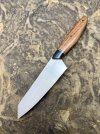
All of our kitchen knives are in AEB-L, CPM-154, or ZDP-189. I have always enjoyed a patina on a carbon steel blade, so decided to make a Santoku. But I wanted to go super thin, and the only really thin carbon steel I could find was 26c3, which is a great kitchen cutlery carbon steel, very close to White #1. Heat treating was a challenge, and I messed up the first attempt. After a 10 minute soak at 1475°F and into an agitated P50 quench, it came out like a banana. Actually, worse than a banana! But I had me handy dandy aluminum plates right there, and was able to catch it before full transformation. Came out straight-ish. I did the temper cycles and tried using the carbide tip hammer but it did not work at all. I don't know if it was because the steel was so thin, or what the deal was. I managed to get it straight by clamping it up while doing another temper cycle, but then I noticed the edge had a few micro cracks, which were not there prior to the carbide hammer.

Ordererd another piece, and this time I ran a 1200°F 2 hour stress relief prior to heat treating, which did absolutely nothing. I decided not to agitate the oil, but it still came out like a banana on steroids. Quench plates again got it pretty straight. I ended up just using the clamp method during tempering, and it came out dead nuts flat. Luck. Puro suerte.

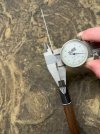
It's 0.040" at the spine with a full flat, slight convex grind. I cut up a lot of lemons during the week for me tea, and it glides through them like they're hardly there! Can't wait to get into some fajitas. I was surprised the lemons didn't do much to patina the steel., but I know those fajitas will do the trick! Thanks for looking.

26c3 66HRC 0.007" at the edge shoulders
IMG_0006.jpeg IMG_0007.jpeg
 
I have sent AEB-L steel blades that thin to Boss heat treating and they came back straight.
I sent some to Peter's that weren't quite as thin as this knife, but I had ground the bevels to sub 0.010" at the edge. Blades came back straight and no problems with that thin of an edge. The only thing I wasn't too fond of was they used a torch on the spine to straighten. But it was one spot on the spine about the size of the tip of a Q-tip, and they were kitchen knives, the oxides sanded right off, so I wasn't too concerned about it.
 
Hey Robert!

Thank you! Ha! Only a masochist would attempt such a thing! No, I just profiled it, quenched in P50 and into plates before martensite start. Both times the knife came out of the quench with a massive bend. Same direction. Makes me wonder if the steel was on a coil and retained the memory. The stress relief cycle didn't help at all.
 
I figured as much.
In my experience 26C3 is like AEB-L in that the thin stuff usually takes a bit of a bend but never to such a degree.
I don't know how 26C3 is processed and stored but if it's coiled Maybe you got a piece from the core of the coil?
 
Quite possible. When I say they came out of the quench with a bend, I'm not joking! I have a few bananas on the kitchen counter right now that are more straight than those 26c3 blades!
 
I am not an expert by any means, I am not even an amateur, but my Japanese made Blue steel #2 Santoku, is laminated between plain carbon steel, and I have believed that they do it to save cost for one, and then to make the knife stronger, reduce the chance for the thin, very hard steel core to crack or actually break.

Am I wrong about all that?

Whatever the case, my knife is danger sharp, and a pleasure to use. I have a Japanese-style rubberized cutting board that I always use for it.

Just curious. Your knife looks great!
 
You are right! They would laminate the harder to source high carbon steel to wrought iron or mild steel in order to save the good stuff. It was also a lot easier to straighten should it take a warp during quench, as well as have more toughness. However, don't quote me, but I don't think they were doing it to make the blade tougher, more to save the amount of high carbon steel used, as it was quite the process to make tamahagane. Don't need a whole lot of toughness on a kitchen knife.

Thanks for the compliment!
 
You are both partly right.
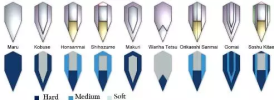
Initially, high carbon blade steel was scarce and expensive. After a bloom of steel was made, it was broken into pieces. The carbon content was judged by expert smiths, and sorted into low, medium, and high carbon grades. This was then mixed and folded many times in a process called shita-kitae to homologize the carbon content to somewhere between .60% and .70%. This made good maru-kitae swords blades, but they weren't the hardest they could be. Blades made from using only the higher carbon grades were sharper and harder, but also cracked easier. To solve this issue, the high carbon steel was laminated between lower carbon steel, or plain iron. This san-mai construction, and many other kitae techniques (see below images), saved money. They also resulted in a sword or knife with a hard sharp edge between .80% and 1.00% carbon (the HA), and a softer high toughness body (the JI).
It was not used to make a thinner blade, but to make a fighting blade, usually a sword, that could take more abuse. The thinner core was more flexible, allowing the blade to bend without snapping as easily. It also allowed a chip or crack to happen without the sword falling into two pieces. This improved the sword and allowed a limited amount of high carbon steel to make more swords. In times of war, wariha-kitae was used to use only a small amount of high carbon steel to make a large sword.

Fast forward to today when good high carbon steel is readily available and not expensive, san-mai and many other laminating techniques, like suminagashi-san-mai, create beautiful blades with a had sharp edge and contrasting upper bevels. Since we don't fight with swords and knives anymore, smiths have moved such laminating techniques from the military arena into the culinary arena. Thin blades in various XXXX-mai constructions are both lovely and crazy sharp. Suminagashi-san-mai is my favorite for beauty and sharpness. It can be made with 40-layer stainless damascus cladding on a high carbon steel core like white/blue/W2 or other high-tech steel.

I recently made a Ku-mai/Cu-mai (nine-layer kitae with copper ... soft-Cu-soft-Cu-Hard-Cu-soft-Cu-soft) gyuto that was forged and ground to around .07" thick at the handle, and tapers to .02" at 1" from the tip..
Last week I had an issue with a shichi-mai (7-layer) santoku blade that had some delams, so I TIG welded up the delams and FFG ground it to around .04". It isn't the blade I wanted, but will go in my kitchen block. I ran the measurements through an angle calculation and the spine-to-edge angle is just slightly above 1°. I gave it a secondary bevel at 7°. It It is thin-thin-thin and also sharp-sharp-sharp.


1774005556853.png
 
Back
Top